






By Liu Yu
Time is a wallless botanical garden. The 1832 ginkgo stands there—a unique, untranslatable tome in the library of the Marburg University. Three generations have inscribed a century of forked time into the veins of its leaves, leaving behind only the oblivion that lives in human memory. We always think of ourselves as the chroniclers of history, as those who have walked out of time's labyrinth—yet we do not realize that between the ginkgo's leaves, we have already fallen into its silent gaze, becoming an unalterable, obscure, flowing line of script in its growth rings.
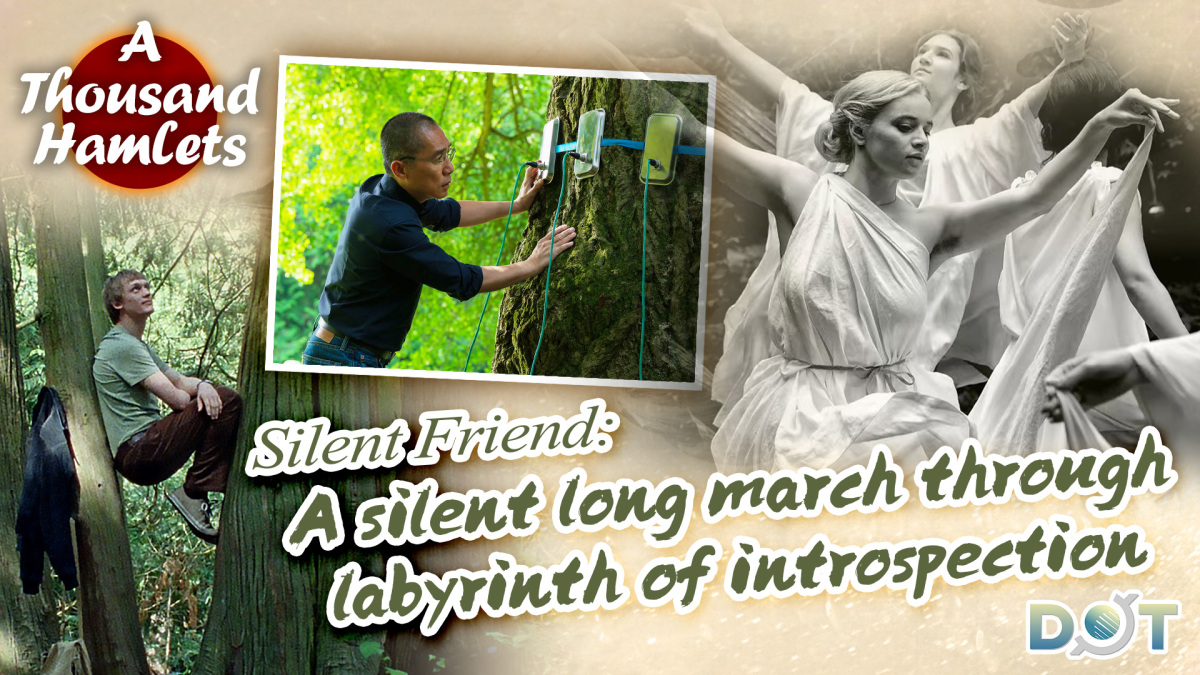
This film has no so-called "narrative" (some will surely argue with me), only the cyclical folding of time. In 1908, Grete, with her bulky camera, embarked on a slow, "anthropocentricity‑shedding" practice in the alchemy of light—yes, anti‑logocentrism. Time and again, she retouched the negatives of human portraits, trading false light and shadow for beautiful illusions, then turned her lens to pressed plants, even to apples, radishes, and kale on a dinner table. She photographed them, allowing vision to develop in the darkroom of the flesh. I call this the film's first covenant between human and plant. Eventually, like a vine, the camera quietly returned to her own body, lingering forever on the underarm hair and the curves of her form. In that moment, the subject of the gaze quietly shifted: no longer the plant watching the woman, but the woman contemplating her own identity. The sensor of a century later is merely the other side of the same coin. Professor Wong from the East glued tiny electrodes to his temples, attempting to capture with data the neural pulse shared by all things. Before the ageless silence of plants and trees, the human scale feels to me like a kind of mocking, nihilistic, perverse imitation.
The moment one becomes aware of being watched by plants, one stands forever as if naked. This statement is not a metaphor but a precise perceptual description: the instant a person begins to believe that plants possess a gaze, clothing, identity, all the boundaries that separate the self from the world—collapse. The director's lens has always embodied this gaze—not an anthropomorphic "performance," but a camera that approaches a plant‑like way of seeing: no judgment, no classification, only a prolonged, silent watching. The campus guard is a person transformed by such a gaze. At first, he stared at Professor Wong; his looking, as framed by the camera, was full of institutionalized vigilance—a foreigner doing strange things under a ginkgo tree, clearly something to be scrutinized. Yet, as day after day he watched—the arcs traced by Tai Chi pushing hands, the murmurs into empty air, that utter defenseless openness—the act of watching itself began to loosen. Not because he intellectually grasped something, but because the act of watching itself changes the watcher. He no longer measured this "Heterotopia" with a ruler; instead, he was drawn into the same rhythm of the gaze, even unconsciously mimicking the pushing‑hands gestures. That is the film's quietest revolution: understanding never occurs in the mind. It happens in the moment when the gaze grows soft, when a person sets aside judgment and begins to look at another living being. In that moment, the ruler itself falls away.
Spores are indecipherable signals dispatched by the cosmos. Drifting from the hidden architecture of the century‑old ginkgo, they settle on Professor Wong's shoulder. For him—a traveler stranded in a foreign land because of the pandemic—they are an interspecies handshake offered by the ancient tree. He does not flee; he catches that untranslatable code. New knowledge is never born of calculation or books, but quietly unlocks itself in this ineffable, silent communion. That exile in a foreign place, that voiceless long march of introspection through the labyrinth of institutions—here arrives at the circular origin, the source of light and silence.
The ginkgo's branches and leaves spread across the frame; light and shadow flood the entire visual field. Human beings within it are merely tiny flecks of light in the flowing greenery. The three temporalities are not fragmented shards but overlapping reflections around a circular table, echoing one another. Grete's negatives, Gundula's neurology, Professor Wong's sensors—all are ripples in this silent flux. They split and reunite; beneath a restrained order lies an unceasing, living tension.
In this world, there has never been a separation between observer and observed—only a bidirectional, fated gaze. We think we are observing plants and trees, yet they have long since transcribed our entire lives into their annals of growth rings. The so-called "Marsch" is never an outward escape but an ultimate inward-looking: inside a cage wrapped in order, a person looks at a tree, and the tree looks back. The human becomes small, while the plant silently proliferates. All we can do is attempt this untranslatable connection, and in our smallness, complete a gentle revolution of our own.
Liu Yu is the lead editor of the cultural commentary "A Thousand Hamlets." Liu holds a BA in English Literature from HKBU and an MA in History from HKU.
The views do not necessarily reflect those of DotDotNews.
Related Readings:
A Thousand Hamlets | And then, would you risk everything for love?
A Thousand Hamlets | The modern life of the queen of detective fiction




Comment