






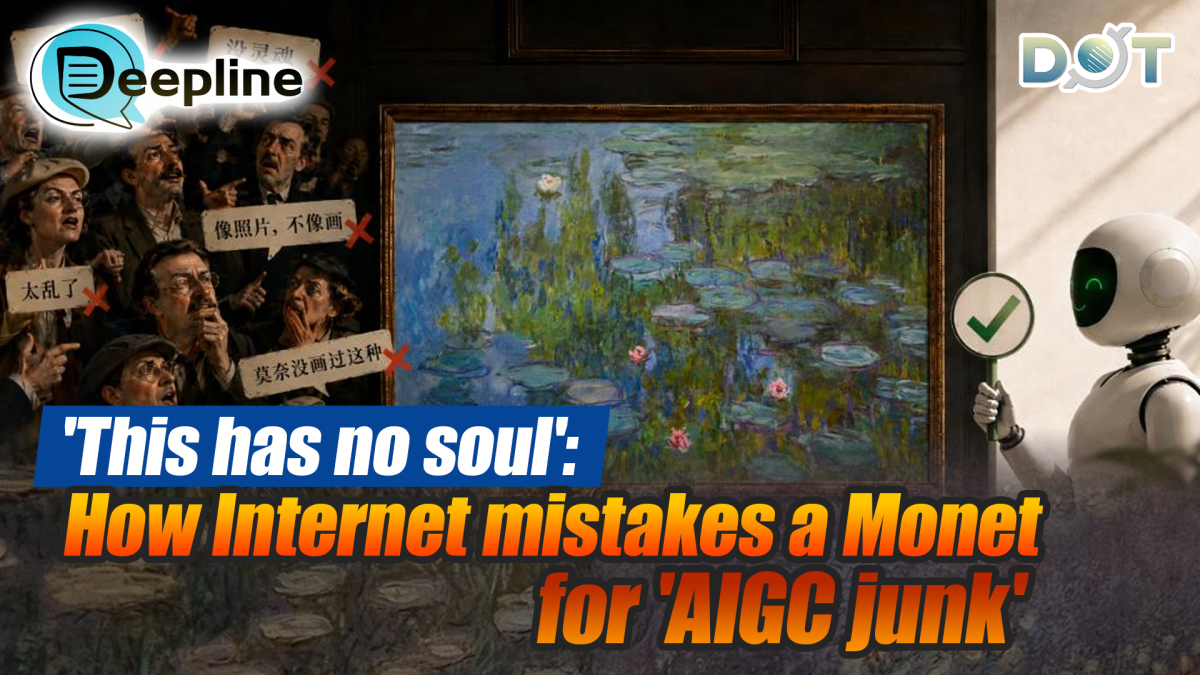
If one wants to ruin a world-famous painting on today's internet, the fastest way is not to destroy it physically, but to slap a label on it: "AIGC."
Recently, X user @SHL0MS conducted a social experiment full of mischievous irony. He uploaded an authentic painting of Water Lilies by the French Impressionist master Claude Monet, deliberately tagged it with the platform's AI label, and added the following caption:
"I just generated an AI image in the style of Monet. Please describe, in as much detail as possible, what makes this inferior to a real Monet painting."
Faced with this trolling bait, the online guardians of anti-AI art jumped on it instantly. Lured by the user's deliberate emphasis on "detail," the comment section was quickly flooded with lengthy, pseudo-professional analyses.
More than just a hilarious and deeply ironic mass blunder, this farce reveals a brutal truth: today, it's not just AI that has begun to hallucinate severely—it's also humans themselves.
As of this writing, the original tweet has drawn over 4 million views and is spreading across major social platforms.
The painting itself shows nothing suspicious. It features Monet's iconic water lily pond, with dappled light scattered across the surface, brushstrokes bleeding into varying shades of green, and an overall soft, misty atmosphere. If one encountered it in the Louvre, they'd probably just sigh, "Monet is truly Monet," and take a photo.
But now, hanging there with the AI label, it provoked exactly what the user expected. To prove their superior artistic discernment against AI, the comment section instantly filled with amateur sleuths.
Armed with magnifying glasses, they began dissecting every detail of this supposed "AI garbage." Some confidently pointed out compositional flaws, "This whole thing is a mess, no sense of space at all."
Others claimed to spot color errors, "The colors are reversed—blue water lilies appear on green water."
Some harshly criticized the lack of detail, "No texture, edges, folds, gaps, creases, bevels, or three-dimensionality—hallmarks of plastic art."
One quipped, "The depth of field and color choices have no coordination. The tree reflections are mixed up with the water lilies, completely ignoring spatial depth and contrast. The blurred mix of lilies and algae in the background is typical of most AI work."
Another offered the seemingly most piercing critique, "You can feel deep down that this painting lacks any real passion—soulless cyber waste."
Reading these earnest, logically coherent criticisms, you might almost applaud humanity's keen artistic sensitivity—until the truth was revealed: the universally mocked painting was actually a masterpiece painted by Impressionist master Claude Monet himself.
Anyone with a basic knowledge of art history knows that Monet was diagnosed with severe bilateral cataracts in 1912. As his eyesight deteriorated, the world he saw lost its cool tones, becoming blurry and mottled.
In his later years, he painted 250 Water Lilies oil works, using extremely abstract, bold, and even "imprecise" brushstrokes to record the dissolving world of light and shadow before his failing eyes.
If someone had judged him back then using the same standards—"imprecise brushwork," "lack of passion"—Monet would have likely just smiled wryly.
So why did netizens mistake a genuine Monet for an AI painting?
On Reddit's Singularity board, this incident sparked thousands of heated comments. One user hit the nail on the head: it's just another classic cognitive bias experiment.
This brings to mind a famous psychology experiment conducted in 2001 at the University of Bordeaux. Researcher Frédéric Brochet invited 54 expert wine tasters. He dyed a cheap white wine red using tasteless food coloring, then asked the experts to evaluate it.
The results were astonishing: these connoisseurs, normally so picky about flavors, swirled their glasses and earnestly wrote notes like "rich berry notes," "nutty finish," and "firm tannins"—all descriptors for red wine. Not one realized it was actually white wine.
Today, the phrase "AI-generated" is that label stuck on the bottle.
When the painting was labeled "AIGC," people's subconscious already deemed it cheap, mechanical, and soulless. So they weren't seeing the painting with their eyes; they were using their brain's biases to "find" those predetermined flaws.
What users called "feeling deep down that it lacks soul" is nothing more than mystical nonsense wrapped in a rationalist framework. As one Reddit user sharply put it: "If someone tells you it's AI, it's soulless; if they tell you it's human-made, it's full of passion. The actual quality of the art becomes irrelevant in the discussion."
We must admit an awkward fact: most people, including those glib online arbiters, cannot simply distinguish top-tier art from AI masterpieces. If one couldn't appreciate Monet before AI, they still won't after AI.
The Monet incident is no exception; it reflects a dangerously pathological trend on today's internet: the "anti-AI witch hunt."
As generative AI races ahead, countless real human artists desperately try to prove their innocence every day. Their works get attacked and labeled as AI-generated just for being too realistic, having perfect lighting, or conversely, for having slightly rough hands or slightly off proportions.
One of the most famous online tragedies is the Ben Moran case in late 2022.
This human digital artist posted an illustration titled A Muse in Warzone on a Reddit forum with 22 million users. The moderator permanently banned him, citing it as an "AI-generated image."
When Ben Moran submitted his sketches, layers, and hours of process video to prove his innocence, the moderator arrogantly replied, "I don't believe you. Even if you really drew this, the style looks too much like AI. It's worthless. You'd better change your style."
This is our absurd reality today. Real human artists can neither draw too perfectly (that's AI cheating) nor make basic mistakes (that's AI hallucinating), nor even have a style that too closely resembles another.
This bias exists not only among the general public but is also spreading into professional fields.
Fantasy novelist Brandon Sanderson conducted a blind test. Researchers mixed his own writing with AI-generated text mimicking his style, then asked professional writers and peers to identify which was which.
The result: even these wordsmiths could not reliably tell which was written by AI.
Even more interestingly, in some unlabeled literary experiments, top literary critics, when blind, actually preferred AI-generated literature, finding it more dynamic. Yet once the same works were labeled "AI-generated," the same critics immediately switched gears, complaining about a lack of human emotional resonance.
That a genuine Monet was dismissed as AI cyber-junk seems like mere internet fun, but the social crisis behind it is no laughing matter.
As one netizen said, "What scares me most isn't how powerful AI becomes, but how it's destroying the very foundation of social trust. In a society where no one believes in anything, we won't be able to move forward."
(Source: iFanr)
Related News:
Deepline | Man-made Mandela Effect: How AIGC fabricates fake EXO member 'King'




Comment