






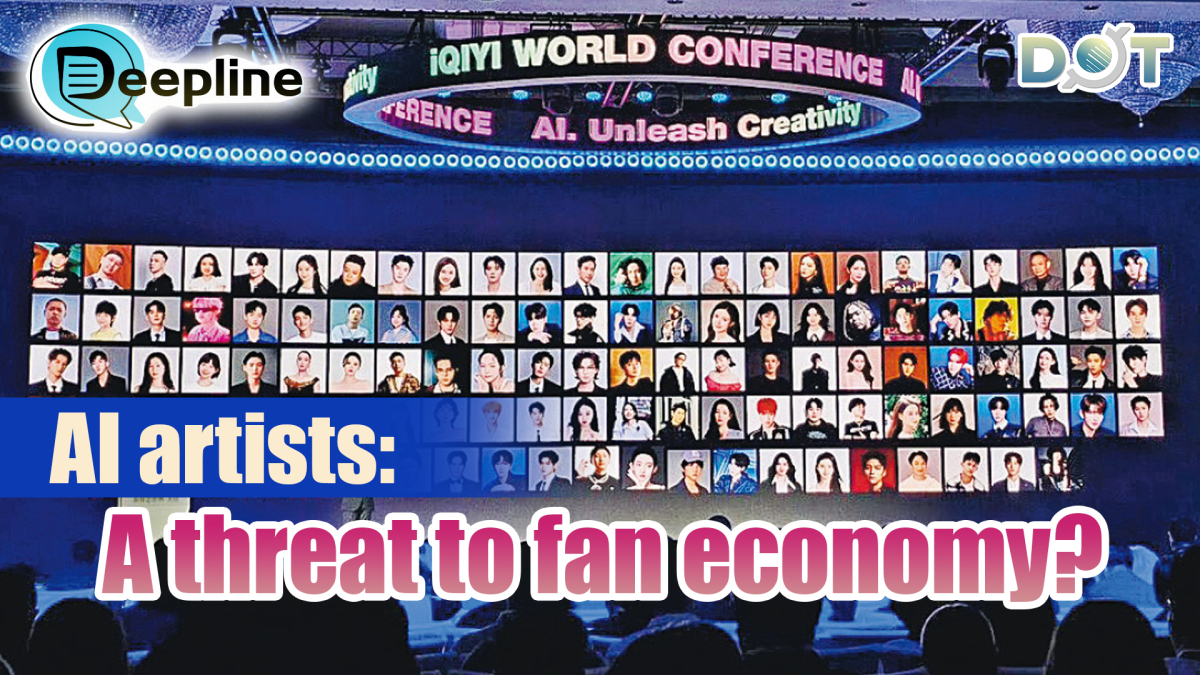
A few days ago, the news that iQiyi was building an "AI artist resource library" set off a storm across the entire Chinese film and television industry. Artists denied involvement, audiences boycotted it, and industry insiders were shocked. A flood of criticism poured in on iQiyi, forcing CEO Gong Yu to post three explanations on Weibo. A new story had barely begun, yet it seemed destined to die young.
Before the fallout from this incident had subsided, NetEase also found itself boycotted over AI. On April 23, during the anniversary celebration of its game Identity V, a large number of players posted messages boycotting NetEase games and agreed to stop spending money in the game that day. The reason was that many had recently noticed obvious signs of AI usage in the anniversary videos and paid skin illustrations—for example, a certain character had only four fingers.
If we rewind to last month, a similar scenario had already played out. Youhug Media, a film and television production company, announced the signing of two AI digital artists. Not only did they set up social media accounts for them, but they also arranged for them to star in an AIGC-produced series.
At their core, these three incidents point to a single issue: the disruption and anxiety brought about by AI's "invasion" of the traditional film and entertainment industry. Although the audience's strong reaction clearly signals opposition to AI-generated content, this doesn't seem to be deterring production companies and platforms from their intense desire to cut costs.
However, in their pursuit of cost reduction and efficiency-driven profits, they may have overlooked a key point: AI artists are not expanding the fan economy, but might instead be eroding it, which will make it harder for companies and platforms along the traditional film and television industry chain to profit from fans.
Fans don't want to pay for AI artists either.
Given Youhug Media's experience, why did iQiyi still choose to defy public opinion and venture into AI artists on its own?
The answer is the cost. A long-form drama starring top talent often costs hundreds of millions of yuan, with a production cycle of half a year or more. In contrast, AI-driven production could cut costs by half or even more, leaving platforms with massive profit margins and potentially helping long-form video escape the industry's high-cost predicament.
Yet, given the current public backlash against AI content, especially AI artists entering traditional film and TV production, a pressing question arises: Long-form video platforms rely on paid memberships for revenue. But are audiences willing to pay for AI-generated long-form dramas that don't feature real performances?
For most people, the answer is no; some even reject all AI-generated dramas outright. According to a survey on Sina Weibo, over 90% of viewers refuse to watch fully AI-generated dramas. The reason is simple: no matter how polished an AI performance may be, it lacks genuine emotion, results in stiff movements and expressions, and fails to convey a character's complex psychology, preventing any emotional resonance between actors and the audience.
Fans may also be unwilling to pay for AI versions of their favorite artists.
"If he authorized his likeness to iQiyi, I wouldn't consider him an actor anymore—it's not even him performing," said a fan who became devoted to a lead actor after one drama. Another fan similarly noted, "I only spend money on real people because I invest my emotions. But if I know it's an AI performing, my subconscious tells me it's fake, so I see no need to invest my feelings or spend money on it."
Whether it's AI artists, AI game characters, or AI applications and services, users show low willingness to pay. This isn't just because current AI products lack sophistication—it's also rooted in a deep-seated resistance, or at least caution, toward AI.
This attitude stems from anxiety over AI infiltrating various industries, replacing or eliminating countless jobs, as well as a fear of the blurring line between the real world and the fake. In the film industry, for example, as AI's involvement increases, fewer tasks are left for humans along the production chain. The final results increasingly lack human creativity and authenticity.
And if we look further into the future: if the world is no longer built on reality but woven from layers of "falsehoods," will we one day be unable to distinguish truth from fiction?
Of course, that's speculation. But this reasonable doubt may lead consumers to tighten their purse strings and refuse to pay for AI content. In that case, although iQiyi reduces production costs, it may not be able to convince audiences to buy memberships.
As the internet ushered in the age of traffic, the film and entertainment industry gave rise to new business models, particularly the fan economy. China's vast market seems to have an endless appetite for digesting massive fan bases.
But no matter how stars are manufactured, and regardless of their varying quality, they at least offer fans a human being to connect and resonate with. That emotional bond is formed through a specific role, persona, or charisma, which presents each star as a vibrant, compelling individual.
AI artists, however, replace human performance in acting or variety shows, eroding this sense of "aliveness." Not only does this prevent roles from adding charisma to the star, but more critically, the star lacks a complete growth trajectory. Fans can't witness their development and changes, which greatly reduces their sense of involvement and authentic emotional investment.
Moreover, the idea of feeding one's likeness to AI and collecting royalties from home is unacceptable not only to audiences but also to most fans.
So if AI artists sever the emotional bond between stars and fans, then "harvesting" fans across a longer commercial chain becomes difficult. And as Hollywood studios have demonstrated, the most profitable parts lie beyond production and distribution, such as copyrights, licensing, and merchandise, as well as the interests hidden behind fan economy activities like data ranking and fundraising campaigns.
Long-form video platforms like iQiyi have long sought to extract greater value from hit IPs and encourage fans to spend on stars or their works.
Looking at iQiyi's product categories, the platform has diversified by leveraging its core offerings to create niche products. For example, capitalizing on the star effect generated by hit dramas, iQiyi launched "iQiyi Bubble." Riding the trend of novels and online drama IPs, it expanded into mobile games based on the same IPs while also pushing merchandise. Last year, iQiyi disclosed results from its IP-based merchandise for the first time: in the first half of the year, revenue from its self-operated trading card business exceeded 100 million yuan.
The long-form video platforms' most significant achievement was successfully creating a star-making pathway through talent shows, which brought them further upstream in the fan economy. But the frenzy of the traffic game ultimately destroyed their ambitions in this area.
It's understandable for platforms to bet on the fan economy. But using AI artists to cut costs while still trying to extract even greater revenue from fans—these two goals may be mutually exclusive. The very existence of AI artists undermines the meaning of being a fan.
As public anti-AI sentiment is vented at iQiyi, many realize that AI's entry into traditional film and television may be unstoppable. The industry's downturn and persistent cost challenges mean platforms won't abandon AI content trials, as AI's value in lowering production costs is already recognized.
But is relying on artist authorization and AI-generated drama production truly a surefire, highly profitable business?
What must not be overlooked are the additional costs of producing AI content compared to traditional methods. For example, with the combination of computing power and new labor costs, the more AI training, the greater the required computing power. Computing power has become the highest cost in AI content production, and it's not fixed.
Take AI short dramas as a reference. According to reports, as AI technology becomes deeply integrated into short drama production, cost structures are changing significantly. Token consumption now accounts for up to 50% of costs for some AI short drama producers. Meanwhile, AI computing costs continue to rise—per-minute costs have surged from 300 yuan at the beginning of the year to 800-1,000 yuan, with an 80-episode short drama requiring over 100,000 yuan in computing costs alone.
Regardless of whether a drama is performed by humans, content quality is what ultimately matters. Maintaining high-quality output demands even more computing power.
Of course, the combined cost of computing and labor is still far less than traditional production. But there's another issue: as AI-driven long and short dramas undergo efficiency-driven upgrades, the content industry could enter a new "big bang" era. If content supply grows exponentially, will the user acquisition costs required for AI dramas to stand out also skyrocket?
"Last month, we invested 500,000 yuan, but the hit rate was only 0.8%—not even a fraction of our costs," revealed the head of a Hangzhou-based AI drama studio. At the end of 2025, their hit rate was still around 5%, meaning one blockbuster could cover the losses of ten failed dramas. But since the start of the year, as competition intensified and ad creatives became homogenized, user fatigue increased, and hit rates plummeted.
This is not only a struggle for creators but also a source of anxiety for platforms. For long-form video platforms, hits—and how many they have—are crucial to the paid-content business. But as content supply explodes, the odds of creating a hit diminish.
"AI has never been free; high-quality content only burns more money," said one industry insider.
On the matter of building an AI artist resource library, iQiyi's rashness and aggression may stem from a miscalculation of public acceptance. But the real reason lies deeper: the decline of long-form video has forced it to seek new paths. The business narrative around AI artists may sound attractive, but perhaps only on the surface.
(Source: 36kr)
Related News:
Deepline | iQiyi's AI gamble: How a grand vision of digital doubles backfired




Comment