






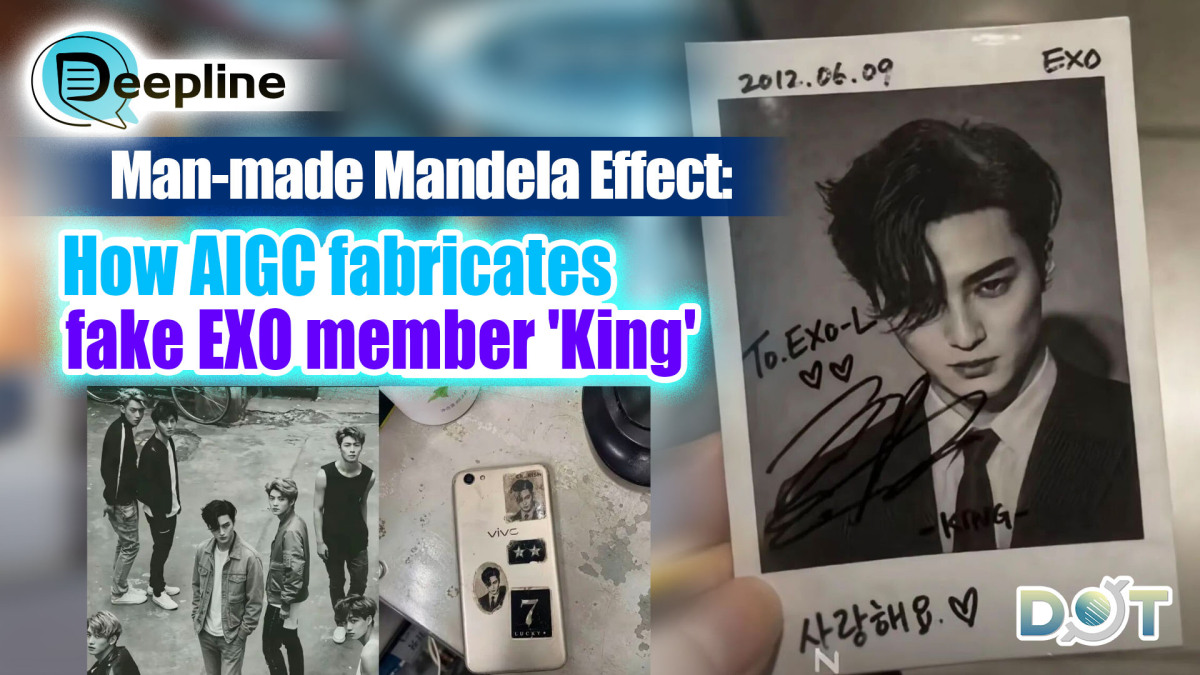
"Do you still remember 'King'?"
In a live-streaming room, Chinese singer Huang Zitao (Tao) looked somewhat perplexed and asked the staff member next to him, "What does this bullet comment mean? Is 'King' some internet slang?"
Perhaps he had not yet realized that he had become part of a large-scale social experiment driven by AIGC technology.
Recently, a fictional character named "King, the ghost member of EXO," has gone viral on the internet. With a fully fleshed-out debut timeline, meticulously crafted relationships among members, alleged old photos, stage clips, fan photos, and even an "inside story of his departure from the group," all of which is highly realistic and logically coherent. A large number of netizens have been reminiscing, empathizing, and mourning in the comment sections, as if this person 'King' had actually existed.
This is not simply a niche fandom inside joke, but a deep incursion into public memory using AI technology. As creative trolling evolves into memory manipulation, a chilling question emerges: In the age of AIGC, can our collective perception be rewritten at will?
"King" is not the prank of a single creator, but a relay-style online collaborative effort.
Late last year, a Yunnan renovation worker, whose profile resembled Huang's, sparked a casual joke in the comment section: "Isn't this that hidden member of EXO?" Unexpectedly, that joke ignited a wave of creative energy across the internet as netizens gradually built a complete life story for this virtual figure.
The character was set up as follows: His name is Wang Long, stage name "King," born in 1990 in Yunnan. In 2008, he was scouted along with Huang by Lee Soo-man. He was originally the first overall leader of the planned EXO, an all-around ace, credited with composing the track "MAMA" and choreographing "Growl."
However, on the eve of his debut, he refused SM Entertainment's unfair contract terms and refused to transfer his music copyrights. As a result, the company erased all traces of him overnight. EXO changed from a 13-member group to a 12-member group. He was sent back to China under a lifelong confidentiality agreement, developed severe depression, gained weight, worked as a laborer at a construction site in Yunnan, and never sang or danced professionally again.
The setup is dramatic enough and complete enough.
Crucially, several AI bloggers have created secondary content that makes "King's" background, practice videos, stage footage, award records, and personal songs even more "tangible and real." Many netizens have also created and posted fan photos from his alleged trainee days.
In other words, images, videos, and text are highly consistent. Even the noise and filters of an earlier era's visual quality are precisely simulated, granting a virtual character a "complete world view."
Initially, this narrative circulated only among AIGC enthusiasts and certain fan circles. But as more "materials" were added and content quality improved, the spread began to break out of echo chambers. More bloggers joined in on the meme, and gossip accounts hopped on the "archaeological" bandwagon, seriously analyzing King's position as a main dancer, the inside story of his departure, and even his subtle relationships with Kris Wu, Huang, Luhan, and Lay Zhang. Amplified by short video re-creations, the topic trended on Weibo's trends. Related topics such as "The Former King" and "King" garnered over 5 billion views.
As the participating crowd grew larger, the content was more easily picked up by algorithmic recommendations. The meme was no longer a small-scale tacit understanding but a large-scale public narrative. At this point, truth no longer mattered; what mattered was dissemination efficiency.
If the generation of "King" is a technological experiment, then the comment sections are social samples.
The first group can be called the "believers"—those moved by the tragic narrative. In the comments, we can see that most are not familiar with the history of second-generation K-pop groups or have only casually followed EXO. They reminisce sincerely and feel genuine regret. They naturally lack immunity to narratives like "the hidden genius," and their first reaction is not to verify but to feel anger and empathy.
The second group is the "doubters"—those caught in confusion, doubting themselves. These individuals have some understanding of EXO's lineup, but when faced with a deluge of "old materials" and numerous netizens "confirming" them, they begin to doubt their own memory, "Is this real or not?" "Did I miss something?" Even those relatively familiar with the facts can experience a kind of Mandela Effect.
The third group is the "knowingly playful"—they know it's fictional but immerse themselves in it. Underneath skeptical comments, they post replies like, "At this moment, capital wins," or "How could our youth be fake? Why would the whole internet lie to you?" For them, it's a collective celebration of speaking in code. Truth doesn't matter; participation does.
The fourth group is the "adamant non-believers"—those who actively verify and persistently debunk. They usually have a clear understanding of EXO's lineup, debut timeline, and company background, and some even experienced the original events firsthand. They post evidence, timelines, and repeatedly stress that "EXO NEVER had a 13th member." But in the carnival-like context amplified by algorithms, these voices often come across as "party poopers," and debunking is interpreted as "taking things too seriously" or "not understanding the joke."
After several rounds of fermentation, a strange phenomenon emerged: even after some bloggers clarified that "'King' is fake," a large number of netizens still insisted in the comments, "I clearly remember seeing his photo back then," or "No way, I have an image of his stage performance in my mind."
This is no longer just a joke; it's a live demonstration of a man-made Mandela Effect. When something is repeated enough, fiction begins to feel like reality. This is not a scene from a sci-fi novel; it is a fact happening right now on the internet.
In the past, fabricating a character relied mainly on vague textual descriptions or crude collage images. But now, the technological revolution of AIGC has completely transformed the process of forgery.
Take this "13th member of EXO," who appeared out of nowhere. Today's AI can not only generate static high-definition photos but also dynamic stage clips, even mimicking the visual quality, filters, and noise of a specific era. This multi-dimensional realism greatly lowers the human brain's defense mechanisms. When visuals, audio, and textual logic form a trinity, fiction takes on the texture of "reality."
Meanwhile, the reason "King's" persona broke through niche circles and became a nationwide phenomenon lies in its precise alignment with prevailing psychological desires on the internet. To distill this narrative formula: (brilliant idol + powerful company) × (unjustly hidden talent + tragic exit) = collective fandom regret—highly contagious in itself.
The company at the center of this narrative is, of course, SM Entertainment. In the long-standing fan discourse, "exploitation" and "unfair resource distribution" are already high-frequency keywords. "King" simply materializes this emotional template: a genius suppressed by capital.
On the one hand, the story perfectly aligns with the widespread anti-capital narrative on the internet. Given the current public sentiment against capital monopolies, workplace exploitation, and industry injustices, the storyline of "a genius idol refusing capital's unequal rules, only to be maliciously blacklisted and completely buried" carries an inherent satisfying quality. It satisfies netizens' psychological need to resist capital hegemony and empathize with vulnerable individuals, easily evoking widespread emotional resonance.
By sympathizing with "King," netizens are, in effect, venting their dissatisfaction with the actual entertainment industry system.
On the other hand, the character amplifies emotions through the aesthetics of regret-filled nostalgia. Compared to a real idol's complete and predetermined career trajectory, the hypothetical nostalgia of "what if he hadn't been buried and could have been successful" carries a filter of regret and imaginative space.
This unfinished, tragic narrative is more emotionally compelling than real fan stories, continuously fueling netizens' empathy, creativity, and desire to discuss, thereby empowering and mythologizing the virtual persona. The fictional "King" becomes the pure and unattainable ideal onto which fans project their regrets and their fantasies of a perfect idol.
The Mandela Effect provides the psychological foundation here: human memory is not a reliable video recording but a reconstructive process susceptible to suggestion, group reinforcement, and emotional coloring. Collective discussion and repeated exposure further solidify false memories.
For the entertainment industry, the most direct impact of King's fabricated deification is the disruption of the public's foundational understanding of EXO. Many fans have expressed strong dislike for this meme, saying, "It uses someone else's face, fabricates fake stories for widespread dissemination, and it's not even funny; instead, it's very disrespectful to EXO."
After all, if this foundational knowledge can be arbitrarily tampered with, the legitimacy of the idol industry comes into question, potentially exacerbating fan rifts, increasing the cost of clarification, and even affecting artists' reputations. When facts can be replaced, the historical authenticity upon which the idol industry depends will be undermined.
Looking back, "King" is not just an absurd carnival; it is also a timely industry warning. The initial creators may not have had malicious intent, but the neutrality of technology means it can always be used by anyone for any purpose.
If AI can fabricate a nonexistent history for an idol, then, in theory, it can also construct a "past" for any public figure.
The bigger social risk lies in this: today it's a fictional idol member; tomorrow it could be used to "complete" non-existent files for any historical figure, to forge "hard evidence" photos for a particular event, or to implant negative or positive narratives about public figures. When image and video evidence can be generated at low cost, "seeing is believing" will completely lose its meaning, accelerating the arrival of a "post-truth" era.
(Source: 36kr)
Related News:
Deepline | AI artists: A threat to fan economy?
Deepline | WeChat cracks down on AI-generated content: Why the panic?




Comment