






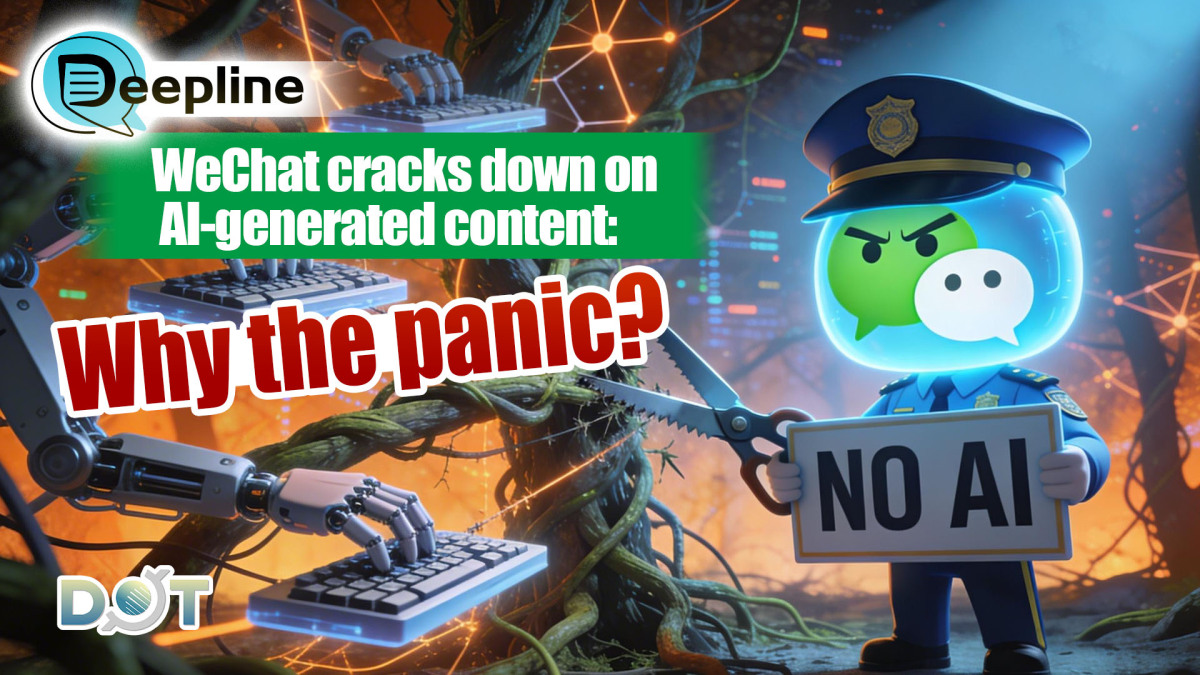
In recent days, the online money-making community that uses "lobster" (Openclaw and other similar agents) to automatically publish official accounts has been completely panicked, as their WeChat official accounts have suddenly been suspended in batches, with notifications indicating that the platform has determined they engage in "non-human automated creation behavior."
That's right—following Xiaohongshu, WeChat official accounts have also begun cracking down hard on AI-managed account activities. Recently, WeChat introduced new regulations to combat non-human automated creation. Actions such as using AI to generate, rewrite, splice, or repost content—detached from genuine creator expression—are now classified as violations. Using script programs to batch-publish continuous content is also against the rules, leading to penalties ranging from traffic restrictions and article deletions to account suspensions.
Interestingly, Tencent has embraced OpenClaw as a "savior," and WeChat has actively welcomed "lobster" by launching the ClawBot plugin. So, how exactly does using lobster for writing and operating official accounts defy Tencent's rules?
In fact, online platforms currently have a complex attitude toward AIGC. They want AI to enrich the depth and breadth of their content pools, but they are unwilling to let AI-generated junk content pollute their content ecosystems.
At present, those using AI for creation are sharply polarized: the good is often very good, but the bad is unbearably poor. Whether generating text, images, videos, or music with AI, current technology cannot achieve instant perfection—it requires repeated manual fine-tuning. Fine-tuning itself is a technical task, and only those with a "reverence for creation" will take the time to polish their content.
Among those hoping to get rich with AI, genuine creators are few and far between; the vast majority are chasing profits, so they naturally lack patience. These individuals are the main contributors to "AI slop" and are precisely the targets of WeChat's crackdown. Legitimate AI creators, unfortunately, are caught in the crossfire.
Otherwise, WeChat wouldn't have specifically emphasized that "promoting tutorials, methods, or services for non-human automated creation" is also within the scope of its crackdown. In truth, WeChat's initial attitude toward AI wasn't hostile. They support using AI for generating topic ideas, preliminary data gathering, and optimizing expression, as long as creators proactively declare when content is AI-generated.
However, it is precisely this ambivalent stance of internet platforms that has fueled the widespread belief that "AI content will be restricted," discouraging creators from voluntarily labeling their content as "AI-generated." Combined with the maturation of agent frameworks like the lobster, this has forced WeChat to adopt a blanket ban. Of course, the claim that AI-generated junk content pollutes community ecosystems is just a pretext—after all, marketing accounts run by real people in the past also churned out low-quality content in bulk.
But is AI-generated public account content truly unwanted? The answer is certainly no. For example, on April 9, a team called "Exploded Yet" claimed to have earned 2 million yuan (RMB) annually by writing public account articles with AI, only to have their account suspended by WeChat.
At the end of the day, the core reason WeChat official accounts resist AI is that, in the current consumer internet landscape, AI cannot replace humans as the main consumers. Articles on WeChat official accounts and the ads they carry are meant for humans to read, not AI.
Two months ago, a scenario report by Citrini Research, which hypothesized that AI would trigger white-collar unemployment, consumer contraction, and economic slowdown by 2028, caused significant turmoil in global markets. Citrini Research's "AI ghost story" argued that AI represents the most extreme "supply-side revolution" in human history, yet it is embedded in a demand-side framework reliant on wage distribution, credit support, and friction-driven benefits, directly undermining the human-centered business model.
The pricing logic of all modern commerce is fundamentally built on the "scarcity of human labor," and the internet economy is no exception. The internet economy established since the 1990s is human-centric, and AI lacks subjective consumer intent and value perception. It cannot truly replace human consumption behavior, serving more as an auxiliary carrier in consumption scenarios.
AI's "consumption" behaviors—such as purchasing computing power or energy—are passive needs required for operation, and thus cannot generate consumption driven by human-like emotions, preferences, or identity. Until true "agentic commerce"—where AI agents represent consumers in everything from product discovery to payment—becomes a reality, AI cannot contribute traffic as humans do. This is precisely the core reason internet content platforms are hostile to AI.
After all, showing WeChat ads to AI is meaningless unless AI can independently decide that the advertised product is exactly what its owner needs and then open the human's WeChat wallet to complete the payment. Allowing AI-generated content to spread unchecked within WeChat's ecosystem would be equivalent to destroying the business system they have built.
Thus, WeChat's current stance is simple: even if AI is a good thing, creators had best not use it on our platform.
(Source: IT-3eLife)
Related News:
Deepline | 'HappyHorse' unmasked: Alibaba as developer of top-ranked AI video model
Deepline | Globalization of Chinese automakers: Lessons from Toyota's rise




Comment