






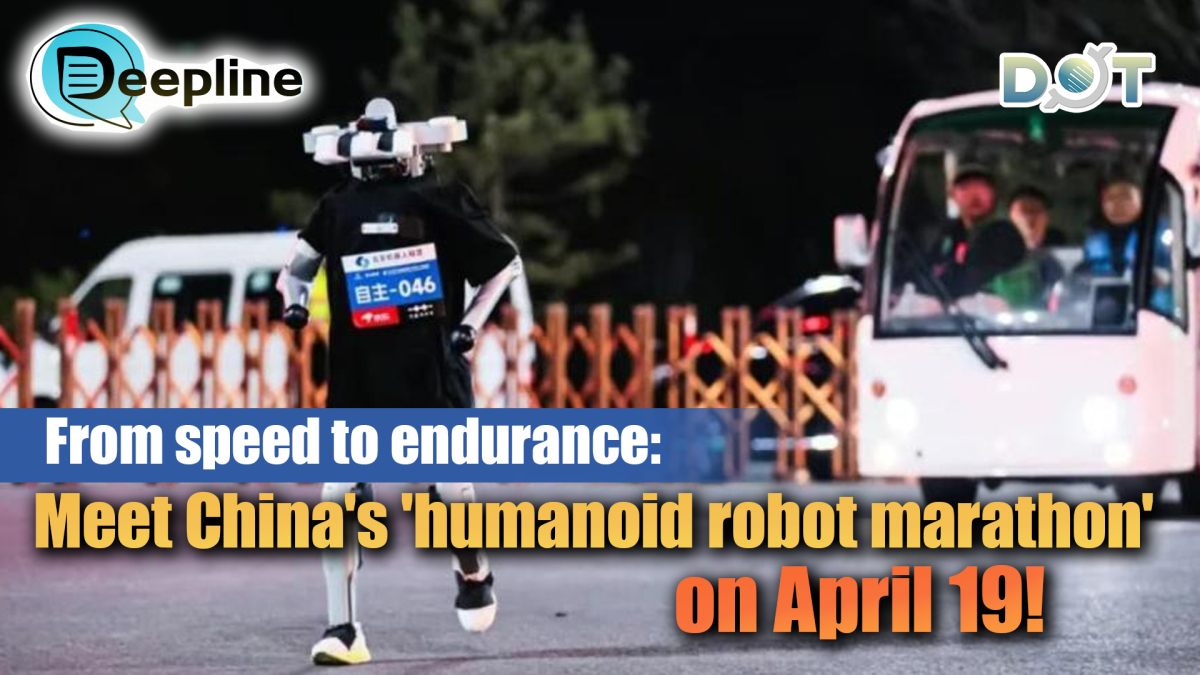
The 2026 Beijing E-Town Half Marathon & Humanoid Robot Half Marathon, scheduled to take place on April 19 in Beijing's E-Town, has already gone viral during its testing phase, becoming a new focus of attention following the 2026 Spring Festival Gala.
Apart from the contestants who "lost their chains" or "shed parts," the word "speed" is likely to be the most intuitive impression this year's robot marathon will leave on audiences. Honor's "Lightning" robot, competing for the first time, drew attention during the pre-race night test on April 11 due to its impressive speed.
In May 2025, when Honor first confirmed its development of humanoid robots, it revealed that its robot had already achieved a running speed of 4 m/s. Unitree Robotics went a step further, releasing a video before the race showing its H1 robot reaching a peak speed of 10 m/s during testing.
"Honor is relatively fast," said a humanoid robotics industry insider, "but this half-marathon isn't about speed."
Undoubtedly, in financing and public listings, speed is an eye-catching label. However, from the perspective of the application, as humanoid robots move from the stage to the track, speed is not the only metric.
Thus, the organizers not only highlight short-distance speed but also emphasize that the event is an extreme test of comprehensive performance and adaptability to complex terrains—designed to "provide greater momentum for the robotics industry and accelerate the transition of humanoid robots from labs to real-world applications."
This race represents an annual major examination for the entire humanoid robotics industry. The evolution of Chinese humanoid robots is, in itself, an ultra-long-distance marathon.
This year's race will start on April 19 and cover a total distance of over 21 kilometers. Human athletes will compete alongside humanoid robots, separated by barriers.
A total of 76 entities from 13 provinces and regions submitted applications, with over 100 teams signing up, including enterprises, universities, and four international teams. The overall participation scale is five times that of 2025.
This year, 20 universities are taking part, either by directly registering, forming joint labs with companies, or participating in training camps. A total of 26 robot brands will be featured.
Unitree Robotics, which did not participate last year, will make its official debut on the track this year. However, another leading brand, Zhiyuan, will again be absent.
The defending champion from 2025, the Tiangong Ultra robot developed by Beijing Humanoid Robot Innovation Center, which finished in 2 hours, 40 minutes, and 42 seconds, is also a key focus. "There have been significant changes in capabilities. Tiangong will have a hard time defending its title," said another industry insider.
When asked about this year's goal, an insider from the defending team said, "(We want to) surpass ourselves."
The same source revealed that the company has supplied 15 robots to other participating teams, including Tiangong Ultra and Tiangong 3.0, while partners are free to develop their own algorithms. Therefore, on the track this year, spectators will notice that while robots may look similar, their running performances can differ greatly.
The increase in participating teams reflects broader industry expansion.
According to a previous report by Xinhua News Agency, on January 21, the Ministry of Industry and Information Technology released data on the development of China's humanoid robotics industry in 2025—over 140 domestic manufacturers and more than 330 humanoid robot models were launched.
Last year's half-marathon was full of joy, largely due to the quirky robot designs and unexpected incidents during the race, such as parts falling off.
Based on pre-race tests, this joyful atmosphere remains. However, as the event becomes more standardized and technology advances, the "sense of fun" may gradually diminish.
According to the rules released by the organizers, the race will start in a Z-shaped formation across two columns, with a 3-meter gap between robots in the same column. Robots will start one by one with a 1-minute interval. During the race, robots must maintain a safe distance of at least 5 meters, overtake on the left, and go around any malfunctioning robots, which will be promptly cleared by referees and volunteers.
The biggest highlight of this year's competition is the introduction of an autonomous navigation category alongside the remote-controlled category, with nearly 40% of teams opting for autonomous navigation.
At a previous press conference, the organizers explained that this adjustment aligns with the rapid development of the robotics industry, creating a competition scenario better suited to current technological realities.
The remote-controlled or semi-autonomous approach requires a navigator to guide the robot, essentially having a human lead the robot as it runs. In contrast, the fully autonomous approach eliminates the need for remote guidance, relying instead on the robot's sensory and recognition capabilities.
If the 21-kilometer long-distance run tests endurance, energy management, dynamic balance, and gait control, then the value of autonomous navigation lies in reducing human intervention to verify the robot's perception and decision-making abilities in complex, changing environments.
In future races, robots will be labeled according to their competition category, such as "autonomous navigation" or "remote-controlled." Teams using the two different approaches will compete on the same track, with mixed timing and unified rankings.
Regarding mixed timing, a time penalty coefficient will be applied to remote-controlled robots, multiplying their original time by a specific factor and adding any penalties to calculate the final time.
"To encourage teams and companies to invest in autonomous technology development and ensure fair competition, we have set a weighting factor of 1.2 for autonomous completion, based on expert discussions, participant feedback, and multiple rounds of test data," the organizer's representative previously disclosed at a press conference.
Of course, differences in robot designs, ranging from very compact to full-sized—along with decorative and structural modifications for collision and fall protection, mean that some robots will still look delightful as they run.
On the night of April 11 into the early morning of April 12, the organizers conducted a full-process, full-scenario, and full-element test of the robot marathon. The test followed the official 21.0975-kilometer race route, adhering to the same schedule and track rules, covering both urban main roads and ecological park settings.
The nighttime test also provided a valuable opportunity for first-time participants like Unitree to familiarize themselves with the rules and venue and make necessary adjustments.
However, fully autonomous does not mean completely human-independent. Engineers must still accompany the robots, and manual intervention is allowed only in cases of sudden malfunctions or safety hazards, with referee approval. Thus, spectators will still see groups of people following the robots in electric minibuses.
Regarding accompanying personnel and intervention, the rules state, "Robots must compete within designated lanes. Accompanying vehicles must stay behind their team's robot, with up to three team members per vehicle. Intervention is allowed only in scenarios such as battery replacement, switching to a backup robot, or a fall, after the team leader signals the referee for approval."
With increasingly clear rules, smoother operations, and technological advancements, the previously mentioned "joyful atmosphere" is being compressed.
Of course, this can also be seen as a contradiction: on one hand, we want technological progress, making robots more professional and high-performing; on the other hand, we worry that this will reduce the sense of fun the event brings.
Finally, we return to the topic of "speed" mentioned at the beginning of the article.
If all metrics can be validated and autonomous perception capabilities continue to improve, then speed becomes even more meaningful in a competition, doesn't it?
(Source: Tencent Technology)
Related News:
Deepline | WeChat cracks down on AI-generated content: Why the panic?
Deepline | 'HappyHorse' unmasked: Alibaba as developer of top-ranked AI video model




Comment