






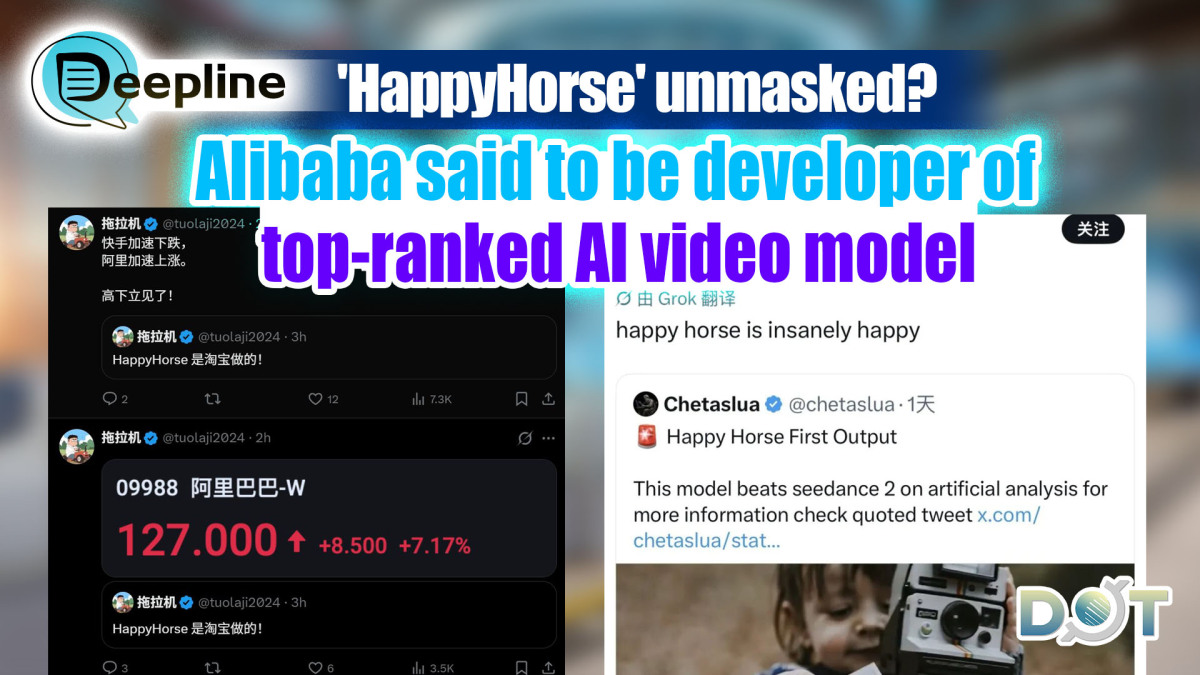
Two insiders claimed that the developer of HappyHorse-1.0, which recently topped the AI video generation leaderboard, is China's Alibaba Group, according to The Information. The model is expected to launch tomorrow (April 12).
On April 8, Lin Junyang, former head of Alibaba's Tongyi Qwen team, publicly reposted a sample generated by HappyHorse on X, praising it with the comment "happy horse is insanely happy," which many interpreted as a possible hint about the model's origin.
Recently, the mysterious dark horse appeared anonymously on the Artificial Analysis blind test leaderboard, beating ByteDance's Seedance 2.0 in both text-to-video and image-to-video categories, sparking intense online guessing. Now, with these rumors gaining credibility, Alibaba is doubling down on AI video generation with this new model to compete with ByteDance.
According to data from Artificial Analysis, HappyHorse-1.0 currently ranks first in both text-to-video and image-to-video categories without audio. It holds an ELO score of 1,386 for text-to-video (no audio) and 1,412 for image-to-video (no audio), ahead of ByteDance's Seedance 2.0 in both.
However, in the two categories that include audio, Seedance 2.0 still maintains a narrow lead. Additionally, HappyHorse's comparative evaluation sample size is approximately 3,500, far smaller than Seedance 2.0's roughly 7,500, meaning its ranking could still fluctuate.
The biggest debate following HappyHorse's appearance on the leaderboard has been its identity.
User Brent Lynch was the first to post a guess on X, "WHO IS HAPPYHORSE? IS IT WAN 2.7 VIDEO?" He noted that the model has two variants, V1 and V2, and that it "definitely appears to be from Asia," though he added that it is not really a Seedance 2.0 killer, but "more in line with the more recent Kling models."
Other rumors point to the team led by Zhang Di at the Future Life Lab of Alibaba's Taotian Group.
Zhang currently focuses on cutting-edge technologies such as multimodal large models. He first joined Alibaba in 2010 as a senior technical expert, then moved to Kuaishou in 2020 as Vice President of Technology. In April 2025, as Kuaishou's VP and head of Kling AI, he released Kling 2.0 Master Edition. In early September 2025, Zhang joined Bilibili as head of technology, but left after just over a month. In November 2025, he returned to Alibaba.
Before The Information's report, speculation was rampant, with the only consensus being that HappyHorse came from a Chinese team. Today, Alibaba issued a statement confirming that HappyHorse is a model developed by the AI Innovation Unit of its ATH subsidiary.
According to insiders, Alibaba's cloud computing division is preparing to make the model available to enterprise customers, with a launch expected as soon as tomorrow. This suggests that HappyHorse could become a new piece of Alibaba Cloud's AI service portfolio.
According to The Information, this new model represents Alibaba's latest move in its all-out AI competition with ByteDance, a rivalry spanning model capabilities, application ecosystems, and AI cloud services. ByteDance's Seedance 2.0, released domestically in China in February this year, stunned the world with its hyper-realistic video generation capabilities but also ran into copyright disputes with Hollywood studios.
Releasing a model under a pseudonym before an official announcement is becoming a common tactic among Chinese AI companies. The Information cited several recent examples: last month, Xiaomi quietly launched its LLM MiMo-V2-Pro on the OpenRouter platform under the code name "Hunter Alpha"; in February this year, "Pony Alpha," which appeared anonymously on OpenRouter, was eventually confirmed to come from Zhipu, as its next-generation GLM-5 model.
The core logic behind this strategy is not hard to understand: an anonymous identity forces a model to compete purely on merit in blind tests, and the sense of mystery itself becomes fuel for virality, sparking more discussion on social media than traditional product launches.
Last month, OpenAI announced it would shut down Sora, exiting the AI video generation area. The once-celebrated pioneer ultimately fell victim to pressures such as high costs and superior competing products. But Sora's departure has not cooled the track – on the contrary, Chinese companies are accelerating to fill the vacuum.
From ByteDance's Seedance 2.0 making global waves to HappyHorse's anonymous rise to the top of the leaderboard, the center of gravity in AI video generation has clearly shifted. Regardless of whether HappyHorse launches tomorrow, competition in AI video generation is likely to intensify further.
(Source: zhidxcom)
Related News:
Deepline | Globalization of Chinese automakers: Lessons from Toyota's rise
Deepline | Takeout dilemma: Why luxury hotels refuse to let robots do the job




Comment