






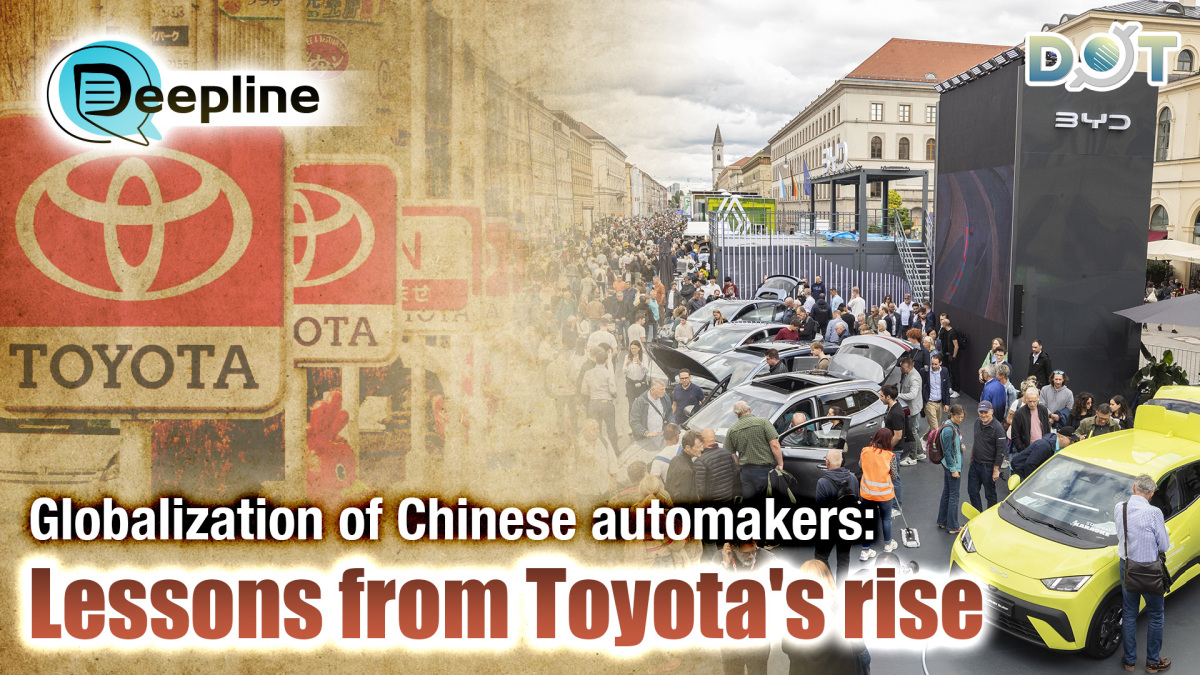
Last year, Chinese automakers surpassed Japan for the first time in global vehicle sales, achieving nearly 27 million units sold and claiming the top spot in the world's automotive sales rankings. Behind this milestone lies eight consecutive years as the world's largest producer and seller of new energy vehicles (NEVs), as well as a transformative moment for the Chinese automotive industry.
However, as people often say, a large automotive country is not necessarily an automotive powerhouse. Therefore, topping sales charts does not equate to becoming a brand powerhouse. With EU countervailing tariffs taking effect, surging international oil prices opening a window for NEVs, and rising global trade protectionism, the real test is whether Chinese automobiles can stand at the global summit.
For Chinese automotive brands, how should the path to globalization unfold? Perhaps we can draw some lessons from history. Looking back, Japanese automakers in the latter half of the last century also faced severe trials such as trade frictions, technological skepticism, and market barriers, ultimately rising to global dominance through lean management and technological breakthroughs.
The most typical example is Toyota. From the disastrous failure of the Crown in the US market to the Corolla becoming the world's best-selling car over an eighty-year journey, this provides a valuable case study for Chinese automakers. In other words, can Chinese automakers learn from the globalization path of Japanese automakers and forge a new route in the intelligent electric era?
How did Toyota go global?
Toyota's globalization journey began with growing pains in the 1950s. In 1957, Toyota exported the Crown sedan to the United States. Within less than a month, serious problems emerged: the headlights did not meet US brightness regulations, and the engine power was insufficient for American highway cruising.
This failure, however, became Toyota's most valuable lesson in globalization.
The 1960s marked a critical turning point for Toyota's exports. In 1965, Toyota launched the Corona RT43L, redesigned for the US market. Equipped with an automatic transmission and a 1900cc engine, it was priced at US$1,860—positioned strategically between American and European cars—and quickly captured market share.
Then, in 1966, the Corolla was introduced, solidifying Toyota's global DNA with the "80%+α" design philosophy: achieving at least 80 points in all performance areas while excelling in one area (α) beyond competitors. After its US export launch in 1968, this economy car propelled Toyota's US sales from 98,000 to 155,000 units, making it the second-largest imported automotive brand in America.
Data shows that between 1961 and 1979, Toyota's export volume surged from 12,000 to 1.384 million units, while overseas production increased 82-fold, marking its transformation from a Japanese automaker to an international player. Of course, this 19-year timeline was undoubtedly a profound and unforgettable journey.
What truly elevated Toyota to world-class status was the dual challenge of the 1970s oil crisis and trade frictions. When the first oil crisis broke out in 1973, international oil prices soared from US$3 to US$12 per barrel, shifting US consumer preferences from large-displacement, high-horsepower vehicles to fuel-efficient ones.
Toyota avoided direct competition with the mainstream US market, making small cars its core strength and seizing the oil crisis window to successfully enter the global market. More importantly, Toyota built a lean production management system on the supply side. Through Just-In-Time (JIT), zero inventory, and company-wide continuous improvement (kaizen), Toyota minimized production cuts during demand downturns and maximized production increases during recoveries.
Notably, this management system later became a cornerstone of management science and cemented Toyota's global competitiveness.
In the 1980s, as US-Japan trade frictions intensified, Japan was forced to implement voluntary export restrictions. Toyota's response became a textbook case in globalization: in 1984, it established a joint venture with General Motors to build the NUMMI plant. This was Toyota's true turning point toward globalization, producing Toyota-quality cars using American workers and factories.
Thereafter, Toyota's overseas expansion followed a clear four-stage evolution: Stage 1 (1980-1984) continued using overseas production bases centered on Asia and Africa; Stage 2 (1985-1991) built production capacity in North America through joint ventures like NUMMI; Stage 3 (1992-2001) expanded local production in Europe; Stage 4 (2002-2008) largely completed production layout across North America, Asia, and Europe.
By 2007, Toyota's US market share reached 16.1%, second only to General Motors. During this process, Toyota's overseas sales grew from fewer than one million units in 1980 to over 2.6 million units in 2007, achieving a leap from export-led growth to deep localization.
In fact, Toyota's roughly 70-year globalization journey reveals several core principles. For example, maintaining strategic resolve in technology roadmaps, synergizing supply and demand, and adapting market entry strategies over time, from direct exports to joint ventures and then to wholly owned local operations, while flexibly responding to trade barriers. These lessons provide a complete overseas expansion model for those who follow.
History often repeats itself strikingly. Today, Chinese automobiles stand at a crossroads similar to Toyota's. In the first two months of 2026, China's auto exports reached 1.352 million units, a year-on-year increase of 48.4%, while NEV exports hit 583,000 units, a 1.1-fold increase, accounting for over 40% of total exports.
Similar to the oil crisis window Toyota seized, current international oil prices remain persistently high, amplifying the total-life-cycle cost advantage of NEVs and further highlighting the global competitiveness of China's new energy products. For instance, Geely Auto's exports grew 129% year-on-year from January to February, while BYD's overseas sales rose 51%, demonstrating strong momentum among leading automakers.
Yet, much like Toyota faced US-Japan trade frictions, Chinese automobiles are also encountering trade barriers. In mid-2024, the EU imposed countervailing tariffs on Chinese electric vehicles. However, in January 2026, the EU issued its "Guidance Document on the Submission of Price Undertaking Applications," allowing Chinese exporters to replace tariffs by committing to minimum prices—a move seen as a dispute-suspension solution.
More notably, Chinese automakers are exploring new paths that go beyond Toyota's experience. According to relevant reports, Chinese automotive companies in Europe are shifting from a trade model focused on vehicle exports to a symbiotic, win-win approach combining "vehicle exports, technology output, and local production."
This means Chinese automakers are moving from single-product exports to full-factor export of technology, management, and brands. In other words, today's Chinese auto industry can both draw on Toyota's core lessons and leverage its own unique strengths.
Crucially, it must seize the window of technological transformation and maintain resolve in electrification and intelligence. Toyota adhered to energy-saving and emission-reduction routes during the oil crisis and ultimately became a global leader. Today, Chinese automakers possess cost-performance advantages in electric vehicles, including energy efficiency, pricing, and features.
Especially in the field of intelligence, China has built global leadership in technologies such as LiDAR, domain controllers, and vehicle-road-cloud integration. The penetration rate of L2 passenger vehicles has reached 64.2%, and the penetration rate of navigation-assisted driving is 22.9%.
Many auto executives have said that for Chinese automotive brands, globalization is essentially local localization. Therefore, market entry should also shift from export-led to deep localization. Toyota, for example, adopted different strategies such as joint-venture plants and wholly owned factories after trade frictions.
In fact, today's Chinese automakers have more flexible paths. For example, Leapmotor formed a joint venture with Stellantis, leveraging the latter's global channels to accelerate its European expansion. Xpeng and GAC have found contract manufacturing with Magna in Europe, reducing policy risks through local supply chains.
At the same time, Chinese automakers can adopt asset-light strategies, using idle factories of international automakers to lower overseas investment risks. For instance, Chery took over Nissan's South Africa plant, Geely partnered with Renault in Brazil, and Great Wall Motors is in talks with Mercedes-Benz's South Africa plant for sharing. This diversified approach to market entry is even richer than what Toyota had back then.
It is often said that Chinese automakers are caught in brutal competition. However, Toyota also faced accusations of being a price butcher during its overseas expansion, but ultimately built brand value through lean management and technological upgrades. In this regard, Chinese automakers should place greater emphasis on moving away from price wars to value wars and cultivating long-term brand competitiveness.
Looking back, all automotive professionals recognize that Chinese auto exports are undergoing a critical transition from scale expansion to quality improvement. So, given past experiences, it is highly worth anticipating whether Chinese automobiles can forge a globalization path that surpasses that of Japanese automakers or Toyota.
(Source: iAUTO2010)
Related News:
Deepline | New 'Tasks' for delivery: How DoorDash uses gig workers to train real-world AI models
Deepline | Beyond OpenClaw's craze: What remains after the AI storm?




Comment