






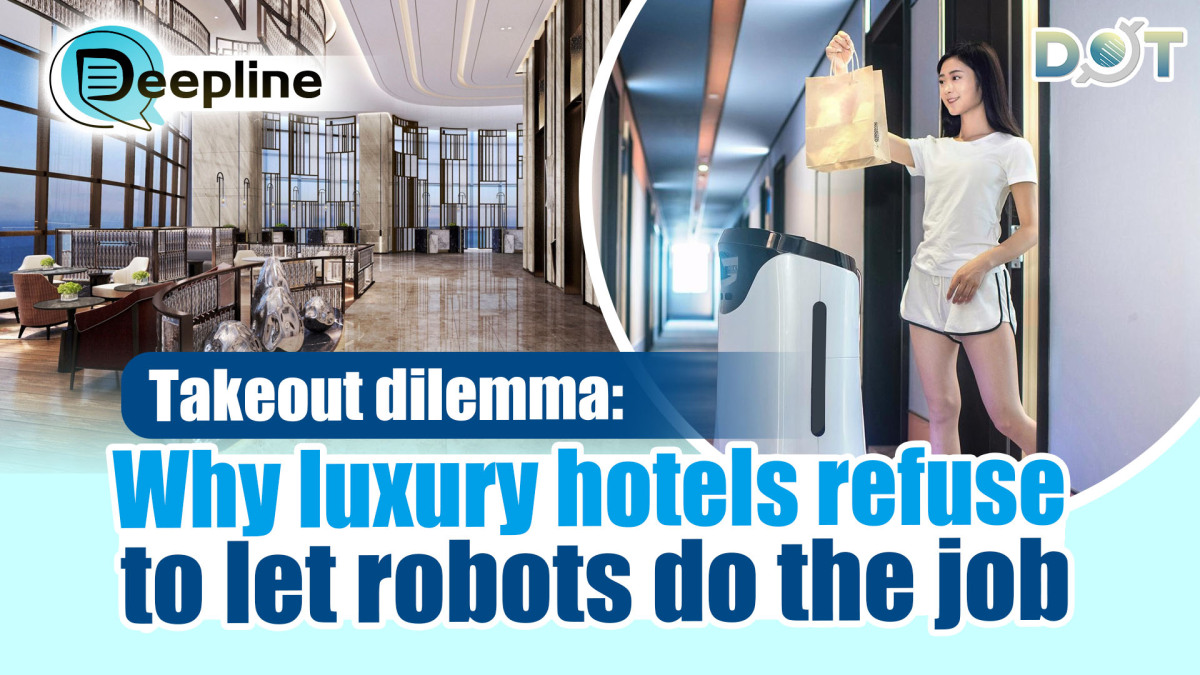
A post by Chinese entrepreneur Luo Yonghao has brought back the old debate about whether five-star hotels should allow food delivery to be brought up to guests' rooms.
Luo was on a business trip in Guangzhou and stayed at the Jumeirah Hotel, where the staff actually arranged for someone to deliver his takeout to his room. He posted online, "This is the only high-end hotel I've ever stayed at in my life that does something like this."
Nowadays, in China's mid-to-high-end, mid-range, and even economy hotels, using robots to deliver takeout is already old news—so common that going downstairs to pick up your order feels outdated. But five-star hotels are the exception: either they don't offer delivery at all, asking delivery drivers to leave orders in the lobby for guests to collect downstairs, or, in rare cases like the Jumeirah, they have a real person deliver it.
Hidden within this are two questions: First, why is the Jumeirah able to have a person deliver takeout? Second, since five-star hotels clearly have the option of using robots to make things easier, why don't they?
Let's start with the first question.
The practical challenge for five-star hotels is that a single property can have anywhere from 200 to 300 rooms, or even over a thousand. Based on a conservative estimate of one takeout order per room per day, that adds up to at least several hundred orders daily. If each order requires a dedicated staff member to receive it from the delivery driver and then bring it to the guest's door, how high would the labor cost be?
Some data gives a clear picture: According to a report by Mercer China and Horwath HTL, before the pandemic, the average labor cost per available room in first-tier city five-star hotels—excluding destination resorts—was already approaching 140,000 yuan (RMB) per room in 2019. Even more striking, labor costs account for 43% to 45% of a hotel's total costs. In other words, for every 100 yuan the hotel earns, nearly 45 yuan goes to employee expenses—a proportion that ranks among the highest in the service industry.
Returning to the specific scenario of takeout delivery, if every five-star hotel were to offer the same dedicated delivery service as the Jumeirah, how much would the cost increase?
Labor costs in the hotel industry are far more complex than one might think. An employee's base salary is just "the tip of the iceberg." When factoring in social insurance, housing fund, meals, accommodation, uniforms, training, and management overhead, the total cost of employing someone is typically about 1.5 times their nominal salary. Adding to the difficulty, takeout orders come in obvious peaks and valleys: breakfast, lunch, dinner, and late-night hours—all concentrated within a few short windows. To handle these peak periods, the hotel would need enough staff on hand, but for the remaining ten-plus hours, those same staff would be underutilized.
The hotel would either have to create a dedicated takeout delivery role, adding to its headcount, or assign the task to existing employees, squeezing their already full schedules.
Either way, it's a losing proposition.
This is the cost trap for five-star hotels: offering delivery pushes labor costs to unsustainable levels, while not offering it draws complaints about subpar service. That's why most five-star hotels simply ask guests to pick up their own orders downstairs—the delivery driver calls when they arrive, and both parties get what they need. The hotel doesn't need extra staff and avoids taking responsibility for takeout security.
It's a calculated outcome, but also a reluctant one.
Then some might ask: If economy and mid-range hotels are using robots so cost-effectively, why aren't five-star hotels doing the same?
A research report from Orient Securities once provided some data: for a mid-range hotel with 150 rooms, equipping it with two delivery robots would cost just 60,000 yuan over five years. Moreover, robot prices are dropping faster than smartphone prices—early models cost 130,000 yuan each, but now the average price has plunged to around 10,000 yuan, a drop of over 90%.
Take a certain brand's robot series as an example: in 2024, the average selling price was only 20,900 yuan, while the high-end "UP" series saw its price halve from 54,200 yuan to 22,300 yuan within a year. For mid-range hotels, the math works out.
Is it that five-star hotels can't afford them? Don't be ridiculous—these are establishments that don't blink at spending hundreds of thousands of yuan on crystal chandeliers. The core issue is that five-star hotels have a fundamentally different understanding of what constitutes "good service" compared to mid-range hotels.
The most straightforward factor is brand identity. In the mindset of five-star hotel professionals, the essence of "high-end service" lies in human interaction.
The Ritz-Carlton has a famous motto: "We are Ladies and Gentlemen serving Ladies and Gentlemen." The essence of this phrase is the human element: only a person can convey warmth, only a person can read subtle cues, only a person can offer an extra "Would you like me to heat that for you?" when needed, and quietly step away when you prefer not to be disturbed.
A robot, on the other hand, simply executes a program. It knocks, makes a call, drops off the item, and leaves. It doesn't pick up on your mood, remember your preferences, or offer an extra "Happy Birthday" on your special day.
In the eyes of five-star hotel managers, using a hunk of metal to deliver takeout would send the message, "You're not worth sending a real person to serve." That, to them, would tarnish their reputation.
Looking abroad, at the world's top luxury hotels, robots are almost nowhere to be seen. These century-old establishments take pride in their well-trained staff—people who remember your name, know your favorite tea, and can even tell from your expression how your day is going.
The logic at these hotels is simple: technology can improve efficiency, but efficiency has never been the core of luxury. What does luxury sell? Time, dedicated attention, and the gesture of "I'm willing to assign someone specifically for you."
There's also a practical hurdle: in most five-star hotels, elevators require keycard access to reach specific floors, and robots can't navigate that on their own. Unless the hotel grants special access, but that raises security concerns—letting a robot roam freely across all floors would give the security department a headache, as there's no guarantee the system couldn't be exploited.
Industry data shows that robot adoption in luxury hotels remains low, with the vast majority of five-star hotels still taking a wait-and-see approach, hesitant to experiment.
That said, a five-star hotel isn't a monolith; some pioneers have started testing the waters.
At the newly opened Traders Hotel by Shanghai Hongqiao Airport, robots are no longer just simple tools—they've become key players in shaping the future hotel experience. From self-service check-in kiosks to smart luggage carts and even a robotic barista capable of latte art with its mechanical arm, robots are integrated throughout the entire guest journey, including check-in, guidance, service, and specialty experiences. This shows that the value of robots can be leveraged as a strategic asset to improve operational efficiency and create a distinctive brand identity.
The future trend may not be about whether to use robots, but how to use them. Robots can handle standardized, repetitive tasks that don't require emotional engagement—like delivering takeout, bottled water, or toiletries—while humans focus on the scenarios that truly call for a personal touch: bringing a bowl of congee to a guest who's feeling unwell, delivering a birthday cake to someone celebrating, or flexibly accommodating special requests.
As the younger generation of guests becomes accustomed to the convenience of robots, how will they view a five-star hotel that insists on a "human-only" approach? Will they see it as a nostalgic commitment to quality, or as out of touch with the times?
Only time will tell, but one thing is certain: now that robot delivery has become standard in mid-range hotels, five-star hotels really need to think carefully about what true high-end service means. After all, while the cost equation may have a clear answer, winning over guests' hearts has never been a simple matter.
(Source: wenlvpai)
Related News:
Deepline | New 'Tasks' for delivery: How DoorDash uses gig workers to train real-world AI models
Deepline | Beyond OpenClaw's craze: What remains after the AI storm?




Comment