






By Liu Yu
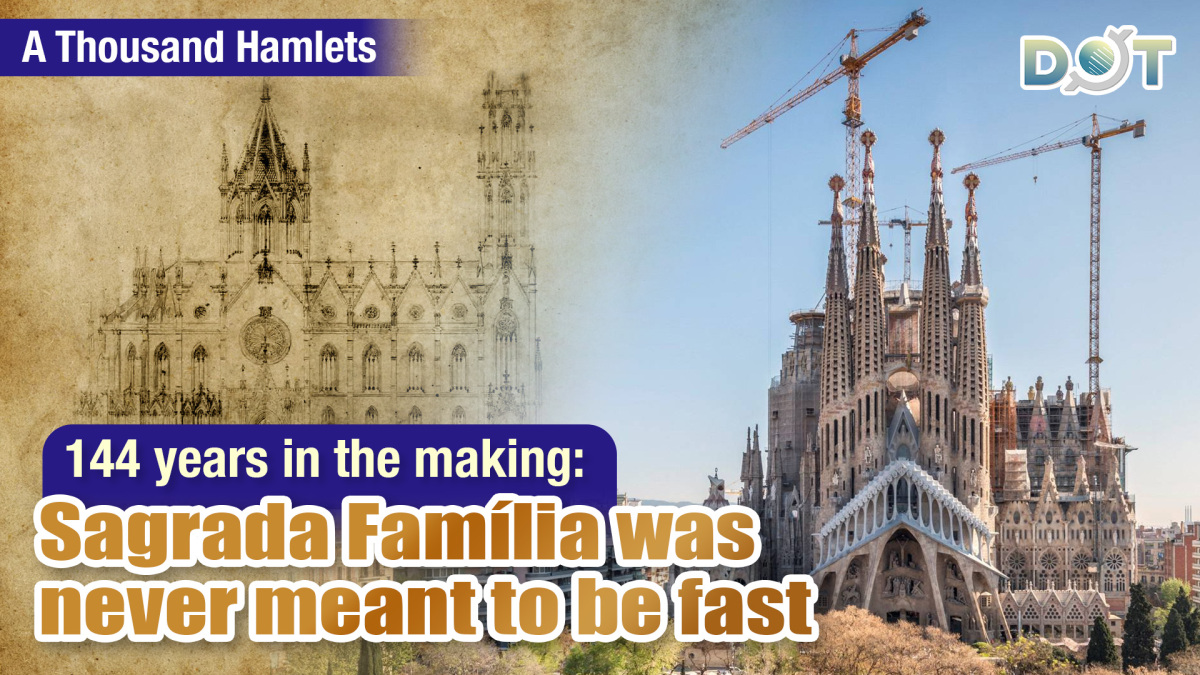
At 10:30 am Spanish time on February 20, the final section of the cross was installed atop the central tower of the Sagrada Família, marking the official completion of the building's topping-out. First begun in 1882, it now stands at 172.5 meters tall, making it the tallest church in the world. This height was no display of grandeur, but a deliberate choice by Antoni Gaudí: in his eyes, no man-made structure should rise above God's creation. For that reason, the Tower of Jesus Christ was carefully designed to stand slightly lower than Montjuïc, the mountain overlooking Barcelona. According to the Sagrada Família Foundation, construction on the main structure will finish in June 2026 — exactly one hundred years after the death of its architect, Antoni Gaudí.
Years ago, when I visited this church, I saw a sign next to the donation box at the entrance inviting visitors to contribute to this "still under construction" church. My companions were all awestruck by the church's exquisite and unique architecture; of course, almost none of them were Catholic, but they still put in all the spare change they had. You would certainly hear some people complaining about the slow progress and inefficiency of the construction; at least for that moment, I felt the church seemed to be growing forever. However, few truly understand that Antony Gaudí's "commissioner" for this church was never in a hurry to complete it.
As Gaudí envisioned, the church will consist of 18 towers in total: six central towers, with the Tower of Jesus Christ at their heart; to the north, the 140‑meter Tower of the Virgin Mary; and four more representing the Four Evangelists. Surrounding the core are three grand façades — the Nativity Façade, the Passion Façade, and the Glory Façade — each with four bell towers honoring the Twelve Apostles. With the central tower now complete, this three‑century‑old project has revealed a shape closer to completion than ever before.
To truly understand the Sagrada Família, we must return to Barcelona in the late 19th century. The wave of industrialization expanded the city rapidly, while traditional faith and social structures began to loosen. From the rise of humanism to the Industrial Revolution, I have always liked using the phrase "the intrusion of the secular" to contrast with the conservatism of the past. Yet many people hoped to find a quiet refuge for their souls amid such rapid change. It was then that Josep Maria Bocabella, a religious bookseller, proposed building a church dedicated to the Holy Family after visiting the Vatican, as a response to the spiritual crisis of the age.
The church was conceived from the start as an Expiatory Temple — funded entirely by private donations, not by the state or the Church, a quiet, collective expression of faith stretched out over generations. Construction officially began in 1882 under the original architect, Francisco de Paula del Villar, who completed the crypt in the prevailing Neo‑Gothic style. Just one year later, he left over creative differences, and 31‑year‑old Antoni Gaudí took on what was then an unremarkable project.
No one could have guessed that this young architect would dedicate the next 44 years of his life entirely to the Sagrada Família. Rejecting conventional Gothic design, Gaudí treated the church as a lifelong architectural experiment. He abandoned traditional buttresses and flying buttresses, believing buildings should support themselves like nature itself. He even used hanging chains, ropes, and weights to create models, letting gravity "draw" the most stable curves, which later became the forest‑like branching columns inside the church. He shunned straight lines and flat surfaces, weaving biblical narrative together with natural forms until the entire structure seemed less a man‑made building than a rocky formation rising from the earth.
The client for this church was time itself. Gaudí built a school for the children of construction workers, and in his later years lived almost on-site, living simply and staying far from public attention. In 1926, at the age of 73, he was hit by a tram in Barcelona. Mistaken for a beggar due to his plain clothes, he died soon afterward. By then, less than a quarter of the Sagrada Família was complete, and only one tower had been finished in his lifetime. In accordance with his wishes, Gaudí was buried inside the unfinished church.
After Gaudí's death, construction slowed dramatically. Then came war, which nearly destroyed everything. Conflict in the first half of the 20th century dried up funding, and the outbreak of the Spanish Civil War in 1936 brought devastating damage: Gaudí's models and original drawings were burned, workshops were looted, twelve construction workers lost their lives, and Domènec Sugrañes, Gaudí's closest assistant and successor, was also killed. The loss of core materials left the project on the brink of abandonment.
When the civil war ended, architect Francesc de Paula Quintana took charge. His work was not to build anew, but to restore and reconstruct. Over the decades that followed, seven different architects continued the project in turn, piecing together Gaudí's vision from surviving fragments, sketches, and memories.
In the 1990s, under a new wave of "secular intrusion," construction entered a period of unprecedented speed. Computer modeling, CNC lathes, and precision cutting machinery arrived on-site, making it possible to accurately realize Gaudí's complex, delicate designs.
To this day, the Sagrada Família accepts no government funding, relying mainly on ticket sales and donations. During the pandemic, the church closed temporarily, visitor numbers plummeted, work paused, and the 2026 completion schedule was adjusted. Entering the 21st century, this still‑growing historic building has continued to clash with modern urban life: plans for steps at the main entrance require the relocation of local residents, and the construction of a high‑speed rail tunnel nearby has sparked safety debates. Yet none of these setbacks have stopped it from moving steadily toward completion.
Today, the Sagrada Família is neither a static historic relic nor a finished work. It is still being built, debated, and reinterpreted. Over 144 years, it has seen groundbreaking, succession, war, interruption, revival, and acceleration. In 2026, the centenary of Gaudí's death, this legendary three‑century‑old structure will at last take its final, complete form.
Liu Yu is the lead editor of the cultural commentary "A Thousand Hamlets." Liu holds a BA in English Literature from HKBU and an MA in History from HKU.
The views do not necessarily reflect those of DotDotNews.
Related Readings:
A Thousand Hamlets | How people celebrated the New Year in Tang Dynasty Chang'an




Comment