






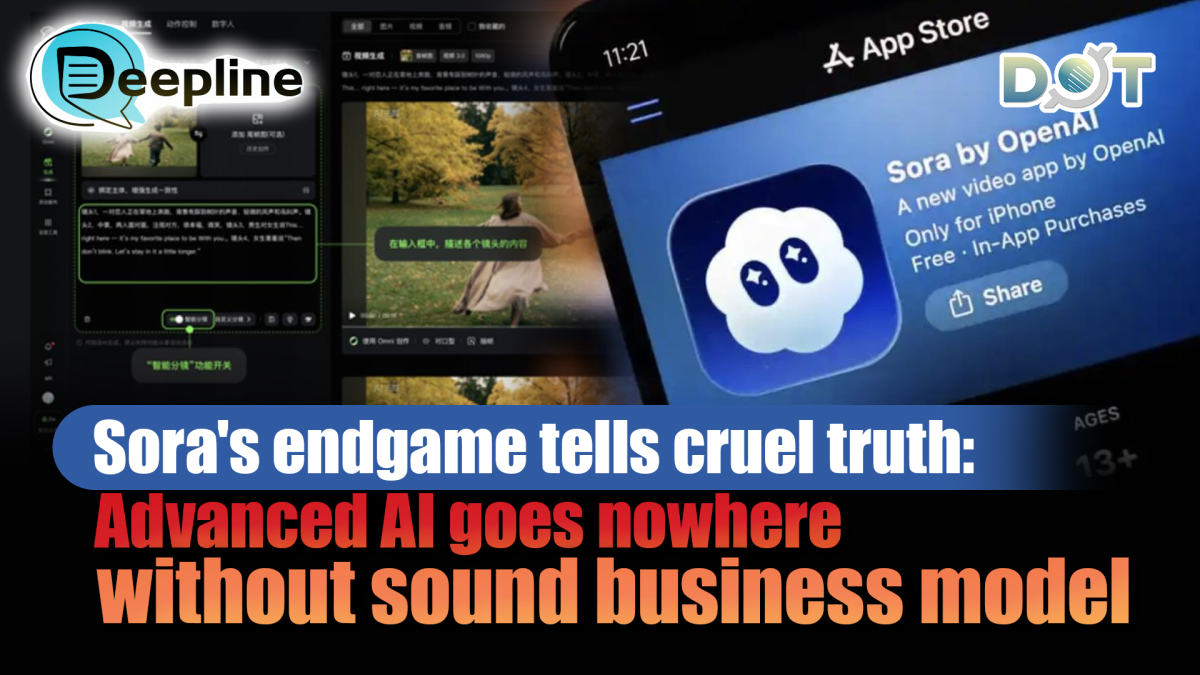
On March 25, Sora's official account on X posted a brief farewell message. The product that once "sent Hollywood into a state of awe" had come to an end.
Sora's closure serves as both a signal and a cautionary tale for the AI video-generation sector. Unlike the mismatch between Sora's technical capabilities and its commercial application, China's Seedance and Kling have already established sustainable revenue streams. However, constrained by limited computing power, the two have taken distinctly different paths—one leveraging its distribution advantages to integrate key nodes in the industry chain, the other using undifferentiated global access to scale worldwide. Both approaches are viable in parallel.
As evidenced by Kuaishou's latest earnings report, the success of Seedance 2.0 has not materially impacted Kling's commercialization efforts, with projected revenue expected to double this year.
Another ripple effect of Sora's downfall is the wavering confidence in the future of AI content platforms. Jimeng, which has been labeled "China's Sora" since last year, gained attention by riding the wave of Seedance 2.0 and saw increased user engagement in its community. Still, it must prove the viability of its product strategy.
However, ByteDance's defensive positioning and experimental approach to AI content platforms are becoming increasingly clear. This strategy also ensures it will not fall into the same trap as OpenAI.
Poor user retention, high computing costs, and belt-tightening ahead of an IPO—these are the surface-level narratives repeatedly cited by the media as reasons for Sora's demise. What truly warrants deeper analysis are two more fundamental mismatches.
The first is the divergence between technological direction and commercial value. OpenAI's original intent in developing Sora was not to serve the content industry as a commercial tool, but to build a "physical world simulator" for its AGI vision. While it achieved industry-leading results in fluid dynamics, collision physics, and light refraction, it strayed from the core needs of film and television production: content and cost controllability.
Data shows that the success rate for generating commercially viable content with Sora was only 5 to 10 percent. It often took ten attempts to achieve a single usable output. The inference cost for generating one minute of high-quality video ranged from US$30 to US$50. After five or six rounds of trial and error, the cost of a single usable video could exceed US$200.
Unable to secure stable enterprise payments, Sora was forced to pivot toward a consumer-facing traffic model—leading to a second, irreconcilable resource mismatch.
The Sora app's product design was almost a mirror image of TikTok: a vertical video feed, "Characters" avatars, and one-click duet templates. Within five days of launch, it surpassed one million downloads and topped the U.S. App Store charts.
But the buzz was short-lived. Downloads plummeted from a peak of 3.33 million to 1.1 million, with a 30-day retention rate of just 1 percent, and a 60-day retention rate of zero. Over its entire lifecycle, the app generated only US$2.1 million in cumulative revenue.
The reason is simple: most users downloaded Sora to create a novelty video and had no reason to return once the novelty wore off. For OpenAI, which was already stretched thin across multiple fronts and facing computing constraints, this was an immense waste of resources.
Copyright issues only accelerated the decline. Sora initially launched with an "opt-out" system, and before Hollywood could react, AI-generated videos featuring characters like Pikachu and SpongeBob SquarePants were flooding the internet. After being forced to switch to an "opt-in" licensing model, creative freedom was severely curtailed, and user attrition accelerated.
As for the unfinished US$1 billion deal with Disney, it amounted to a gamble between two parties facing their own uncertainties: Disney bet that OpenAI could turn Sora into a mass-market platform, while OpenAI bet that Disney's intellectual property could revive its flagging user base. Both bets fell through on the same day Sora shut down.
Over the course of six months and at a cost of billions of dollars, Sora served as a wake-up call for the AI video industry: no matter how advanced the technology, without a matching business model and product form, success will likely remain out of reach.
The differentiated strategies of Seedance and Kling, however, precisely avoid the core pitfalls that doomed Sora. Seedance prioritizes computing resources for its own platforms and ecosystem partners, while Kling uses open access as a means to achieve global reach. Both have steered clear of the trap of "technological showmanship divorced from commercial reality" and are now charting a sustainable path forward.
During this year's Spring Festival, the impact of Seedance 2.0 was impossible to ignore. Meanwhile, Kling 3.0 rolled out almost unnoticed—it played a key role in the visual effects production for the series *The Year of Peace*, yet remained largely absent from public discussion.
If we shift our gaze away from social media, the real story behind this competition lies in the differences between the two platforms' strategies regarding ecosystem openness and industry collaboration.
Seedance 2.0 operates under a clearly prioritized, layered partnership structure. ByteDance's own products—Jimeng, Doubao, Xiaoyunque AI, and the intellectual property reserves of Qimao Fiction, along with the distribution channels of Hongguo Short Dramas—occupy the innermost layer, receiving full access and priority updates. This creates a tightly integrated internal conversion chain.
The next layer consists of deep partnerships with leading content companies. After Zhangyue Technology's comic platform integrated Seedance, production costs per episode for comic-based short dramas dropped from 2,000 RMB to 200 RMB, with monthly output exceeding 10,000 episodes. China Literature Group has announced it will integrate Seedance 2.0 and open up its top-tier intellectual property for authorized use, exploring a model that combines "AI-generated derivative works with official revenue sharing." At the same time, ByteDance is using its recently launched Xiaoyunque AI's short drama agent to uniformly deliver Seedance 2.0 capabilities to the short drama industry.
Further out, while Volcano Engine has announced commercial pricing for Seedance 2.0, actual API access remains limited and has not yet been fully opened to the public. Domestic third-party integrations are prioritized for compliant enterprise clients. Internationally, the situation is more restrictive: Warner Bros., Disney, and other Hollywood studios have sent legal letters citing "pre-licensed characters." In response, BytePlus announced in March that it would suspend overseas API releases for Seedance 2.0, with little likelihood of resuming in the near term.
This contraction was not driven by ByteDance's own strategic choice, but rather by copyright pressures. Nevertheless, it has reinforced Seedance's strategic focus: deepening engagement with core players in China's content industry. By doing so, Seedance serves not just as a tool provider but also participates in content distribution and monetization through ByteDance's own channels, keeping the entire value chain within a relatively closed ecosystem.
Kling has taken a different approach, offering undifferentiated API access to both individual developers and large enterprises, with no feature restrictions. It employs a usage-based pricing model alongside custom enterprise plans.
During Kuaishou's January 2026 earnings call, management expressed confidence in doubling full-year revenue year-over-year. Its API services now reach over 30,000 enterprise clients across 149 countries and regions, with overseas markets contributing approximately 70 percent of revenue.
Currently, Kling's partners span a wide range of industries, including global creative asset platforms like Freepik and Lovart, marketing agencies, game developers, hardware manufacturers, and cloud service providers.
Notably, emerging AI video platforms such as LibTV and EvoLink have integrated Kling 3.0 as one of their core engines. Kling's strategy is to position itself as a generative capability layer that can be broadly integrated, allowing ecosystem partners to handle application-specific deployment and monetization.
The difference between the two approaches ultimately reflects differing views on how to build a sustainable advantage.
Seedance embeds its generative capabilities into ByteDance's proprietary industry chain through layered partnerships, creating a short monetization path and high efficiency. However, its heavy reliance on copyright compliance and the deliberate narrowing of its open access also limit its ability to scale across broader scenarios.
Kling, by contrast, pursues global scale through open access and diversifies policy and copyright risks across multiple markets. Yet its monetization depends heavily on how its partners leverage its capabilities.
Sora proved one thing: without a scenario that generates sustained willingness to pay, even the strongest technology will falter. Seedance and Kling have at least reached the stage of generating real revenue, but how far each model can ultimately go remains to be seen.
In tearing down the technological mythology surrounding the AI video sector, Sora's closure has brought the industry back to the fundamentals of business and real-world value. By shifting away from the blind pursuit of technical spectacle and instead rooting themselves in practical applications, Chinese players are charting differentiated paths that are redefining the future direction of AI video.
(Source: 36kr)
Related News:
Deepline | More than autonomous: AI agents hit the road as automakers move beyond voice commands




Comment