






OpenClaw is evolving at a staggering pace. Just two weeks ago, people were still figuring out how to run it on a PC—now they're already putting it in vehicles.
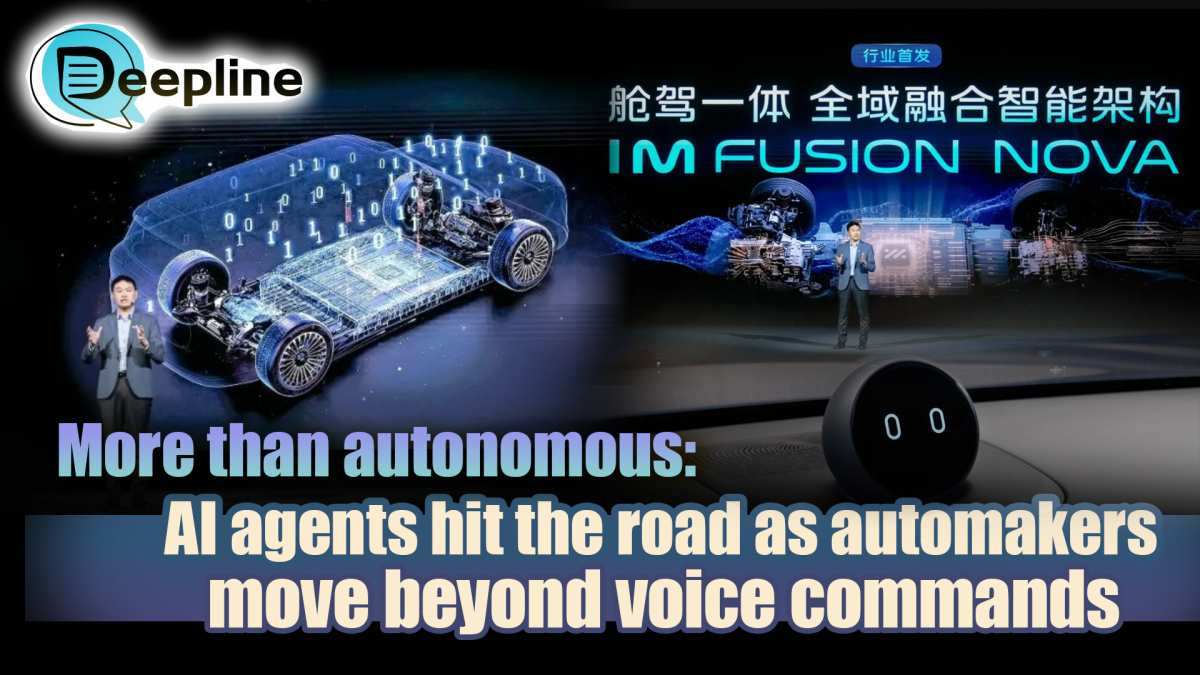
Recently, IM Motors launched IM Ultra Agent, built on Alibaba's Qwen model. It connects the vehicle's steer-by-wire chassis, IM AD intelligent driving system, and smart cockpit, allowing users to control the car, plan trips, and access lifestyle services—all through simple voice commands.
In the past, smart cars meant having a voice assistant inside the car that could respond to people. Today, the smart car itself has become an intelligent agent capable of movement and perception.
That's the idea in theory. But the real question is: is the "agent" just another buzzword in automotive intelligence, or is it actually something meaningful?
Concepts like OpenClaw and "agent" may have exploded in popularity recently, but over the past two or three years, automotive intelligence has mostly moved at a slow pace. Now and then, a flashy new concept appears—adding more screens, letting the car follow a series of commands—but at its core, it's still just a Q&A interaction between the driver and the car.
This kind of voice interaction is simple. The user triggers a keyword in the command library, and the car follows the preset code. The bigger the command library, the smarter the car seems.
But this "intelligence" is essentially a puppet on strings: people pull one string, and it moves one way. The user gives a command, and the car executes it. It has no real ability to "think."
Nowadays, user needs are only becoming more complex, and the Q&A model no longer represents what a true automotive agent should be. What's needed is collaboration across key domains—chassis, cockpit, intelligent driving, and powertrain.
That's where an agent comes in. Through deep reasoning, it transforms question-and-answer interaction into a proactive understanding of intent, evolving into an agent that actively takes charge of the whole vehicle.
Some may ask—do we really need an agent that can think for itself? Consider this scenario, and the difference becomes clear:
In a typical family trip, music and navigation are playing while the family in the back seat has fallen asleep. IM Ultra Agent, using the car's interior camera, notices the passengers are asleep and proactively alerts the driver, asking whether to switch the vehicle to Comfort mode.
Once confirmed, the agent automatically moves the music and navigation audio to the driver's headrest speaker. It also adjusts the powertrain and suspension to Comfort mode and independently sets the climate control for each zone.
All the driver needs to do is press "OK" on the steering wheel. The sleeping passengers in the back barely notice a thing.
In contrast, with a traditional command-based system, the driver would need to say something like "Switch to comfort mode," "Set rear AC to 25 degrees," "Lower volume to level three." By the time all that is said—whether the system can even handle multiple commands or not—the sleeping family members would likely be wide awake.
Today's automotive agents have largely met the smart mobility needs of drivers. But their potential goes far beyond the vehicle itself. Once they achieve cross-scenario coordination, integrating "human-car-home" becomes a natural next step.
For example, on a rainy evening after work, a user could tell their phone, "Come pick me up and drive me home." The agent would then actively assess the car's surroundings, traffic conditions, and weather forecast. It would then activate the intelligent driving system to move the car from the parking space to the office building entrance.
Based on the outside temperature, it would adjust the cabin climate to a comfortable level. Using the exterior Face ID system, it would recognize the user and automatically unlock the door. Once the user is inside, it would map out the fastest route home based on real-time traffic.
At the same time, the agent would send commands to smart home devices—AC, water heater, lighting—to prepare the house. After the user arrives and exits the vehicle, the agent would automatically park the car using the pre-set parking spot. Throughout the entire process, the user barely needs to intervene.
This may sound far-fetched, but it's not guesswork; it's based on existing automotive hardware. The only things standing in the way are Level 3 conditional autonomy and a truly proactive agent. With continued training and optimization, plus more hardware integration, the level of intelligence in cars could go far beyond what we imagine today.
When IM Motors launched IM Ultra Agent, the company called it the "first automotive agent." But other brands are also exploring agents—just at different stages and from different angles.
From where I stand, a truly powerful automotive agent shouldn't just focus on the car itself, or stop at "human-car-home" coordination. The key lies in a comprehensive ecosystem.
If we zoom out, the car plays the role of "limbs" in the system, while the agent is the "brain" giving the orders.
Once that's understood, it becomes clear that being the first to claim an "agent" isn't what matters. What matters is who can build out the ecosystem first.
From that perspective, IM Ultra Agent has a real advantage.
It's built on Alibaba's Qwen model, which opens up a wide range of use cases. Integrated with Alipay, it can automatically handle parking and highway tolls. Connected to Taobao and Cainiao (a Chinese logistics company), it can have deliveries dropped off at the car. Linked with Freshippo (a Chinese retail platform), it can even do grocery shopping—taking care of everyday errands.
For work-related travel, IM Ultra Agent can book tickets, sync with DingTalk for meetings, manage warehouse logistics, and handle cloud-based tasks. Combined with full vehicle control, it blends the roles of assistant, driver, and concierge—giving us a glimpse of what the future of automotive agents could look like.
But whether these features actually work well in practice will depend on the IM LS8, the first vehicle to feature Ultra Agent.
IM isn't alone. Other brands have also introduced their own agents, such as Xiaomi's MiclawAgent and Huawei's Xiaoyi Agent.
Xiaomi has a strong ecosystem and has embraced the "human-car-home" concept from the start. But to truly link all three, it needs an agent to bridge them. In March, Xiaomi introduced MiclawAgent. While it's currently software-only, it's likely only a matter of time before it's integrated into vehicles.
Huawei's Xiaoyi Agent is already being rolled out to HarmonyOS users. While it doesn't yet have full vehicle control, it will become more proactive as it learns from user interactions. Through OTA updates, it could eventually take on more tasks—potentially becoming a key part of Huawei's automotive intelligence strategy.
Some automakers still try to prove their smart credentials with more screens or bigger displays. However, that approach is outdated; the next battleground is about which agent thinks smarter and which ecosystem is broader—who can actually get things done for users efficiently and seamlessly.
For those who've already tinkered with OpenClaw on a PC, hearing about it being put in a car might raise a few questions: how do you ensure security? How much access does it need to the vehicle's core systems? And will all those tokens make it significantly more expensive?
These concerns are understandable, but there's a key difference between how an agent operates in a car versus how it works on a PC.
On a PC, OpenClaw relies on cloud-based LLMs to execute commands, which means files and operations are exposed to data transmission links, raising security and privacy concerns.
In a car, the agent follows a different "vehicle-first, cloud-second" logic. Core data from the smart cockpit, advanced driving system, and steer-by-wire chassis is processed on the vehicle's own chips and never uploaded to the cloud. This physically ensures that data stays within the car.
As for token costs: since the automotive agent can handle data processing on-device, there's no massive cloud computing requirement. That means token usage remains low.
With security and cost addressed, let's revisit the question posed earlier: Is the automotive agent just a made-up concept? In truth, it's more like a direction, showing consumers what the future of smart cars could look like. Putting an agent in a car is ultimately about lowering the barrier for users, helping them get more from their vehicle with less effort.
That said, an automotive agent can only realize its full potential when paired with a complete ecosystem. If it's limited to the car itself, it's like a lobster in a tank—able to please, unable to work.
(Source: Dianchetong)
Related News:




Comment