






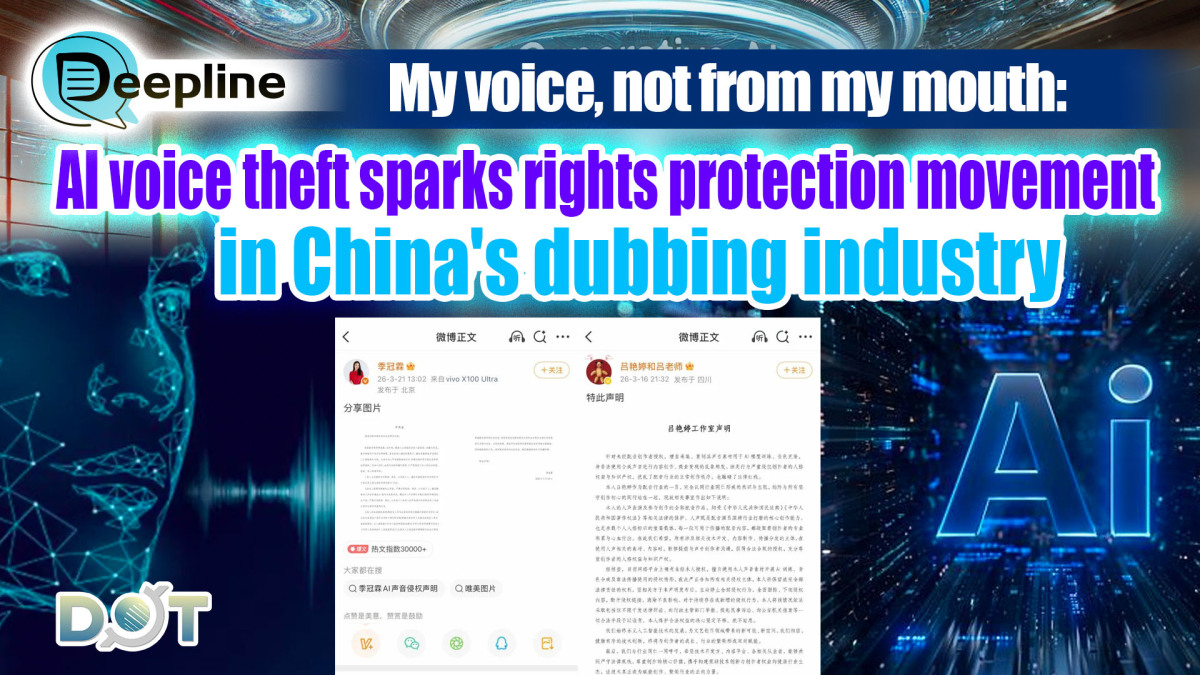
China's dubbing industry is now fighting a "battle to protect voices."
Since March of this year, voice actors from top organizations such as Bian Jiang Studio, 729 Voice Studio, and VOICE BEAR studio have issued joint statements condemning certain institutions and individuals for using their voices without authorization.
Shi Zekun, a voice actor from Bian Jiang Studio, has directly retained a lawyer to file a formal lawsuit and provided an email address to collect evidence of infringing works. In addition to actors affiliated with these organizations, several renowned voice actors have also joined the rights protection efforts.
The wave of collective rights protection has laid bare the chaos brought on by the unchecked growth of AI-generated voice technology.
In fact, the dubbing industry has long been plagued by unauthorized use of AI voices.
As early as 2024, in China's first "AI voice infringement case," the defendant company directly used a voice actor's voice in a commercial app for sale without authorization. The court ultimately ruled that the defendant had infringed the actor's rights by using the actor's voice without permission and ordered the defendant to pay 250,000 yuan (RMB) in damages.
Even so, AI voice infringement continues to spread unchecked online. Recently, many voice actors discovered their voices being used in AI-generated audio dramas and short videos without consent. Unable to tolerate it any longer, a large number of industry professionals have launched this high-profile collective action to protect their rights.
"I randomly opened a video and heard my own voice, but it wasn't me who recorded it," said Nie Fan, a voice actor. She noted that her studio has encountered multiple cases of infringement and is currently in litigation with some of the offenders.
"Illegally cloning someone's voice for derivative creations has become very common, and the producers often don't see anything wrong with it."
She also said that AI voice infringement is spreading across multiple platforms, with certain companies and individual accounts being the worst offenders. While these infringing works often target niche audiences and do not circulate widely, they persistently violate the rights of voice actors.
On social media, AI audio dramas often feature voices strikingly similar to those of well-known voice actors. Even Li Lihong, the narrator for A Bite of China, frequently has his voice "borrowed" for various food videos—a sign of just how widespread AI voice infringement has become.
Derivative works created through AI voice technology have also become a major area of infringement. A notable earlier case involved viral AI-generated covers of singer Stefanie Sun's voice. However, such content did not involve commercial gain, and it did not trigger widespread legal action.
An independent voice actor (identified as U) expressed a similar view, "Using an unauthorized cloned voice in commercial work is inappropriate. However, for non-commercial works, such as competition entries, using cloned voices with clear authorization seems less controversial."
As awareness of intellectual property rights grows within the industry, dubbing studios and voice actors are increasingly trying to avoid such infringements.
Amid the recent wave of collective action, creators who produce AI cover songs and similar derivative content have voluntarily stopped updating or taken down their works in support of the voice actors. For instance, a blogger with 36,000 followers on China's social platform Xiaohongshu, who rose to fame for AI-generated covers related to the game Love and Deepspace, announced on March 15 that they had removed their works and would cease updates. While some commenters expressed regret, most voiced support for the decision.
Even when voice actors choose to take legal action, they face significant obstacles.
In 2024, the leading dubbing studio VOICE BEAR handled a voice infringement case involving the AI voice software "Qianqianmiaoyin." Without authorization, the app used the voices of three affiliated actors from several video games to create similar AI voices.
The three actors immediately initiated legal action upon discovering the misuse. The process lasted half a year, ending only in December 2024 when the app removed the infringing voice sources and issued a public apology.
After winning the case, Xia Lei, one of the three voice actors, posted on his social media that while he had initially wanted to pursue the matter further, he decided to accept the apology after learning that the infringing party consisted of a few recent college graduates starting their own business.
A comment from Xie Tiantian, another voice actor among the three, captured the harsh reality of their efforts.
"The road is long, and I feel so powerless. They steal voices to make money, and once caught, they apologize. A few days later, they delete the apology and carry on as before. That's how it often goes, but we won't give up."
The hidden and complex nature of AI voice infringement further complicates rights protection. According to relevant documents and statements from an industry expert, the technical barriers and costs associated with AI voice technology are "extremely low." Today, deep synthesis technologies such as TTS and voice conversion models are widely available as open-source tools, making it possible to "clone" a person's voice using just tens of seconds of audio. In contrast, pursuing legal action is both time-consuming and expensive.
In addition, a commercial ecosystem has developed around AI-generated voices. Rights holders often struggle to identify the original party responsible for feeding data into the models, while downstream platforms frequently invoke the "safe harbor principle" to evade responsibility, further complicating the disputes.
Moreover, algorithms can "wash" voices. Some infringing parties slightly alter original vocal characteristics or merge multiple voices to obscure direct links to the original owners, making rights protection even harder.
Regarding the key legal standard of "identifiability," which is central to winning such cases, the expert noted that it involves three aspects: physical auditory comparison, public recognition, and distinct identity markers.
In a case the expert previously handled, when faced with ambiguous infringing content from the defendant, they used fan comments in bullet screens and discussion threads to point to a single identifiable individual, thereby establishing the connection. The nature of AI voice infringement can vary widely depending on the circumstances, potentially involving personality rights, copyright, personal information rights, or even unfair competition.
If a platform acts as an AI service provider and infringing AI voices have become widely disseminated or clearly associated with a specific individual, the platform may be found to have "actual or constructive knowledge" of the infringement. Should the platform fail to take timely action, such as deletion, blocking, or disabling access, it could be considered complicit in the infringement.
In addition to AI voice infringement, unauthorized use of likenesses has also become increasingly common. On March 19, media company Youhug Media announced the signing of two AI-generated digital artists. However, netizens pointed out that the digital artists appeared to combine facial features from multiple well-known actors, resulting in noticeable similarities to real celebrities.
Regarding whether such cases constitute infringement of portrait rights, some lawyers argue that the key factor remains identifiability. If an AI-generated image merely incorporates partial features of multiple celebrities without closely resembling any specific individual, and ordinary viewers cannot associate it with a particular person, it becomes difficult to establish infringement under the law. Celebrities in such cases would also face evidentiary challenges.
This practice of blurring the line between AI and real individuals mirrors the challenges commonly seen in AI voice infringement cases.
At its core, the collective rights protection effort by voice actors reflects a deeper anxiety within the industry. Unlike on-camera actors, voice actors rely on their voice as their primary identifying characteristic. While on-camera actors can connect with audiences through their physical appearance and screen presence, voice actors largely depend on their distinctive vocal qualities to attract and engage audiences.
From a broader perspective, the industry expert proposed a solution: replacing confrontation with collaboration. Content creators and industry associations could authorize large AI model companies to use high-quality existing data to advance technology. In return, creators would receive a share of the value generated in the new AI era.
"Helping traditional high-quality content ride the wave of AI to unlock dividends in the new era may offer more long-term value than clinging tightly to copyrights and pursuing difficult legal battles," said the expert.
(Source: newrankcn, 36kr)
Related News:
Deepline | When AI turns toxic, can regulation keep pace with deepfakes?
Deepline | Beyond messaging: Why Telegram, Slack, and Feishu are becoming new home for AI agents




Comment