






By Jason Harding
How does a play written 2500 years ago connect with a modern audience? The Asian premiere of a dance theatre production of Antigone at the 54th Hong Kong Arts Festival staged a provocative cross-cultural encounter. This radical reincarnation of Sophocles' play was advertised by the winter guests company as a "complete sensorial experience, a defiant celebration of our shared humanity, and a call to feel, question, and act." These heady ambitions are grounded in fundamental beliefs about the human condition.
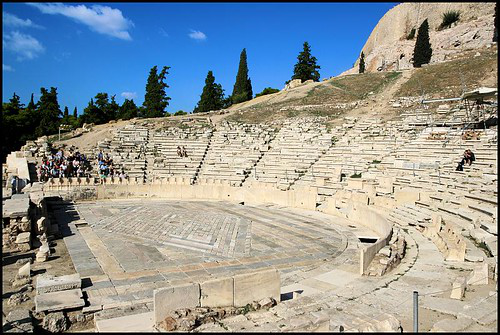
The first performance of Antigone took place around 441-2 BCE before fifteen thousand spectators seated in the open-air theatre of Dionysus, carved into the southern slope of the rocky Acropolis. Three actors wearing masks declaimed Greek poetry, dramatizing a mythological story accompanied by a chorus performing ceremonial dance and song.
Greek tragedy was the invention of ancient Athens. It evolved out of the religious rituals enacted at the spring festival of the Great Dionysia. If Athenian tragedy reworked myths set in an archaic past, it explored them in terms of contemporary issues and values, in an elevated but accessible language.
These plays spoke to an age of participatory democracy and imperial expansion, in which political and military leaders were drawn directly from male citizens (women and slaves were disenfranchised) to form a collective executive, arousing the resentment of those aristocratic families for whom democracy was a dangerous, unstable experiment.
"If there was one supreme hour in the fifth century BC," mused the renowned Oxford classicist Dr. Peter Levi, "perhaps it was that of the Antigone of Sophocles, which was composed while the Parthenon was being built." Throughout the flowering of Athenian tragedy, the city fought wars with Persia (modern-day Iran) and other Greek city-states, employing citizen-soldiers fighting in close-ranked phalanx formations, a ferocity born out of existential survival. This brutal reality helps to explain the Greek fascination with sacrifice and revenge, as well as their strong patriotic ethos and the sacred duty that all killed on the battlefield should receive an honourable burial.
Sophocles' Theban plays – Oedipus the King, Oedipus at Colonus, Antigone – examined the tragic fate of an enemy Greek city-state, Thebes, which frequently aligned with Sparta against Athens. In these plays, Thebes is wracked by plague and civil war as a consequence of the guilt of its royal dynasty, whose actions have offended the gods and provoked divine punishment.
Antigone is the tragedy of the daughter of the cursed King Oedipus. She sacrifices her life to honour the corpse of her brother, Polynices, a traitor to Thebes, refused burial rites by their uncle, King Creon, who has now ascended the throne. The play stages complex triangular debates over conflicting loyalties to family or state, with commentary on the events by the chorus.
After sentencing defiant Antigone to burial alive in a cave, Creon relents, but it is too late. Antigone has already hanged herself, followed by the suicide of her betrothed, Haemon, Creon's son, and then Eurydice, Creon's distraught wife. The blind prophet Tiresias had warned Creon that the gods predestined the extinction of his family line.
Greek tragedy unveils a stark, grim gaze into the abyss. In his brilliant essay on The Birth of Tragedy(1872), Friedrich Nietzsche argued that tragic drama represents the sublime confluence of Apollonian form and ecstatic Dionysiac suffering, offering consolation at the spectacle of cruel catastrophe.
A century after the performance of Antigone, Athenian tragedy acquired the status of a classic. In his Poetics, the foundational treatise of Western literary criticism, Aristotle singled out Sophocles' Oedipus the King as a masterpiece, praised for its sophisticated plot structure and for its psychological effect of cleansing the Athenian audience of the tragic emotions of pity and terror.
Sophocles' plays spread with Greek culture across the Mediterranean to Turkey, Egypt, Syria, and beyond in colonized territories to the border with India. Later Roman imperial elites embedded Greek tragedy in educational curricula, which were revived in creative ways during the European Renaissance, not least by William Shakespeare. His King Lear writes Antigone's drama of familial disobedience cascading into disastrous tyrannical decisions and the implosion of a dynasty.
In Antigones(1984), George Steiner estimated the play had been recreated hundreds of times in drama, opera, ballet, and art. Steiner claims it was prized in nineteenth-century Europe as the pinnacle of art. For example, the German philosopher Hegel, who never saw a performance, lectured influentially on Creon as a tragic hero, the guardian of the city, responsible for holding the Theban people together in political crisis, civic discord, and war. Hegel concluded: "Creon is not a tyrant; he is really a moral power. He is not in the wrong." For Hegel, tragedy is the product of dialectical conflict: it is the violation of powerful opposing rights that makes Antigone "the perfect exemplar of tragedy".
From the twentieth century, Antigone's thrilling defiance of patriarchal edict has made her an icon of feminism. Although Athenian tragedy presents mythic, dynastic heroines, this interpretation is anachronistic, since, as Sarah Pomeroy demonstrated in her study Women in Classical Antiquity(1975), Antigone is repeatedly referred to in the play using a masculine gender as a reproof for her behaviour, "characterizing the heroine who has become a masculine sort of woman."
Women were not considered full citizens in Athens. They had considerable involvement in religious rites and festivals but little cultural entitlement, and could not participate in the theatre. The role of Antigone herself was played by a man. It is significant that the chorus in Antigone – representatives of male Theban elders – condemns the sedition of this female protagonist as a fanaticism that drives ineluctably to the devastation of their beleaguered city. They scold her: "Your own blind will, your passion has destroyed you."
Most shockingly to an Athenian audience, Antigone, doubling down on her decision to honour her brother, says that she would not have done the same for a husband or child, rejecting the traditional duties of a Greek wife and mother. Scholarly editors have found this declaration puzzling because it diminishes her tragic stature in the eyes of the first spectators, to the extent some have doubted its textual authenticity. Sophocles' play, as it has come down to us, does not present Antigone in a straightforwardly positive light.
Disturbingly, she repays her sister Ismene's affection with hatred and contempt.
Irish author and politician Conor Cruise O'Brien interpreted Antigone as a cautionary play warning against the dangers of political extremism and violence. He had been the most senior UN diplomat at the 1961 Congo Crisis, which resulted in the murder of an independence leader and even the death of the UN Secretary-General. O'Brien judged Antigone as the sort of "troublemaker" whose self-sacrificial "death-cult" of martyrdom leads to an entirely preventable tragedy. Instead, he lauded Ismene for her moderation, "feeling for the living" and political good sense in recognising the legitimacy of state law. "But Antigone will not heed such calculations," writes O'Brien, "[she is] as dangerous in her way as Creon, whom she perpetually challenges and provokes."
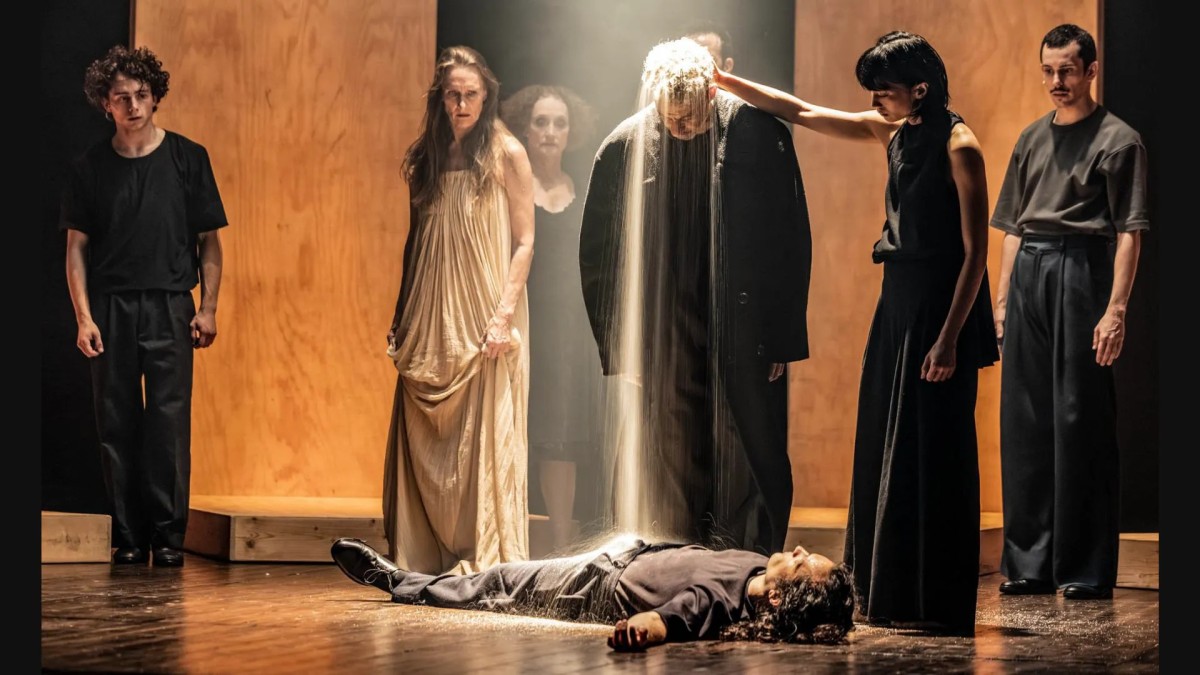
Today, we are encouraged to celebrate the rebellion of a strong woman. Antigone at the 2026 Hong Kong Arts Festival took as its cues the ideological contestation of power and the silencing of women. Winter guests proclaimed the relevance of its championing of the "righteousness" of victims of "political hubris" for our times. This clarified ideal is embodied by the choreography of director Alan Lucien Øyen in expressionist gestures of grief performed by an ensemble of nine dancers, each of whom represents an aspect of Øyen's vision of the "essence of womanhood". When the dancers break out of a funereal trudge around a gloomy stage arranged with seven imposing L-shaped wooden panels (symbolising seven legendary gates of Thebes), their energy is liberating. Meng-ke Wu's flowing, acrobatic struggle amid a swirl of controlling, caressing hands extending from half-naked hooded men is a striking visual metaphor.
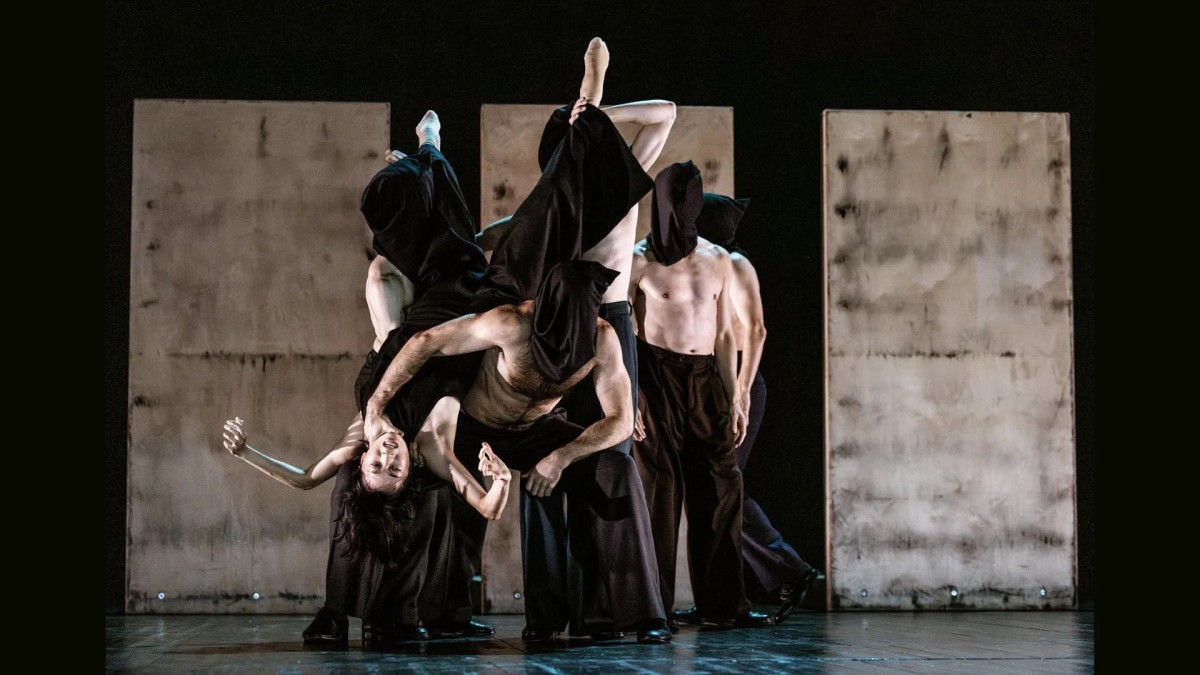
In truth, this performance – like the dance production of The Waste Land at last year's Hong Kong Arts Festival – has the slenderest connection with the canonical text from which it takes its name. Sophocles' coherent narrative development is abandoned for the freer, fleeting movements of Pina Bausch's experimental school of modern dance. A plain, spoken word English is distinct from the "restrained clarity of line [and] great and moving simplicity" that Dr. Peter Levi discerned in Antigone's dignified iambic trimeters. The sprinkling of modish cultural references to Alexa, X, and Britney Spears unsettles the severe mission of "righteousness" by which this production claims an affinity with Sophocles. This is neither tragedy on Aristotle's generic terms nor Nietzsche's spirit of tragedy directing a hard, undaunted stare at the suffering of destructive transgression.
Nietzsche deplored "the notion of the stage as an institution for the moral education of the people" since it led to a swift degeneration into tendentiousness and estrangement from the true purposes of art, which were manifest in the wisdom and aesthetic pleasure he experienced in Greek tragedy. Antigone endures through its drama, not didacticism.
Jason Harding is the Head and Professor of the Department of English at Lingnan University. He holds a PhD from King's College, Cambridge.
The views do not necessarily reflect those of DotDotNews.
Related Readings:
A Thousand Hamlets | Mapping Hong Kong: City of impermanence
A Thousand Hamlets | Hong Kong's spoken-word poetry communities: Nests of singing birds




Comment