






By Jason Harding
Hong Kong can be a lonely place. In a city of 7.5 million, a spirit of community is not easy to create, criss-crossing the MTR on long commutes to longer working hours while doom-scrolling on smartphones. A feeling of isolation, even alienation, can afflict city dwellers, young and old. Where do Hong Kongers find an environment of belonging in hectic, stressful daily lives?
Who hasn't experienced the cold shoulder of indifference in chance encounters in a big city like Hong Kong? The nineteenth-century French poet Charles Baudelaire registered this loneliness in the "Parisian tableaux" section of Flowers of Evil. Lost among crowds, Baudelaire suggested that "multitude" and "solitude" are interchangeable words. The sociologist Georges Simmel claimed that cities are places that bombard our senses, fragmenting interpersonal relationships, forcing individuals into a defensive emotional withdrawal he defined as "blasé". These forces have intensified in the digital age.
And yet, Hong Kong offers lively and captivating social gatherings. Take, for example, the welcoming spoken-word poetry scene where bohemian writers, rappers, and musicians mix with university professors and students after a busy day to enjoy a shared passion for each other's linguistic creativity and performance art.
The moments they create are anything but blasé.
These happenings have forged safe, supportive communities and authentic bonds of friendship in back-street, high-rise venues on Hong Kong Island and Kowloon. Hidden nests of singing birds, they represent a cosmopolitan blend of generations and cultures.
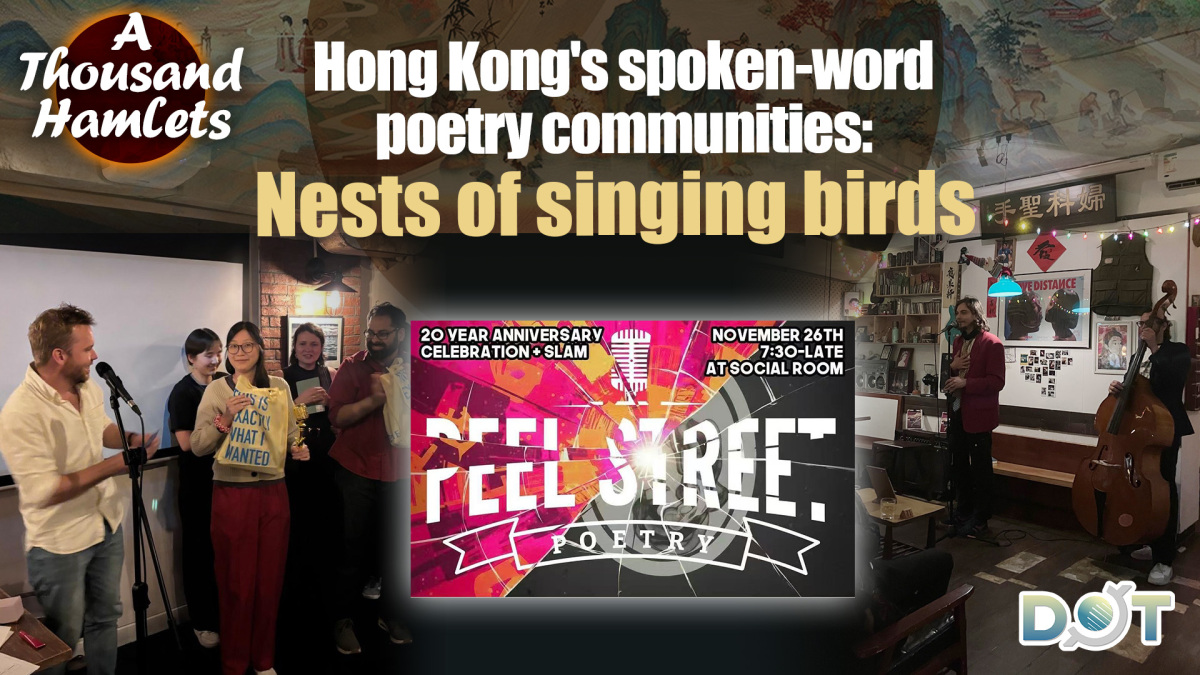
Peel Street Poets celebrated their 20th anniversary on November 26 with a competitive Slam at Central's Social Room. Situated next to the mid-level escalator ferrying bankers and corporate lawyers to one of the world's most competitive financial hubs, words are the currency elevating Peel Street Poets into prize-winning eminence; priceless laurel wreaths are crowned by their peers.
There were two intensive rounds. Each contestant was tasked to write a poem on given themes on the spot. They had 20 minutes to respond to phrases composed by notable Peel Street Poets, who recorded short video clips to provide inspiration for the event. All the finalists displayed an impressive array of personal styles of language and delivery, exploring themes with humour and wit, tragic confessions, empathy, and compassion.
Portia Yu was judged the most precious wordsmith for this resonant, beautifully recited poem responding to the prompt "But you won't find that in a dictionary":
I think I was a lightbulb in another life
I think I used to emit a glow
they switched me on and off
sometimes I was alive, sometimes it was dark
I dreamed of it, in the golden centre of my heartbreak, how I was
suspended in that quiet hollow in the middle of the night, where I
waited, hands fidgeting. It was the space where hours were still, minutes
were gelatinous, glass with bits of dust moving inside
This was a gummed up, rusted up fragment of my life, my filaments
unfurled into shreds of promises
There was no light to read by. It's like when you're in a crowd of people
and you have to admit you have no idea what love means
I had another dream that I ate the sun, and I was sated for a while
but when the curtains opened again, I was starved
I have no idea what love means
no one ever taught me
my mother once said she loves me because god tells her to
I don't know if this is true
there is a switch that I reach for in the dark
my skin is glass
words mean nothing
I turn them on and off and on and off.
Since 2005, when Peel Street Poetry emerged out of the more academic literary soirees at the nearby Fringe Club in Wyndham Street, this group has been distinguished by its cultural diversity and its openness to performers of all ages. Founded by a middle-aged Australian, Keith McMullen, and a teenage Hong Konger, Nash Gallagher, and launched in an artists' bar run by Beijing-born Joyce Peng and a Canadian, Rob Baker, Peel Street Poets has undergone several phoenix-like revivals over two decades before nesting in its current upstairs location at The Social Club.
Wednesday evening assemblies are overseen by the MC poet-impresario Henrik Hoeg, who calls performers and audience to order by clanging a metal spoon on a glass and bullish imperatives to "Clap, damn you, clap!" – two ingrained rituals enjoyed by the Peel Street Poets.
Spoken word poetry organised by OutLoudHK and Flow State exhibit similarly energetic and encouraging atmospheres. Each is distinctive in format. The oldest of these groups, OutLoudHK, established in the last millennium, has featured well-known Hong Kong poets, novelists, playwrights, university professors, and artists. "A Night of Fairytales" on December 3 at The Aftermath Bar in Wyndham Street was hosted by Jason Eng Hun Lee, a professor at Baptist University. The event showcased wide-ranging improvisations on this fantasy theme in spoken word and song. Musical duet and risqué poetry supplied memorable riffs on the art of fairytale and the telling of tall tales.
The vibe at Flow State, set up by Isaac Cheung and Lilli Chung, reflects the sassy decor at owner Fish's Yu Yin Club on Cheung Sha Wan Road in Lai Chi Kok. Performance at the December 12th open mic night was accompanied by a double bassist plucking various tempos from the melancholy cry of whales, flowing water rhythms, to the strident beats of Cantonese-style rap. The performers struck versatile notes, including nostalgia for a Hong Kong grandmother as well as edgy engagement with the environmental and social concerns affecting young people. MC Isaac Cheung did a skilful job of orchestrating the open mic talents of experienced regulars and bashful newbies.
What all these groups demonstrate is a hunger for lyrical performance and communal exchange that creates identity, meaning, and purpose in the labyrinth of a ceaselessly changing city. They draw inspiration and ideas from the kaleidoscopic city around them. Traditions of Chinese and English poetry have always been highly prized for the insights of their creative imagination. Poetry reshapes understanding of seemingly obstinate difficulties. Utopian and therapeutic, Hong Kong's cosmopolitan, socially egalitarian spoken-word poets speak in fresh, vibrant voices to audiences attracted by their warm, welcoming embrace. They are remarkable for the shared hope they generate.
Jason Harding is the Head and Professor of the Department of English at Lingnan University. He holds a PhD from King's College, Cambridge.
The views do not necessarily reflect those of DotDotNews.
Related Readings:
A Thousand Hamlets | The dialectic of fast and slow: Reflections on trains and railway travel




Comment