






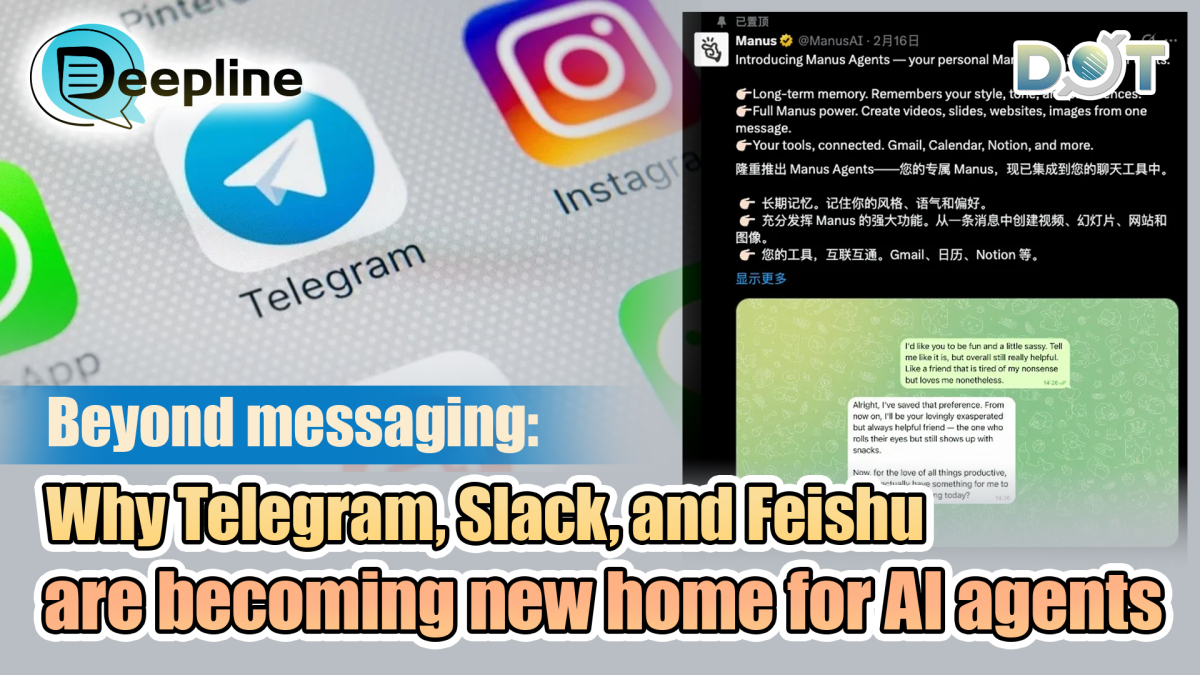
When AI agents need a "home," they do not move into standalone apps—instead, they move into chat software.
In February this year, Manus released its personal agent, choosing Telegram as its debut platform rather than its own WhatsApp.
Around the same time, Salesforce announced in January that the new version of Slackbot had officially launched; Feishu's open platform added support for AI agent workflow nodes and MCP tools; and on Discord, the number of AI bots has been rising rapidly.
This is, of course, thanks to OpenClaw. As one of the fastest-growing open-source AI projects, which grew from a weekend project to 100,000 GitHub stars, its default interface is not a web page or a standalone client, but Telegram.
Why instant messaging (IM) software? By opening the chat app they use most in their daily lives, users can "summon" an AI—a scenario that fits perfectly with the popular vision of "tech-infused living." However, the real answer lies in the architecture of agents.
The working principle of an AI agent is simple: it listens to user instructions, passes them to the AI for processing, and returns the results. This loop is a natural fit for the infrastructure of IM: persistent connections, real-time push notifications, and rich-text messages. The pipes that chat software has spent the past decade building for human-to-human conversations can be used by agents with almost no modification.
More importantly, there is a need for human-in-the-loop interaction. Current AI agents are far from being fully autonomous; they often require human confirmation before executing critical operations. A reply within a chat window feels far more natural than opening a new management console or logging into a separate dashboard. IM is inherently an interface for "approve/reject."
An even more decisive factor exists: users already live inside IM software. There is no need to download a new app or learn a new interface—the agent sits right in the conversation list they open every day, nestled between work group chats and family threads. This zero-migration cost is an advantage that few standalone AI products can replicate. For developers, it means customer acquisition costs approach zero.
However, not all chat software benefits equally from this trend. The key variable that determines who gets to reap the agent dividend first is the platform's openness. Telegram has become the first beneficiary of the agent wave not because it is the largest or most user-friendly, but because it offers the lowest barrier to entry for developers among all mainstream IM platforms.
Creating a Telegram bot requires just a few steps in a conversation with @BotFather—choose a name, get an API token, and start sending and receiving messages. No corporate verification, no approval process, no waiting for manual review. From zero to a working bot, people can complete the whole process within five minutes.
This is not just about registration convenience. Telegram's Bot API is designed to be highly developer-friendly, and more importantly, Telegram imposes very few restrictions on what bots can do—they can create groups, manage channels, handle payments, and perform a wide range of operations. This design philosophy of "bots can do almost anything a human can do" gives developers immense creative freedom.
OpenClaw chose Telegram as its primary interaction channel precisely because of this openness. In OpenClaw's official documentation, Telegram is the first channel detailed, with the most comprehensive setup guide and the most active community discussions.
Manus followed a similar logic when it chose Telegram as its launch platform in February. The fact that a Meta-owned product opted for Telegram, which has a much smaller user base than its own WhatsApp, shows that in the early stages of the agent era, openness matters more than user base size. WhatsApp requires real phone number verification, and its Business API has a complicated approval process that does not support large-scale commercial deployment—frictions that are too high for a fast-iterating AI product.
Still, Telegram's openness is a double-edged sword. The same openness that allows developers to create bots with zero barriers also makes Telegram a long-time breeding ground for gray-market activities.
In scans conducted in January and February, the security firm Bitsight discovered over 30,000 OpenClaw instances exposed on the public internet. In a newly surfaced "exposure dashboard," the number of exposed instances has reached a staggering 220,000. Many of these instances have their API keys and database credentials left exposed in default configurations, leaving security virtually nonexistent.
There lies a paradox: the very conditions that allow the agent ecosystem to flourish most quickly are also the ones that enable security risks to accumulate most rapidly. Moreover, this problem cannot be simply solved by "tightening approvals," because approval processes inherently raise the barrier to entry, and if that happens, Telegram's advantage disappears.
If Telegram represents the "get on board first, buy a ticket later" wild-west approach, Slack and Discord represent two different styles of "controlled openness."
Slack takes an enterprise-oriented approach, with deep integration of development tools through its Bolt framework. In January 2026, Salesforce announced the official launch of the new Slackbot, targeting Business+ and Enterprise Grid users, positioning it as "your personal agent for work"—supporting tasks such as finding information, analyzing documents, managing schedules, and generating summaries.
Slack's stance toward third-party agents is open but controlled: all bots must go through Marketplace review, data access is governed by clear OAuth scope restrictions, and enterprise administrators can finely control which bots are allowed into which channels.
Discord's bot ecosystem is equally mature, but its character is more community- and creator-oriented. Developers need to register an application in the Developer Portal and configure permissions (a few more steps than Telegram's @BotFather), but the process is far from the level of scrutiny required for enterprise IM. Discord's advantage for agents lies in the density of community-based use cases: Midjourney started as a Discord bot, and today, a large number of AI projects still use Discord as a dual entry point for both community engagement and product interaction. OpenClaw itself runs an active developer community on Discord.
What both platforms share is that they have installed a "speed limiter" on openness. For Slack, the speed limiter is enterprise compliance; for Discord, it is community governance. Compared to Telegram's laissez-faire principle, this means the agent ecosystem develops more slowly, but systemic risks are also lower.
For users in China, Feishu Open Platform is a case worth examining separately. Its approach to openness reflects the unique circumstances of Chinese IM platforms in the agent wave.
From a functional perspective, Feishu's agent infrastructure is catching up quickly: bots can read and write documents, send interactive cards with buttons and forms, trigger approval workflows, and create and manage calendar events. These are high-value capabilities for enterprise agent scenarios.
However, Feishu's openness faces two constraints:
The first is platform governance. Feishu's agent ecosystem is inherently B2B, rather than the hybrid C2C/B2C model seen on Telegram. Bots on Feishu operate within an enterprise application framework—developers need to create an internal enterprise app, and permissions must be approved by enterprise administrators. This makes it difficult for individual developers to "create a bot in five minutes" the way they can on Telegram.
Enterprise-level controls bring higher security, but the trade-off is reflected in the developer experience: friction in permission configuration, debugging, and deployment is significantly higher than on Telegram. This friction is not a flaw but a feature, yet it does slow the organic growth of the agent ecosystem.
The second constraint is ecosystem positioning. In the Chinese market, Feishu's main competitors are DingTalk and WeCom. All three are doubling down on agent capabilities, but along different paths: DingTalk tends to be tightly integrated with the Tongyi series of large language models, while WeCom leverages the massive user base of the WeChat ecosystem.
In addition, the IM landscape in China is more fragmented, requiring agent developers to adapt to multiple platforms simultaneously. This increases the complexity of ecosystem formation, giving incumbency advantage a decisive role.
The openness trade-off reveals not just the strategic differences among IM platforms, but a fundamental tension of the agent era: the more open a platform is, the more its agent ecosystem thrives, and the higher the security risks.
Today, every IM platform must find its position on this scale. How long this "second wind" lasts depends on a question for which there is still no standard answer: in the agent era, how open should a chat platform be?
Beneath the debate over openness, a more radical conjecture is taking shape among developers: when a single chat window can call upon any agent to perform any task, from booking tickets to programming to data analysis, it is no longer just a pipe; it is becoming a super-interface.
If we're being honest, this logic will feel familiar to a Chinese audience: isn't this exactly what our WeChat does?
Through mini-programs, payments, and government services, WeChat has nearly achieved "one app for everything" within a closed ecosystem. The model represented by OpenClaw points toward a mirror-image possibility: using openness and a global developer community to achieve a similar density of functionality within any IM.
Not recreating WeChat, but arriving at a functionally similar endpoint through an opposite path—open rather than closed, decentralized rather than platform-led.
Of course, this remains a conjecture, not a prediction. WeChat's success as a super-app relied on China's unique mobile payment infrastructure and user habits—conditions that do not exist globally on the same scale. More fundamentally, no one can yet answer whether an open ecosystem can achieve that level of service density without sacrificing security.
But if this direction proves correct, then IM's "second wind" will be more than just an interlude—it will mark the beginning of an identity shift: from a messaging pipeline to the universal interaction layer of the AI era. Whoever first finds a sustainable balance between openness and security will be the one most likely to define what this new species looks like.
(Source: Selina, ifanr)
Related News:
Deepline | 'Contradictions' of Unitree: Tech giant, marketing silencer




Comment