







While bringing convenience to human life, artificial intelligence (AI) may also be abused and even become a tool for crime. The Legislative Council (LegCo) discussed the issue of "combating the use of AI technology to create indecent images" yesterday (Jan. 28), with some Members believing that the SAR government should establish a legislative timetable for AI regulation as soon as possible.
In response to questions about AI-generated indecent images at the LegCo yesterday, Lillian Cheong, Under Secretary for Innovation, Technology and Industry, emphasized that although current Hong Kong laws do not specifically criminalize the creation of indecent images of others, if such actions involve the distribution of indecent images or infringe on personal privacy, existing laws can regulate them regardless of whether AI was used in the creation process.
On Jan. 22, Grok, an AI chatbot on the social platform X owned by US billionaire Elon Musk, was found to have generated 3 million indecent images of women and children within 11 days. In addition to Indonesia and Malaysia announcing bans on Grok, the European Commission has also launched an investigation into it.
To uncover the operations of deepfake groups, a Wen Wei Po reporter recently joined relevant Telegram groups and found that moderators frequently shared indecent images and videos generated using AI technology, nearly indistinguishable from real ones. Victims included not only well-known public figures, officials, and celebrities but also ordinary citizens and students.
A Ta Kung Pao reporter browsing various websites also discovered that many sites contained a large number of AI-generated pornographic or indecent images and videos. On one social media discussion forum, users daily posted AI-generated photos or short videos of seductive women, often with explicit content.
Last year, a male student from the Faculty of Law at the University of Hong Kong (HKU) was suspected of using AI software to generate over 700 nude and pornographic images using photos of more than 20 women. The victims included university classmates and secondary school teachers.
A friend of the student involved exposed the incident. However, after receiving complaints from affected female students, HKU concluded that no violation of the University of Hong Kong Ordinance had occurred and merely issued a warning letter and verbal reprimand to the male student.
During the LegCo meeting yesterday, Member Mark Chong inquired whether there are currently laws in Hong Kong prohibiting the use of AI technology to create indecent images. In response, Cheong pointed out that there is no specific offense under current legislation targeting the creation of indecent images of others. However, if there's a distribution of indecent images or privacy, multiple ordinances apply regardless of whether the creation process involves AI.
"For example, anyone who distributes or threatens to distribute intimate images without consent may violate Section 159AAE of the Crimes Ordinance, with a maximum penalty of five years' imprisonment. For criminal acts involving computers, the government will handle them using the offense of 'access to computer with criminal or dishonest intent' under Section 161 of the Crimes Ordinance. The publication or public display of items with obscene or indecent content, whether AI was used in their creation or not, is regulated by the Control of Obscene and Indecent Articles Ordinance."
Cheong further noted that to review whether laws in different policy areas are compatible with technological development, including the application of AI, the Department of Justice has established an interdepartmental working group.
For the creation of indecent images using AI, depending on the specific circumstances, such acts may be classified as crimes involving computer networks. The Sub-committee on Cybercrime under the Law Reform Commission will consult the public on its recommendations in due course after completing relevant research.
Also, Cheong noted that the Digital Policy Office has formulated the "Ethical Artificial Intelligence Framework" and the "Hong Kong Generative Artificial Intelligence Technical and Application Guideline" for reference by service providers, users, and developers. These guidelines stipulate that AI-related institutions and service users must comply with applicable Hong Kong laws and regulations to balance the promotion of AI technology development with the protection of public safety and privacy, among other needs.
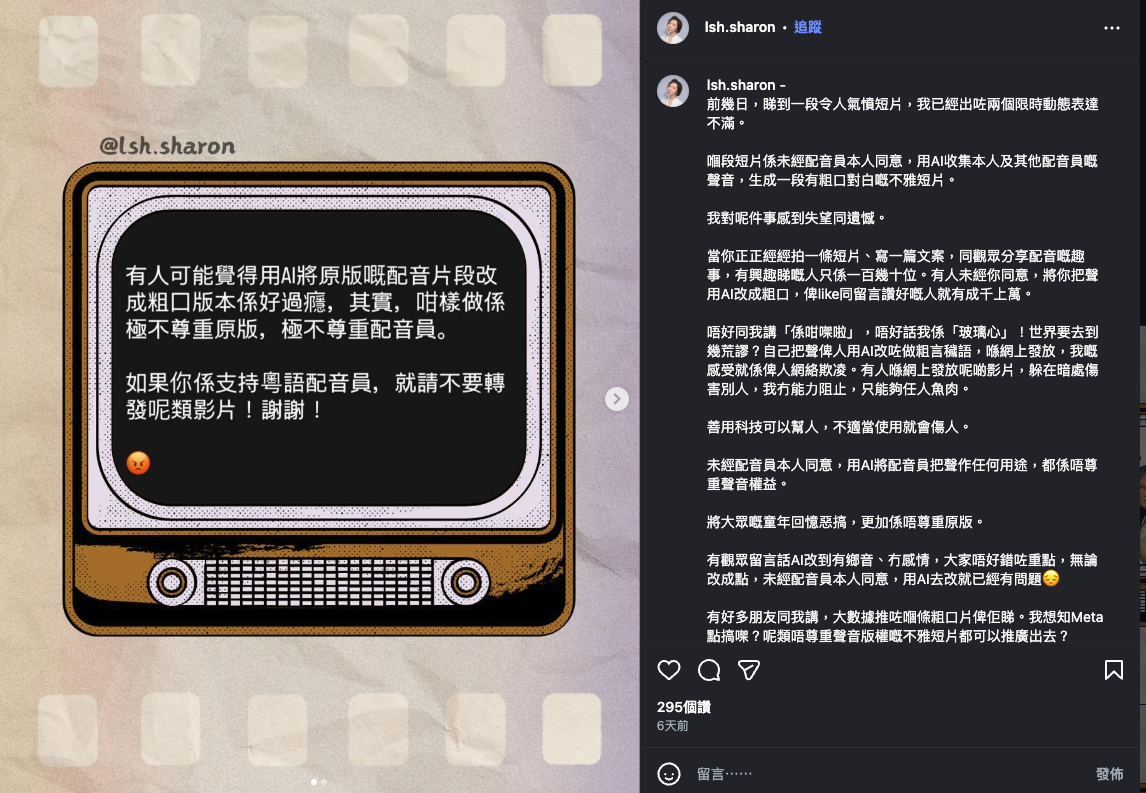
While AI-generated photos have sparked controversy, the issue of AI-altered videos has also drawn attention. Recently, an AI-generated parody video of "Doraemon" with profanity dubbed into it spread on the social platform Threads. The original content of the video came from a Cantonese-dubbed anime broadcast by TVB 11 years ago, but someone used AI technology to modify the voices of several cartoon characters and added a large amount of indecent dialogue and plot.
Sharon Leung, a renowned Hong Kong voice actress who dubs the character Shizuka in the anime, posted online expressing extreme anger after viewing the short video. She said that using AI to alter her voice for other purposes without her consent and parodying the childhood memories of the public is "extremely disrespectful to the original version and the voice actors," and using AI to alter her voice to include profanity made her "feel offended and subjected to cyberbullying."
According to Leung, two other voice actors whose voices were used in the video have passed away and cannot express their dissatisfaction even if they wished to. She urged the public to stop viewing and spreading such videos that disrespect voice copyrights and contain indecent content.
Jingle Tsang, a renowned Hong Kong voice actress who dubs the character Usagi Tsukino in "Sailor Moon," said in an interview that she opposes the use of AI dubbing. She believes that AI dubbing infringes on the rights of voice actors, and if used to generate indecent language, it could also damage the professional image of those voice actors.
Tsang hopes the SAR government will promote legislation to regulate voice copyrights in the application of AI.
The Labour Union of Dubbing of Hong Kong also stated on Jan. 9, strictly prohibiting the unauthorized use of voice actors' voices for AI technology purposes and reserving the right to pursue legal action against such behavior.
(With input from Ta Kung Pao, Wen Wei Po)
Related News:
Deepline | Hurun report: AI reshapes China's wealth landscape in 2025
Deepline | Double-edged sword! High AI adoption rates raise concerns over HK student independence




Comment