






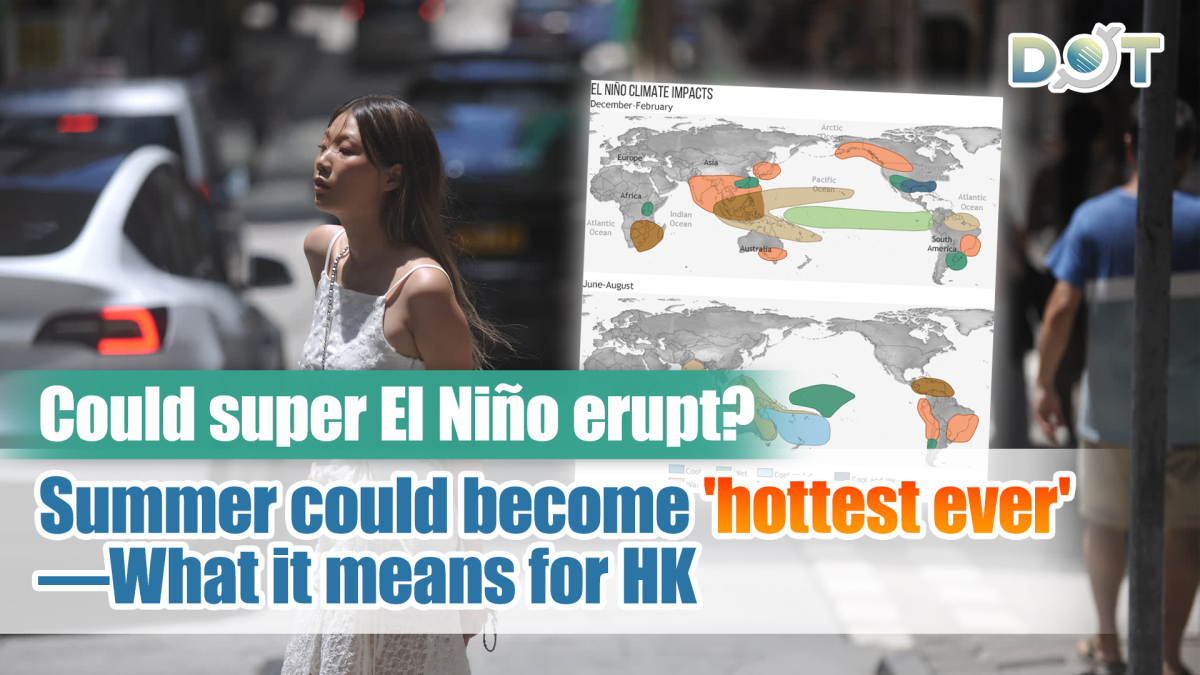
Recently, the Guangdong coastal region has been experiencing large temperature swings between morning and evening, with some netizens complaining that "mornings are chilly, afternoons are scorching." A mainland weather blogger even warned that "this year may see a super El Niño" and that "this year and next may become the hottest years on record," a topic that briefly trended on Weibo. What is a "super El Niño"? What would it mean for Hong Kong?
What is a "super El Niño"?
El Niño refers to a climate phenomenon in which sea surface temperatures in the eastern equatorial Pacific remain persistently above normal and cause anomalies in atmospheric circulation. It often triggers abnormal weather across many regions around the Pacific: some areas experience frequent heavy rain and flooding, while others suffer from high temperatures and severe drought.
The 2015 event is widely regarded as a "super El Niño" year. California experienced prolonged heavy winter rains, East Africa suffered severe flooding, and Southeast Asia saw frequent fires. That El Niño persisted for about 20 months, with monthly sea surface temperature anomalies totaling as high as 2.97°C, and it drove extreme heat and flooding in many parts of the world.
Recently, several international research institutions issued forecasts that a strong El Niño could develop later this year, disrupting global climate patterns. This could trigger extreme heat, floods, droughts and other hazards, and could further push up global temperatures, potentially making this year and next summer among the warmest on record.
Model forecasts differ
China's National Climate Center recently reported that the La Niña condition has tended to end and that the system will enter a neutral phase (i.e., neither La Niña nor El Niño). Historical statistics show that when a La Niña event ends, there is roughly a one-in-three chance that El Niño will develop in the same year.
However, international model forecasts differ on the timing of El Niño's onset: the earliest projections indicate April of this year, while others put it as late as late summer or early autumn. For example, the European Centre for Medium-Range Weather Forecasts forecasts April; Australia's bureau predicts May; the Japan Meteorological Agency predicts June; and a US expert poll expects July to September.
China's National Climate Center expects sea surface temperatures in the tropical central-eastern Pacific to continue rising, and that El Niño conditions are more likely in the latter part of this spring. Liu Yunyun, director of the Climate Prediction Office at the National Climate Center, told reporters that there is a greater likelihood of El Niño conditions in the equatorial central-eastern Pacific in the second half of this year, but that the precise timing and overall strength cannot yet be predicted accurately. She cautioned that it is still too early to conclude that this year will see a "super El Niño."
What would it mean for Hong Kong?
According to the Hong Kong Observatory, Hong Kong defines El Niño events using sea surface temperature anomaly indices for a composite Niño region. An El Niño event is defined as either: a sea surface temperature anomaly index of +0.5°C or higher sustained for at least five to six months; or the index remaining at +0.5°C or higher for five consecutive months with a cumulative anomaly of +4.0°C or more.
If El Niño occurs in winter (December–February) and spring (March–May), it can affect atmospheric circulation over the northern part of the South China Sea and typically brings increased rainfall to coastal areas of South China. Regarding tropical cyclones, fewer tropical cyclones tend to develop in April and May during El Niño years, and their genesis locations are generally further east in the northwest Pacific; therefore, tropical cyclones usually do not affect Hong Kong before June.
In its latest report on El Niño and La Niña, published in February, the Observatory noted that, over the past month or so, sea surface temperatures over the central and eastern equatorial Pacific have risen and overall remained close to normal. Based on the latest ocean observations and forecasts from multiple climate models worldwide, the Observatory expects the central and eastern equatorial Pacific to continue warming through spring 2026. Sea surface temperatures in that region are expected to remain near normal for the remainder of this winter, and to be in the normal-to-above-normal range by spring 2026.
Related News:
Mao Hamasaki announces HK residency: Fans flood social media with recommendations
Watch This | Water buffalo struck on highway, collapses and rolls—AFCD removes with tranquilizer




Comment