






By Cai Zongqi
The Chinese New Year, commonly known as the Spring Festival, is a compendium of traditional rites and practices that have traversed time and space to thrive in some East Asian and Southeast Asian countries as well as the Chinese-speaking world. Its festive cycle unfurls with the "Little New Year" on the twenty-third day of the twelfth lunar month, a preliminary observance that signals the formal start of the season's celebrations and sets the tone for what follows.
Among the first and most emblematic rituals is the thorough housecleaning. In an actual sense, people sweep and scrub every corner of the home; in a symbolic sense, they "sweep away the old and welcome the new," casting off the misfortunes and ill luck of the past year to make room for auspicious beginnings.
On New Year's Eve, families gather for the much-anticipated reunion dinner, the emotional and ceremonial heart of the Spring Festival. The dishes on the festive table, too, are laden with meaning: fish, signifying "surplus year after year" through a homonym; dumplings, whose shapes evoke the ancient gold ingots that symbolize wealth; and New Year rice cakes, which convey the hope of "rising higher with each passing year."
After the meal, family members keep vigil into the night, and as midnight approaches, the staccato crackle of firecrackers rises and falls, meant both to drive away malevolent forces and to herald the arrival of a new year. Beginning on the first day of the lunar year, people visit relatives and friends, exchanging warm greetings and blessings, while children, to their delight, receive lucky money in red envelopes.
Spring Festival couplets—duilian—constitute a literary form unique to China and bear the weight of people's best wishes for the year ahead. A complete set consists of an opening line (usually placed right, from the viewer's perspective), a closing line (placed left), and a horizontal scroll, all composed with careful attention to balanced parallelism and a harmonious pattern of tones. The themes of these couplets commonly express hopes for prosperity, good health, family harmony, and success in one's endeavors. A frequently seen pair reads, "At the gate we welcome the blessings of spring, summer, autumn, and winter; into the household we receive wealth from east, west, south, and north," an elegant encapsulation of the yearning for blessings from every direction and through all the seasons.
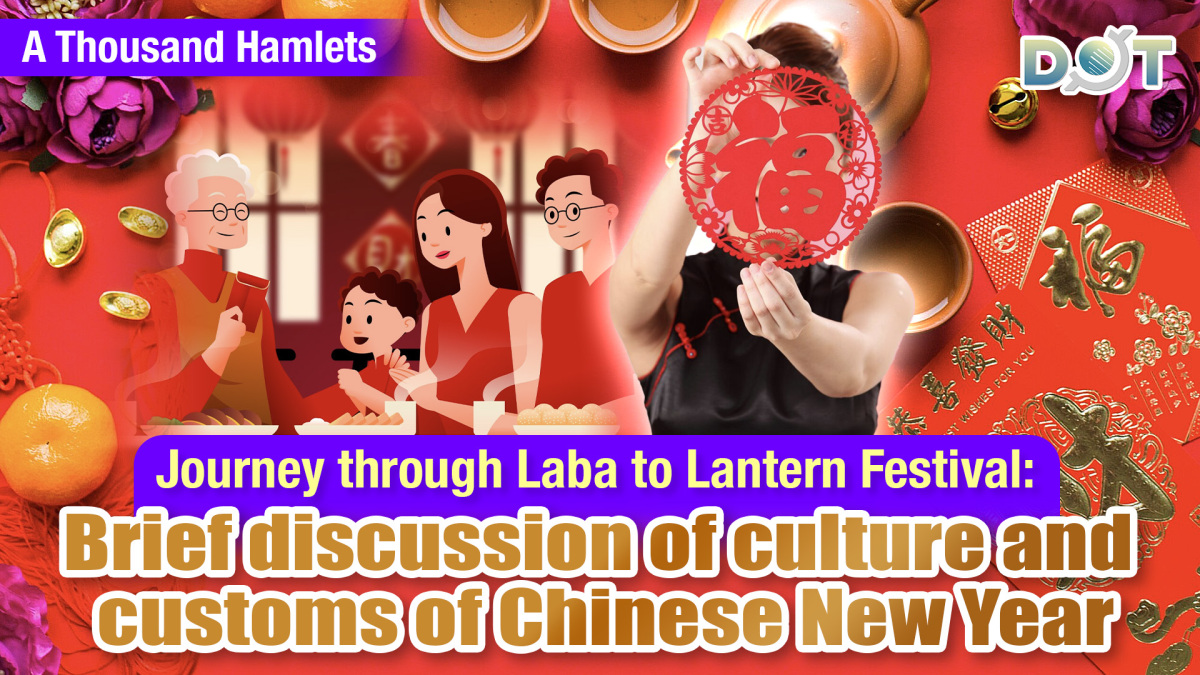
Accompanying the couplets is the finely wrought art of paper-cutting. With nimble hands and keen eyes, artisans cut auspicious motifs from red paper: the character fu, meaning "good fortune"; pomegranates that symbolize many sons and grandsons; and fish that convey the wish for abundance year after year. These paper-cuts are often pasted onto windows and are thus known as "window flowers." When sunlight filters through these crimson patterns and falls upon the floor, the room is scattered with auspicious images, suffusing the interior with a heightened sense of festivity and joy.
Poetry is an indispensable artistic element within the culture of the New Year. From ancient times onward, men of letters have left many beloved verses that have become part of the season's shared memory. In "Reflections on New Year's Day" (元日述懷), the Tang poet Lu Zhaolin wrote, "May it ever be thus; may the seasons' blessings be new year after year" (願得長如此,年年物候新), giving voice to the simple, enduring wish that good times might abide. In "A Farmer's New Year's Day" (田家元日), the Tang poet Meng Haoran captures the agricultural household's hope for a bountiful harvest: "The farmers read the signs of the weather; All say this year will be bountiful" (田家佔氣候,共說此年豐), binding the Spring Festival closely to the rhythms and aspirations of agrarian life. Among the numerous ancient poems celebrating the New Year, the most famous is perhaps Song poet Wang Anshi's "New Year's Day" (元日): "Amid the crackle of firecrackers, the old year is seen off; the spring breeze brings warmth to the Tusu wine. As the bright sun shines on thousands upon thousands of households, all replace the old peachwood charms with new ones" (爆竹聲中一歲除,春風送暖入屠蘇。 千門萬戶曈曈日,總把新桃換舊符). This poem vividly depicts the festivity of the Spring Festival—setting off firecrackers, drinking Tusu wine, replacing old charms with new peachwood charms—evoking a jubilant holiday atmosphere. Even a thousand years later, we can still read in it that upbeat, life-filled spirit.
The Spring Festival is not merely a holiday native to China; around the world, its celebrations continue the transmission of Chinese traditional culture. From the lively street parades in San Francisco to the festivities in London's Trafalgar Square, Chinese culture is carried to many corners of the globe. These events attract not only members of the Chinese diaspora but also, increasingly, the enthusiastic participation of local residents. In Hong Kong, a place where Chinese and Western cultures meet, Spring Festival celebrations are especially distinctive. From the bustling Chinese New Year flower markets to the blessing rituals at Wong Tai Sin Temple, tradition and modernity intermingle, coming together to form a cultural panorama that is uniquely the city's own.
Cai Zongqi is the Director of the Advanced Institute for Global Chinese Studies and Lee Wing Tat Chair Professor of Chinese Literature of Lingnan University
The views do not necessarily reflect those of DotDotNews.
Related Readings:
A Thousand Hamlets | Mapping Hong Kong: City of impermanence




Comment