






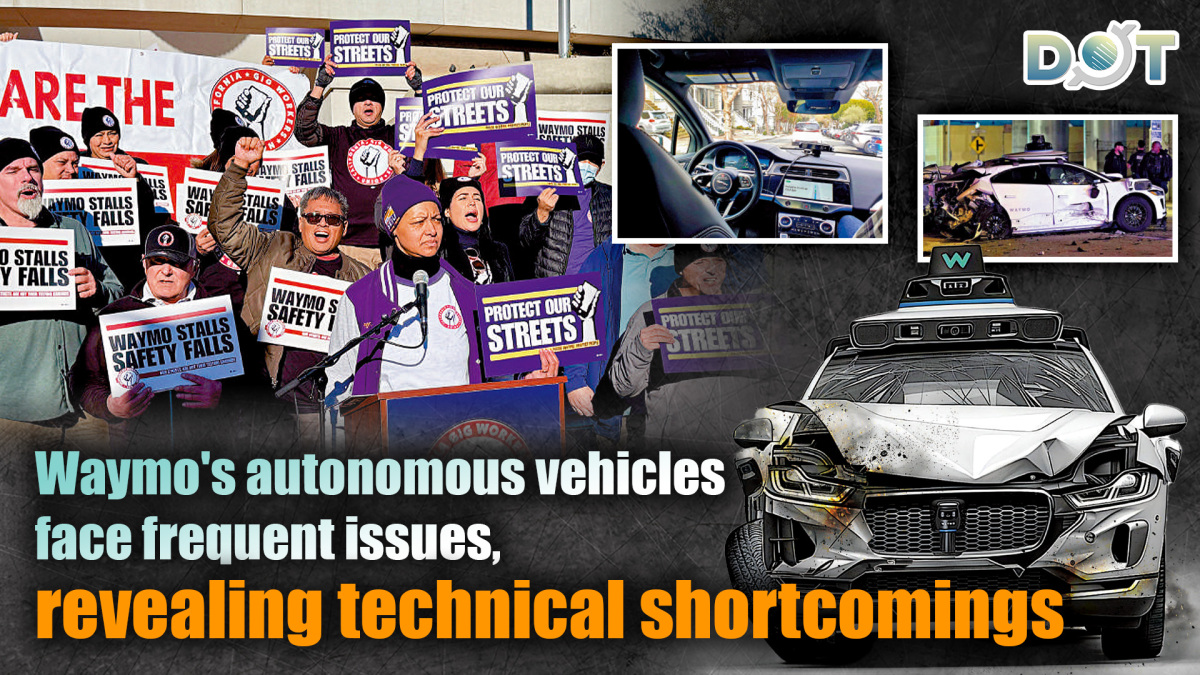
As autonomous vehicles reshape the global transportation industry, 2026 is widely seen as a pivotal year for the development of robotaxis. However, a massive power outage in San Francisco late last year exposed critical weaknesses in the technology, when multiple Waymo vehicles — owned by Google's parent company Alphabet — came to a standstill on roads and intersections, drawing widespread attention. Analysts suggest that while autonomous driving technology has advanced, its ability to assess and respond to complex and emergencies still requires improvement, and in some cases, human intervention remains essential. A California passenger told Ta Kung Pao that her experience riding a Waymo was fraught with complications, describing the technology as insufficiently comprehensive and the service as poor.
On Dec. 20 last year, a fire at a substation triggered a large-scale blackout in San Francisco, knocking out countless traffic lights across the city. Videos circulating on social media showed multiple Waymo robotaxis stopped at intersections and in the middle of streets, unable to navigate without functioning traffic signals, causing severe gridlock and forcing other vehicles to find alternate routes.
Waymo later explained that its system is designed to treat unsignalized intersections as "four-way stops," requiring extended periods to "observe" and confirm the right-of-way sequence. Simultaneously, a surge of vehicles sending confirmation requests overwhelmed the backend processing capacity, leaving the cars "waiting for instructions" and stranded for extended periods.
Waymo Takes Wrong Route, Passenger Forced to Break Branches to Free Vehicle
Zoey, a Chinese resident living in the San Francisco Bay Area, shared her frustrating experience riding a Waymo. On Jan. 26 this year, Zoey used Waymo's ride-hailing service for the first time. Although the journey lasted only five minutes and she arrived safely, she was nervous throughout, worried about potential deviations in the vehicle's navigation. On her return trip, Zoey's experience took a turn for the worse.
Zoey explained that after boarding from a parking lot, the conventional route would have simply required the vehicle to turn around and exit. "Instead, it (the Waymo) insisted on taking a small path behind the parking lot — a route people never use." The vehicle then detected an excessive number of trees and low-hanging branches along the path and "dared not proceed." "The car just stopped. The screen showed backend intervention, but in reality, it only reversed and moved forward in place," she said. Zoey tried to contact customer service, but after waiting 10 minutes, the system finally notified her that a rescue team would arrive in 40 minutes. "My trip was only five minutes long — I was so angry I felt like driving it myself."
According to Waymo's official guidelines, its vehicles remain in autonomous mode at all times. Even when issues arise, only remote human assistance can be requested, with operators sending commands to help the vehicle, but direct human driving is not permitted.
Ultimately, Zoey decided to get out and break the branches. "But I was afraid that as soon as I broke them, the Waymo would recognize the path and drive off without me. So I held the door open, snapped the branches, and immediately got back in." "Sure enough, once it sensed the path was clear, it continued on its way." Zoey expressed helplessness over the experience, pointing out that Waymo's driverless technology remains insufficiently comprehensive and its service is "very poor." She said she would not want to use such robotaxis again in the future.
Backend Operations Rely on Hundreds of Philippine 'Cloud Drivers'
Other incidents, such as a Waymo vehicle continuously circling a parking lot last year with a passenger trapped inside, unable to even unbuckle their seatbelt, have also highlighted the technical limitations of the autonomous driving industry, which still requires "human backup."
In the case of Waymo, its driverless cars rely on complex LiDAR, cameras, and radar systems to interpret their environment and make decisions. However, if map data is outdated or inaccurate, the vehicle may struggle to find the correct path. Environmental factors such as heavy rain, thick fog, or snow can also interfere with sensors, leading to navigation errors. Moreover, real-world road conditions are always unpredictable, and unexpected issues like temporary road closures or detours can confuse autonomous systems that lack updated information.
On Feb. 4 this year, Waymo Chief Safety Officer Mauricio Peña testified before a U.S. Senate hearing, acknowledging that the company's driverless vehicles rely heavily on a large number of "cloud drivers" — remote operators — who monitor vehicles to ensure they can navigate special situations. These operators are mostly contract workers, with a significant portion based in the Philippines and other regions more than 10,000 kilometers away from the United States.
Senator Ed Markey of Massachusetts called this situation "completely unacceptable," noting on one hand the potential safety risks posed by network latency from operators located half a globe away, and on the other hand, the security concerns raised by outsourcing critical transportation-related jobs overseas.
(Source: Ta Kung Pao)
Related News:




Comment