






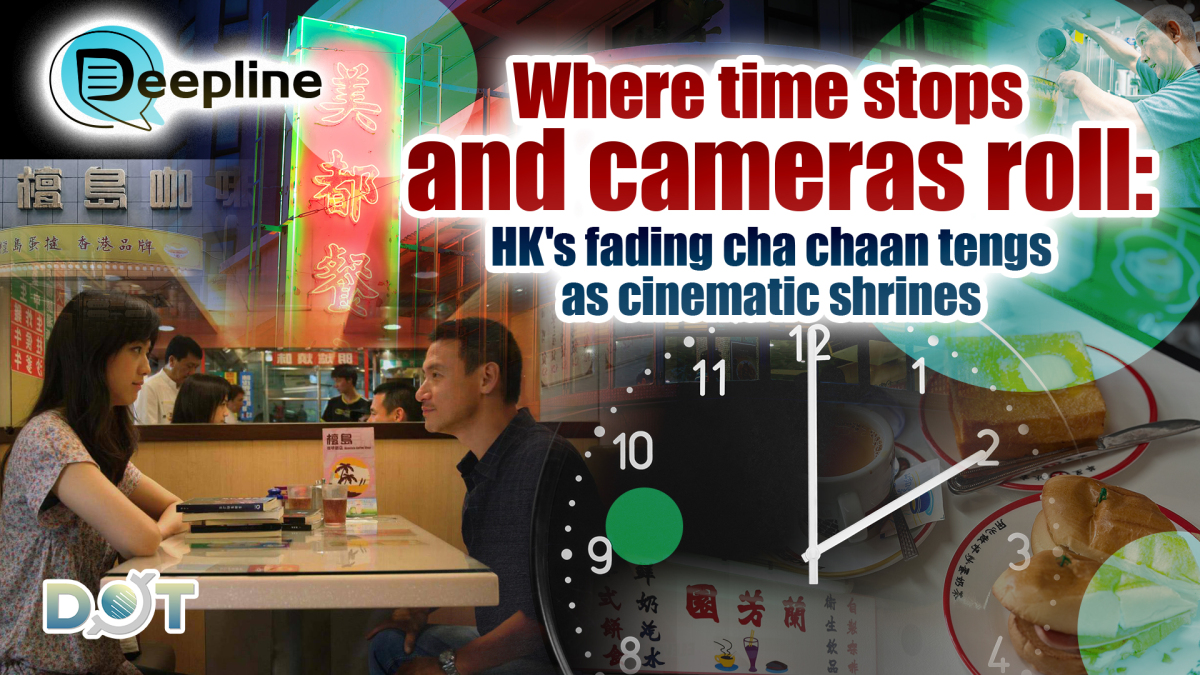
As times change, elements of traditional Hong Kong culture are gradually fading away, including time-honored restaurants, historic buildings, and neon signs. Distinctive cultural symbols are also diminishing; the unique character of old Hong Kong—shaped by a mix of historical influences—is now in decline due to shifting social structures, urban development, and labor shortages. Yet, to describe Hong Kong cinema's enduring legacy as "legendary" is by no means an overstatement. Even today, the fragments of this city captured on film continue to carry a distinct sense of time and cultural memory.
Among the most iconic settings in Hong Kong films are cha chaan tengs and bing sutt (Hong Kong-style Café). Columnist Ma Ka-fai once described the cha chaan teng as "neither fully Chinese nor Western, yet both at once. Serve wonton noodles and foie gras, Indian flatbreads, Vietnamese rice noodles, and Thai-style river noodles—encompassing the world between chopsticks, spoons, knives, and forks. A globalization in miniature." In this sense, the cha chaan teng acts as a microcosm of Hong Kong society.
Yet, even the culture of cha chaan tengs and bing sutt is fading at the margins. The bing sutt once served as social spaces and provided respite from the heat. But with the rise of modernization and fast-food culture, traditional bing sutt have declined. Many have been demolished to accommodate urban renewal, and those with distinct Hong Kong-style diner features face the threat of disappearance. These establishments form the core of Hong Kong's unique identity—they embody the city's spirit and community memory, and are irreplaceable cultural assets.
Mong Kok's Hung Wan Café has become a favored filming location for numerous classic Hong Kong movies due to its vivid representation of traditional local food culture. Among the most fondly remembered is Stephen Chow's The Lucky Guy, where the ice house served as a key setting for countless comedic moments. Intense triad confrontations in Election 2 (starring Simon Yam, Louis Koo, and Nick Cheung), as well as the recent Rob N Roll—featuring a negotiation scene between Gordon Lam and Nancy Wu—were all filmed within the story-rich walls of this establishment.
Pushing open its doors transports visitors back to the 80s and 90s. Staff in signature white uniforms bustle about, serving milk tea and meals. Patrons slowly sip their tea and chat while reading newspapers. Time seems to have forgotten this place—the traffic outside and the tourists passing by feel entirely removed. Honestly, it's hard to find bad food here. Egg tarts, iced milk tea, sizzling steak platters, and French toast—no room for disappointment.
When the café announced its closure last year, a wave of nostalgia swept through fans and longtime patrons. Many made special trips to bid farewell to this cherished establishment that had grown alongside generations of Hongkongers. Now, following a thoughtful revitalization, Hung Wan Café has retained its original soul while incorporating innovative elements, allowing this living fossil of Hong Kong cinema to continue its legendary legacy.
As early as the 1960s, Hong Kong's distinctively atmospheric restaurants had already appeared in films. The 1960 Anglo-American romantic drama The World of Suzie Wong, for instance, shot scenes outside the Mido Café on Temple Street. In one scene, as William Holden's character Robert Lomax passes through Temple Street, a multi-story building can be seen behind him—it was the Mido Café as it appeared over sixty years ago. Beyond this, The World of Suzie Wong was filmed at various iconic Hong Kong locations, including the Star Ferry Pier, Central, and Wan Chai. It also documented many now-vanished cityscapes, offering a visual record of Hong Kong in the late 1950s.
Mido Café first opened its doors in 1950 and still retains the interior décor of an old-school ice house from the 1950s and 60s, exuding a rich Hong Kong atmosphere. The artistic signage at the entrance is a hallmark of the ground floor, while the row of green iron-framed windows on the second floor has become its signature design feature. Sunlight streams through the stained glass, casting a particularly warm glow. Time flows on, but Mido Café has remained standing at the corner tong lau of 63 Temple Street for over seventy years.
For more than seven decades, it has felt as though time itself has come to a standstill within its walls. The café's nostalgic décor has made it a popular filming location for movies and TV dramas. In 2017's Chasing the Dragon, starring Donnie Yen and Andy Lau, several period-specific scenes were either inspired by or shot at the venue.
According to Elaine Chu, CEO of Milkyway Image (Hong Kong) Limited, filmmakers often choose to shoot in restaurants that have already closed but not yet been demolished. As a result, it is not uncommon for such settings to be lost over time.
Nevertheless, some cinematic settings captured in restaurants now exist only in memory. Cheung Lee Restaurant, which closed in 2010, was once a filming location for Sparrow and Dragon Loaded 2003. Similarly, the Goldfinch Restaurant, famed for its appearances in Wong Kar-wai's 2046 and In the Mood for Love, ceased operations in 2015. So many settings—much like the long-gone Kowloon Walled City—have quietly drifted into the currents of time, swept away by rapid urbanization, never to be seen again.
(Source: Wen Wei Po; Journalist: Wu Sin)
Related News:
Deepline | China Travel in Chinese New Year: How foreigners immerse themselves in Spring Festival




Comment