






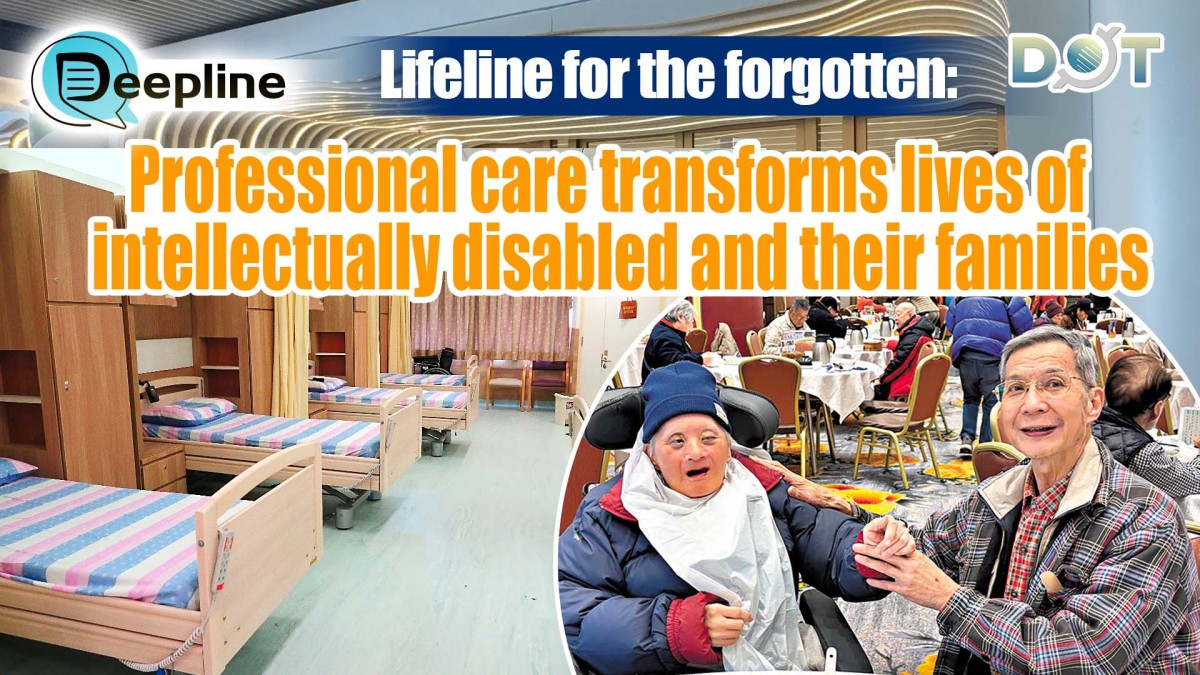
Individuals with moderate to severe intellectual disabilities often lack essential daily living skills, requiring caregivers to invest immense effort each day in attending to their basic needs—food, clothing, shelter, and daily routines. Over the years, caregivers not only endure accumulated stress and anxiety but also face aging and diminishing capacity to continue providing care. Timely professional services are, therefore, especially invaluable to them.
Recently, a Wen Wei Po reporter visited the Haven of Hope Ming Tak Day Activity Centre and Hostel, listening to family members of intellectually disabled residents share their real-life experiences. One individual spent the greater part of their life caring for an intellectually disabled younger sibling, only realizing they couldn't ensure their sibling's safety alone after the sibling went missing three times. Another person expressed gratitude for the hostel staff's attentive observation, which led to the timely diagnosis and treatment of her son's stage three colorectal cancer.
Representatives of the hostel emphasized that its existence is not only to provide a haven for residents but also to build a support network for caregivers, ensuring they are not alone on the difficult journey of caregiving.
Now 47, Chun-hung has lived at the hostel for over 20 years. His mother recalled that due to her and her husband's advancing age, they worried about being unable to provide care for their son. "At the time, my feelings were conflicted. I was afraid my son wouldn't adjust, and I couldn't bear to be apart from him. But my body could no longer handle the strain, so I had to decide for him to enter the hostel."
To her relief, Chun-hung has lived happily at the hostel. The staff frequently shares updates about his daily life through photos and, through group activities, discovered his talent for painting. "The hostel is like a second home for my son, and the staff here are like his family," she said.
What moved her most was an experience in 2024. In December of that year, Chun-hung was diagnosed with cancer. Although she brought him home every week, she never noticed anything unusual due to his difficulty expressing himself. It was only when Chun-hung showed signs of poor appetite and vomiting that the attentive staff noticed something was wrong and immediately sent him to the hospital. He was then diagnosed with colorectal cancer. Fortunately, the doctor said he was brought in just in time, and after treatment, Chun-hung gradually recovered. His mother said tearfully, "The hostel staff were so observant, giving my son a new lease on life."
Another resident, 63-year-old Kwai-ming, has relied on his older brother Tsui since childhood. Tsui always saw caring for his intellectually disabled brother as his life's mission, believing only he could care for him properly. However, as Kwai-ming's condition changed, his temper grew, and he became less compliant. He went missing three times, with the most serious incident involving him traveling alone from Wong Tai Sin to the Sha Tin Racecourse, where he was found three days later, which made Tsui realize he could no longer ensure his brother's safety.
Through a referral from the Social Welfare Department (SWD), Kwai-ming was admitted to the hostel. Tsui admitted that although he was initially worried, he now sees the hostel as a second home. "Seeing my brother happy here, receiving professional care, the weight in my heart has finally lifted," he said.
Having cared for his brother for many years, Tsui never married. Even simple social activities like dining with friends were unimaginable for him in the past. Only after Kwai-ming received care at the hostel could Tsui breathe a sigh of relief and go out for meals with friends. He even plans to bring his brother home for Chinese New Year reunions with the support of hostel staff. For this purpose, the hostel's therapist specially made wooden boxes and racks to facilitate Kwai-ming's home visits in his wheelchair.
In an interview with Wen Wei Po, Steven Tsoi, General Manager of Operations at the Haven of Hope Ming Tak Day Activity Centre and Hostel, stated that maintaining a sense of "home" hinges on communication—staying in constant contact with families to report on care methods and residents' lives. He also observed that more families now recognize the importance of professional care, particularly for intellectually disabled individuals, which requires specialized knowledge and skills. He hopes that the combination of professionalism and genuine care at the hostel can gradually break down society's stereotypes and highlight the value of residential care.
(Source: Wen Wei Po; Journalist: Wu Jianyi)
Related News:
Deepline | Let us all unite! Over HK$1 bn raised for Tai Po No. 5 fire victims




Comment