






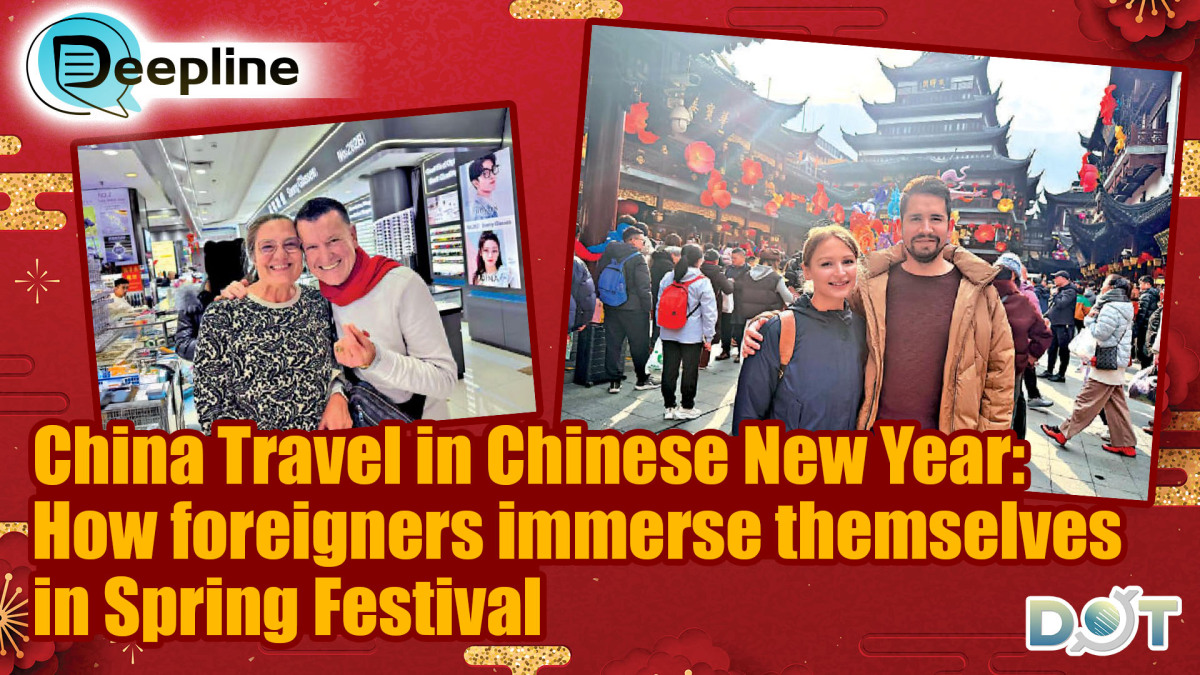
As China's visa-free policy continues to expand, "celebrating the Spring Festival in China" has become a new global travel trend. According to data, inbound travel orders for the 2026 Year of the Horse Spring Festival have seen explosive growth. In the past two weeks, flight bookings to China by foreign tourists surged more than 400% year-on-year, with several European countries posting increases of over 200%. From shopping for New Year goods, browsing festive markets, to admiring lantern displays, a growing number of international visitors are following the scent of Chinese New Year traditions, immersing themselves in an authentic, warm, and lively Chinese celebration.
"This is a must-visit if foreigners come to Beijing!" As Spring Festival approaches, the Hongqiao Market, located just south of the Temple of Heaven in Beijing, has entered its busiest season of the year. Once dubbed by foreign media as "Beijing's most international pearl market," it is also a popular destination for overseas travelers visiting China. From world leaders to backpackers, countless visitors have taken home their cherished gifts from China from this bustling marketplace. Spanning five floors, the market brims with pearls, silk scarves, and handicrafts, attracting a diverse crowd where multiple languages fill the air. More than just a market, it feels like a microcosm of a diplomatic salon.
"This is my first time in China," said Anton, a visitor from Russia, while selecting a silk scarf. He had done extensive research in advance, not only preparing a shopping list but also learning a few simple bargaining phrases in Chinese. In addition to buying souvenirs for himself, he carefully chose New Year gifts for his family—pearl earrings for his mother, and an embroidered pouch and handmade ceramic ornament for his sister.
"China is really cool," he said, "It has both ancient culture and modern vitality."
Turn our attention to Shanghai: The 2026 Yuyuan Lantern Festival in Shanghai is now illuminated, and the Yuyuan Garden is packed with visitors day and night. Amid the crowds, exclamations of admiration in various languages can be heard at every turn.
Tina from Romania first visited China nine years ago, traveling to Beijing. This time, she came to Shanghai and was captivated by the traditional architectural beauty of Yuyuan Garden—a place of special interest to her as an architecture student. The vibrant lantern display further immersed her in the festive spirit. "I really love how deeply the Chinese people carry the Spring Festival in their hearts," she said.
Earlier this year, both the British Prime Minister and the President of Uruguay visited the Yuyuan Lantern Festival. The high-profile visits quickly became a trending topic in international media, further elevating the festival's global profile. Gabriele from Germany took time off to travel to China and reunite with her husband, Pedro, from Ecuador. "It's beautiful here. For foreigners, Yuyuan is definitely one of the must-visit places in China," Pedro remarked, adding that the visit left him deeply impressed.
Today, foreign visitors seeking to experience the Chinese New Year are eager to immerse themselves in hands-on activities: they wander through Beijing's hutongs, observing households paste up couplets and hang lanterns; they learn to make tangyuan and jiaozi (Chinese dumplings) alongside Chinese families. At the Qianmen commercial district in Beijing, many international tourists gather around inheritors of intangible cultural heritage, earnestly learning to write the character "Fu" (blessing) and cut paper window decorations. Every stroke of the brush reflects a sense of novelty and fascination.
On Chinese social media platform Xiaohongshu and international short-video platforms like TikTok, content related to the Shanghai Yuyuan Lantern Festival continues to trend. "I saw it on social media and thought it looked so beautiful that I just had to come," said Hugo from Spain, who chose Shanghai for his first trip to China. Yuyuan Garden was a stop he added to his itinerary after stumbling upon videos of the lantern festival online. Standing in Yuyuan itself, Hugo was impressed. "This feels really 'Chinese'," he said.
The growing trend of foreigners spending Chinese New Year in China reflects the country's continuous efforts to open up. Sheng Qiuping, China's Vice Minister of Commerce, recently noted at a press conference, "We welcome friends from all over the world to experience China during the Spring Festival, and we have prepared a full package of policy incentives."
As an example, he cited recent measures jointly introduced by 11 government departments—including the Cyberspace Administration and the Ministry of Commerce—to enhance digital services and facilitate smoother entry for international visitors.
In addition, the Ministry of Commerce encourages local governments to release multilingual maps highlighting Spring Festival folk customs, allowing international travelers to easily discover temple fairs, lantern shows, time-honored brands, and intangible cultural heritage markets with just one click—so they can "celebrate the New Year like a local."
"Over 13,000 tax-refund stores are fully stocked with a wide range of high-quality products. Foreign visitors shopping in China can enjoy what is essentially an extra 10% discount," Sheng added.
Data from the National Immigration Administration shows that during the 2026 New Year's Day holiday, there were 828,000 inbound and outbound trips made by foreign nationals, a 29.8% increase from the previous year. China has now implemented a 240-hour transit visa-free policy for 55 countries, with eligible ports expanded to 65. A spontaneous trip to China has become an increasingly popular choice for travelers from around the world.
(Source: Wen Wei Po; Journalists: Li Chang, Xia Wei)
Related News:
Deepline | Deceitful mesh mix: Substandard flame-retardant netting suspected in fatal Tai Po fire




Comment