






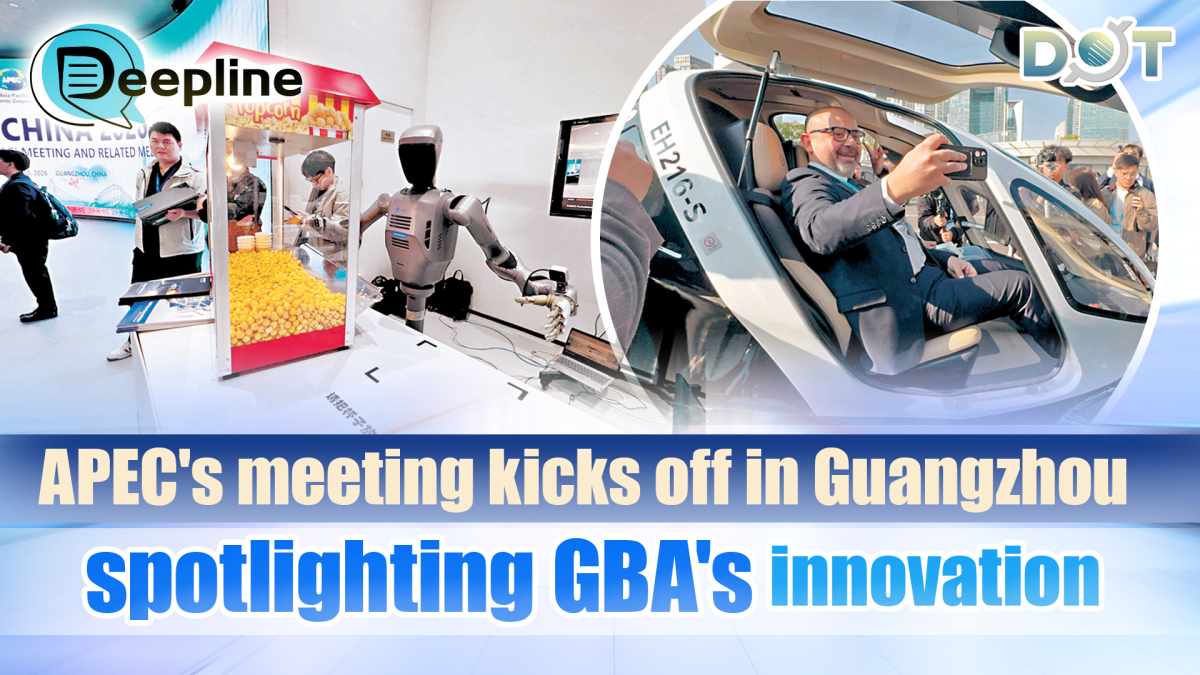
The first APEC Senior Officials' Meeting (SOM1) and related meetings for 2026 are being held in Guangzhou from Feb. 1 to 10. On Feb. 2, multiple delegates participated in a technology and innovation-themed site visit, experiencing unmanned electric aircraft and AI-powered glasses firsthand and enjoying a robot dance performance.
In an interview, Zheng Yongnian, Dean of the School of Public Policy at The Chinese University of Hong Kong, Shenzhen, and Board Director of Guangzhou Institute of the GBA, said that "anti-globalization" is only a temporary phenomenon.
"New technologies, such as artificial intelligence (AI), are injecting momentum into manufacturing, and a new era for "Made in China" and "Guangdong products" has arrived."
The APEC SOM1 and related meetings will include over 70 sessions and supporting events, covering topics such as trade and investment, economic and technical cooperation, technological innovation, and the digital economy. More than 1,000 participants from APEC member economies, the APEC Secretariat, and the APEC Business Advisory Council are expected to attend.
The meetings will focus on the 2026 APEC theme, "Building an Asia-Pacific Community and Advancing Shared Prosperity," and the three priority areas of "Openness, Innovation, and Cooperation." Discussions will advance cooperation across various fields and mechanisms, laying the groundwork for the APEC Economic Leaders' Meeting in November.
At the Guangzhou Baiyun International Convention Center, driverless shuttle buses operate smoothly between the venue and hotels, offering convenient transportation for international guests. Robot baristas, designed to be "introvert-friendly," prepare a variety of coffees, highlighting smart and convenient services. Cultural and creative products with Guangdong characteristics have also captivated foreign guests, prompting them to indulge in some shopping.
Against the backdrop of a changing international landscape and multiple challenges to global economic and trade cooperation, Zheng emphasized in a media interview that the core message of this APEC meeting remains "cooperation" and "development." Regarding the rise of "anti-globalization" sentiments in the Asia-Pacific region and beyond, he expressed optimism, "I believe this is only a temporary phenomenon. Once these countries complete their internal adjustments, openness will remain the inevitable choice."
Zheng previously noted that, from an industrial perspective, Shenzhen and the entire GBA have developed substantial production capacity in fields such as the internet, AI, and biomedicine, which align well with the development needs of APEC member economies.
He further proposed a new "troika" to drive GBA's development, highlighting the region's concentration of high-quality research institutions and universities, manufacturing enterprises with strong technology commercialization capabilities, and the support of Hong Kong's world-class financial services system. These elements, he said, are key to the region's high-quality development. This complementary and synergistic development model, combined with the organic integration of Guangzhou, Shenzhen, and Hong Kong, forms a unique competitive advantage that is difficult for other regions to replicate. "The future of the Greater Bay Area will undoubtedly be a world-class bay area of higher quality and sophistication."
"We are currently in the midst of the fourth industrial revolution, where new technologies like artificial intelligence are deeply empowering the upgrading of manufacturing. A new era for 'Made in China' and 'Guangdong products' has arrived," he added.
Warm feedback from attendees
On Feb. 2, attendees of the 2026 APEC SOM1 experienced GBA's technological and manufacturing strength and innovative vitality through an immersive tour. Gianpiero Antonazzo from the World Bank Group remarked after the visit that the most immediate impression was the globally leading scale effect of GBA's innovation industries, with achievements already transitioning from the laboratory to real-world applications.
After trying a low-altitude unmanned aircraft, he praised such products for their significant advantages in highly congested cities, meeting the need for fast travel while ensuring safety and environmental friendliness. "This is the future direction of transportation," he said.
Taking advantage of the APEC platform, tech companies from GBA showcased their core products and explored overseas markets. Zhao Peng, founder of Zoom Vision, introduced AI auto-focus glasses that adjust lens power through built-in sensors, ensuring clear vision in different scenarios while reducing eye strain. "This is a universal need globally, and we hope to introduce this product gradually to more overseas markets, including APEC member economies."
AI learning robots, capable of chatting, reading, and retaining memory, also attracted interaction from many delegates. Yu Beiying, Senior Public Affairs Manager at Shifang Ronghai, noted that their open-source system had topped global open-source platforms and is now integrated into over one million devices, forming a mature ecosystem. Since the system supports 37 languages, including Japanese and Korean, many partner products have been successfully exported to Southeast Asian markets with positive feedback.
Industrial humanoid robots, capable of lifting and operating without rest, drew attention from delegates from Southeast Asian countries. Cao Yuran, Senior Marketing Manager at Li-Gong, noted that some of their products have already entered the Malaysian market. He highlighted the huge potential demand for industrial robots in Southeast Asia and noted that GBA's robust manufacturing foundation positions it well to meet the needs of APEC-related enterprises.
"We hope to further expand our market in APEC member economies in the future."
(Source: Wen Wei Po; Journalist: Huang Baoyi, Lu Jingyi)
Related News:
APEC report: Digital transition 'essential' for aging societies, outlines 4 key tech pillars




Comment