






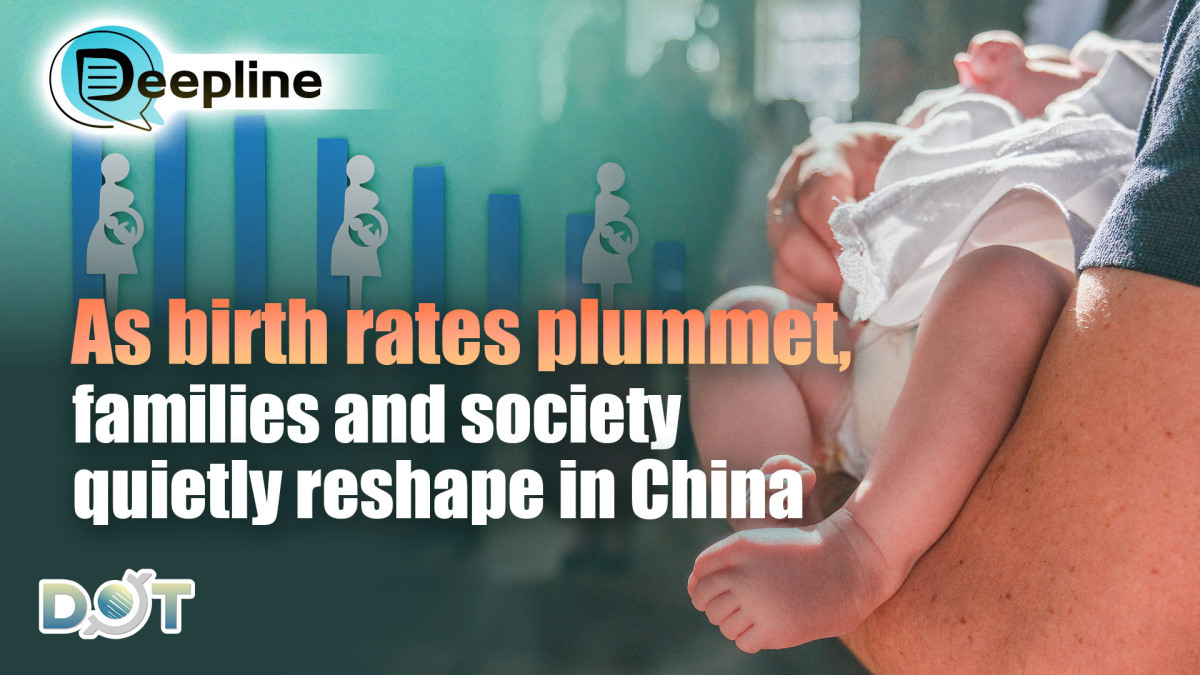
A recent news headline, "China's fertility rate falls to levels last seen in the third year of Emperor Qianlong's reign (1738)," has gone viral as China's newborn population dropped to 7.92 million in 2025. However, the trend of declining birth rates is not unique to China—most countries and regions worldwide are grappling with the issue. This trend is also becoming a key variable signaling shifts in social structure, triggering a chain reaction akin to the "butterfly effect." Family dynamics, consumer preferences, and the demand for public services in Chinese society are quietly being reshaped.
The effect of declining fertility has long extended beyond macro-level data, permeating countless ordinary households. A lifestyle markedly different from the traditional family model is on the rise.
On sunny afternoons, Ms. Wu, 48, can always be found at small cafes near her home, enjoying a cup of coffee and flipping through a book. She retired early and lives with her partner, raising five cats and two dogs, with no children. Before heading out each day, she takes care to dress. Childcare duties no longer fragment her time, leaving it entirely her own.
Meanwhile, on the other side of the city, the rhythm of life for Ms. Zhong, a mother of two, couldn't be more different.
"I used to think adding another family member was just like setting an extra place at the table. Now I realize it's not like that," says Ms. Zhong. She describes her daily life as a tightly compressed timeline: shuttling the kids to and from school, helping with homework, and managing household chores—each task interconnected, with any disruption risking a "systemic collapse" of the family.
What truly weighs on Ms. Zhong is the approaching educational transition for her children.
"The biggest anxiety for multi-child families is still education... Now with two kids, I have to fight for educational resources for each of them."
Just as Ms. Zhong laments the scarcity of quality educational resources, another shift is quietly unfolding. With the continued decline in fertility rates, the demand for basic education is shrinking. In some regions, kindergartens struggle to enroll new students, with teacher numbers already surpassing student counts.
Primary schools are also feeling the impact. On social media, a spreadsheet titled "Summary of School Closures and Suspensions in Shanghai, 2025–2026" has drawn attention. As of Jan. 25 this year, the list includes 74 kindergartens and primary schools in Shanghai that have either closed or suspended enrollment.
Sensing the sustained decline in fertility rates, businesses are already adapting. Some are pivoting toward high-end, functional niche products, while others are transitioning into sectors like the pet economy or household services.
Manufacturing and labor-intensive industries are also planning. With a future drop in labor supply seeming inevitable, companies are accelerating automation and intelligent transformation, with "machines replacing humans" becoming a key strategy to cushion the decline of the demographic dividend.
Professor Chen Rong, Deputy Director of the Asian Demographic Research Center, Shanghai University, explained in an interview with Wen Wei Po that the decline in newborn numbers is not due to a single factor but results from a long-term process shaped by overlapping demographic structures, marriage and childbirth behaviors, and societal attitudes.
"This statistical annual report reflects a drop in the total number of births. However, the number of births is determined not only by fertility rates but also by the declining total number of women of childbearing age," Chen said. Demographically, women aged 15 to 49 are considered of childbearing age. With extended education, the average age for first marriage and first childbirth has shifted later, particularly in major cities. She also noted that the age range once regarded as the "peak fertility period" has now been significantly compressed.
How should policies respond to declining fertility and its ripple effects? Drawing on international experience, Chen noted that even after decades of sustained fertility support policies, almost no country or region has managed to restore fertility levels to the replacement rate (an average of 2.1 children per couple, which would roughly maintain population stability).
Chen emphasized that building a fertility support policy system is a long-term endeavor requiring sustained effort, encompassing three key principles: First, in the short term, policies should aim to increase awareness and convenience to unlock the fertility potential of policy-sensitive groups. Second, in the medium term, policies should ensure coordination—for instance, between maternity leave policies and childcare services. Third, in the long term, efforts should focus on shaping attitudes and improving institutions to create stable expectations.
"We need policies designed as a comprehensive package," she noted, highlighting that precision and effectiveness are particularly crucial across different cities and income groups. In Chen's view, addressing fertility is not as simple as "turning on a tap." Fertility support policies must be a persistent, well-integrated, and precisely targeted effort—like sustained drip irrigation.
(Source: Wen Wei Po; Journalist: Kong Wenqiong)
Related News:
Deepline | When AI turns toxic, can regulation keep pace with deepfakes?
Deepline | Hurun report: AI reshapes China's wealth landscape in 2025




Comment