






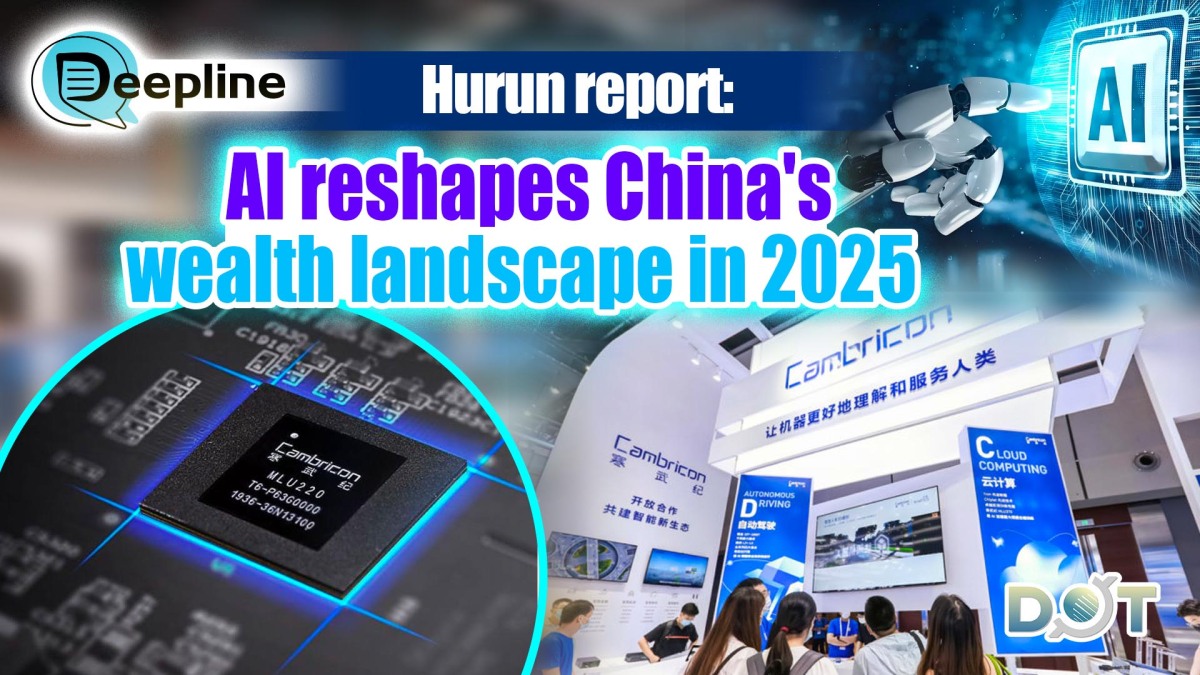
The Hurun Research Institute in Beijing released the "2025 Hurun China Artificial Intelligence Enterprises Top 50" on July 19. AI chip company Cambricon Technologies topped the ranking with a valuation of 630 billion yuan (RMB), a 165% increase from last year.
Rupert Hoogewerf, chairman and chief researcher of the Hurun Report, stated that AI is reshaping China's wealth landscape.
The list focuses on Chinese companies whose core business is AI computing power or algorithms. The entry threshold was 9.5 billion yuan, 3.5 billion yuan higher than last year. The threshold for the top ten was 73 billion yuan, more than three times last year's 22 billion yuan. The average value of the listed companies was 54 billion yuan, 2.4 times that of the previous year. Five companies have valuations exceeding 100 billion yuan.
AI chip-related companies occupied seven of the top ten spots, including Horizon Robotics, Rockchip, Biren Technology, and VeriSilicon. Eighteen of the top 50 companies, more than one-third of the list, were new entrants this year, including 10 AI chip-related firms. Voice recognition leader iFLYTEK, computer vision leader SenseTime, and multimodal generative AI pioneer MiniMax ranked within the top ten.
Hoogewerf also noted that China has a vast number of AI users. According to a report on generative AI application development released by the China Internet Network Information Center, the number of generative AI users in China reached 515 million as of June 2025.
"This means nearly 40% of Chinese people were already generative AI users at that time. AI's impact on people's lives has already become very significant," he said.
The wealth of Chen Tianshi, co-founder of Cambricon Technologies, increased by nearly 150 billion yuan compared to the previous year, placing him within the top 20 of the latest Hurun China Rich List. The wealth of Rockchip's Li Min grew by over 30 billion yuan. Yang Zhilin, founder of Kimi, made his debut on the rich list with a fortune of 7.3 billion yuan.
"Among the entrepreneurs on the Rich List, 9% are involved in the AI field, with AI as their primary focus," Hoogewerf added.
At the beginning of 2025, DeepSeek emerged with disruptive cost-effectiveness. At the end of 2025, Manus, having been around for only nine months, was acquired by Meta, marking Meta's third-largest acquisition since its inception.
Hoogewerf also mentioned that the third-party AI model aggregation platform OpenRouter recorded usage data of 100 trillion tokens over the past year. The results showed that at the end of 2024, Chinese open-source models had a market share as low as 1.2%, which subsequently grew significantly, peaking at nearly 30%.
He revealed that there are over 1,200 Chinese-listed companies related to the AI concept on the A-share, Hong Kong, and US stock markets. However, only 31 have AI as their genuine core business with a corporate value above 9.5 billion yuan. Currently, the core value of AI still lies in extending human capabilities, namely the "brain, eyes, ears, hands, and legs."
- Brain: Primarily companies in data analysis and decision-making, including XtalPi, Mininglamp Technology, and 4Paradigm.
- Eyes: Mainly companies in the computer vision field, represented by SenseTime, Orbbec, and Shanghai Hehe Information Technology.
- Ears: Primarily companies in the intelligent speech field, led by iFLYTEK, TRS, and Unisound.
- Hands: Mainly AIGC (artificial intelligence generated content) large model companies that help people create music, draw images, write text, and express ideas. Key players in this area are Moonshot AI (Kimi), Z.ai, and Minimax.
- Legs: Mainly autonomous driving-related companies, with industry representatives like DiDi Autonomous Driving, Pony.ai, and WeRide.
"The number of AI chip companies on the list has grown significantly this year, reaching 14, an increase of 9 from last year. The top three companies on the list are all AI chip-related. The core reason is the ongoing tightening of US export controls on high-end AI chips, which is forcing domestic acceleration of computing power self-reliance," Hoogewerf noted.
"Regarding going global, the AI companies on this list act as 'behind-the-scenes enablers,' driving the high-quality expansion of Chinese industries like consumer electronics and new energy vehicles worldwide." Currently, these companies still rely primarily on the domestic market for revenue, with overseas business mostly concentrated in testing, demonstration, or technology transfer stages. Their significance for Chinese companies expanding overseas lies more in technological pathways and industry experience.
"For example, in the computing power field, VeriSilicon is already engaged in businesses like chip customization in the US, Europe, and Japan. The company's 2025 interim report indicates that its overseas revenue amounted to 4 billion yuan, representing 41% of its total revenue. In the autonomous driving field, companies like Pony.ai and WeRide provide practical references for Chinese autonomous driving solutions exploring overseas markets through experience accumulated from overseas testing and demonstration operations."
(Source: Wen Wei Po; Journalist: Ma Xiaofang)
Related News:
Deepline | Double-edged sword! High AI adoption rates raise concerns over HK student independence




Comment