






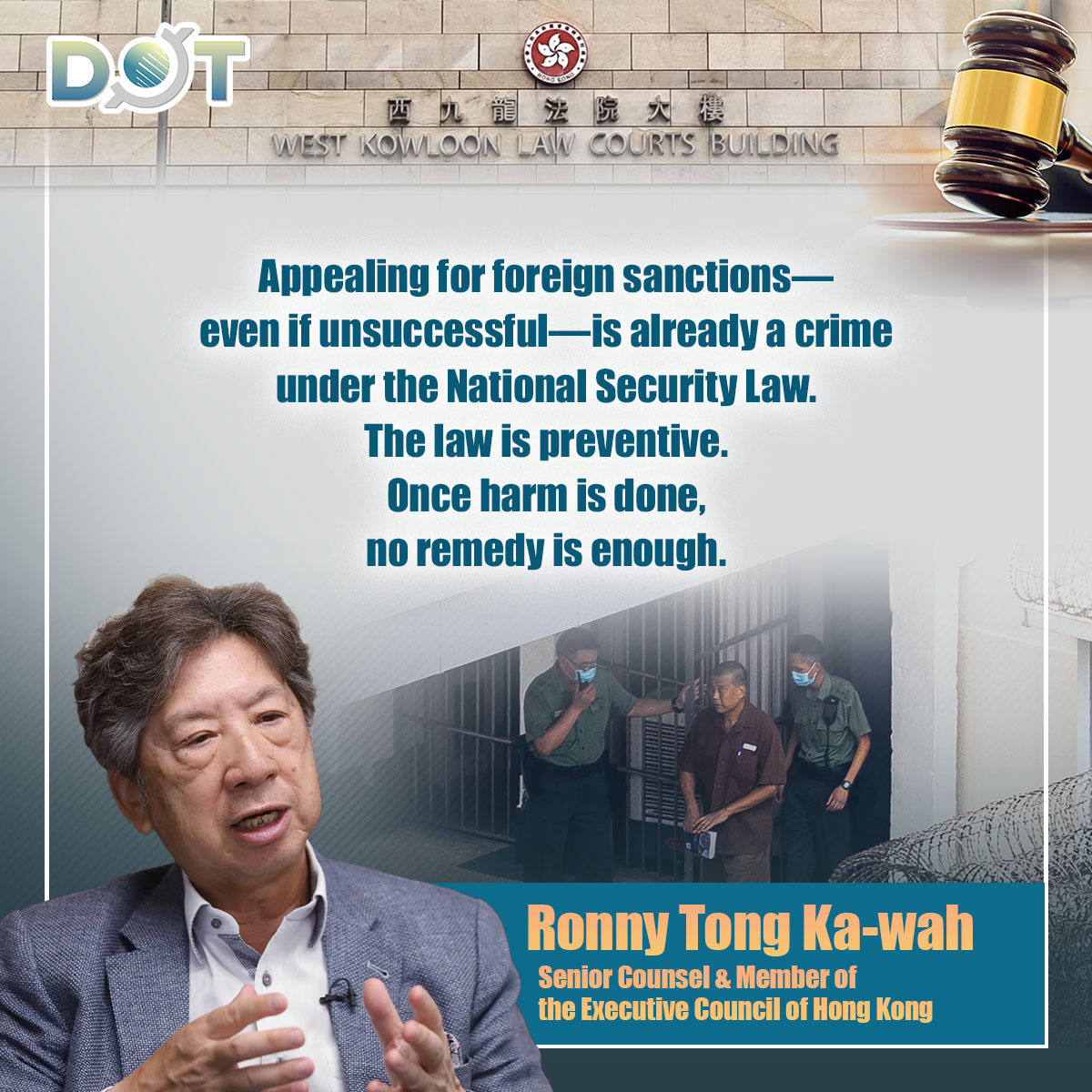
As Hong Kong's 2026 legal year commenced, an unprecedented alignment emerged among keynote speakers—from the Chief Justice of the Court of Final Appeal to the Secretary for Justice—all responding directly to escalating external attacks on the city's judiciary. While the heads of the Bar Association and Law Society responded more cautiously, their concern was evident. The focal point? The Jimmy Lai case has become a significant issue in the courtroom.
The recent international criticism directed at Hong Kong's judiciary over the Lai case is alarming in its scale and ferocity, particularly given the lack of factual and legal basis. Even more concerning is the fact that such criticism has come not only from foreign politicians and media but also from seemingly independent figures such as former overseas non-permanent judges of Hong Kong's top court and former law professors at the University of Hong Kong.
Jimmy Lai is facing—and has already been convicted of—two charges: incitement to cause hatred against the government and collusion with foreign forces. The former charge is based on a colonial-era statute, now repealed, that requires proof of intent to incite "hatred or contempt against the central or Hong Kong government"—far beyond general criticism. Freedom of speech has its limits. Defamation laws are a clear example. The consensus is that free speech does not extend to slander, much less incitement to hatred.
The collusion charge, under the Hong Kong National Security Law (NSL), is entirely different in nature. It criminalizes acts of requesting or conspiring with foreign entities to impose sanctions, blockades, or other hostile actions against Hong Kong or China. These are universally recognized acts of betrayal and clearly fall under the international definition of national security offenses.
Some critics argue that most countries lack equivalent laws. But that's irrelevant—each nation defines national security differently. Some may use it to justify military expansion; others see foreign sanctions as a threat to sovereignty. The key principle is this: if an act harms national interests, the state is justified in preventing it.
For comparison, the UK's National Security Act criminalizes "foreign interference" involving foreign power conditions or causing harm to property, rights, or reputation—often with vague definitions. By contrast, the NSL's requirement of explicitly soliciting sanctions is much narrower and more specific.
Yet most criticisms of the Lai case avoid addressing this legal core. Even former judges and scholars seldom address the substantive aspects of the charges or their limitations concerning free speech. More importantly, few confront the evidence: Jimmy Lai himself has admitted to calling for foreign sanctions against China and Hong Kong—a fact that is central to the case.
The criticism of the judiciary in handling the Jimmy Lai case is clearly politically motivated. Viewing criminal cases through a political lens is an affront to the rule of law. Baseless attacks on the judiciary—especially from individuals once respected for their impartiality—are far more damaging than biased commentary from known partisan actors.
It is thus no surprise that all four speakers at the legal year opening ceremony focused on defending Hong Kong's judiciary. After all, a rule of law left undefended is a law in decline. Undermining the foundations of judicial independence requires a firm and principled response that is not only appropriate but essential.
(Source: Opinion column in Ta Kung Pao by Ronny Tong Ka-wah, Member of the Executive Council, Senior Counsel)
Related News:




Comment