






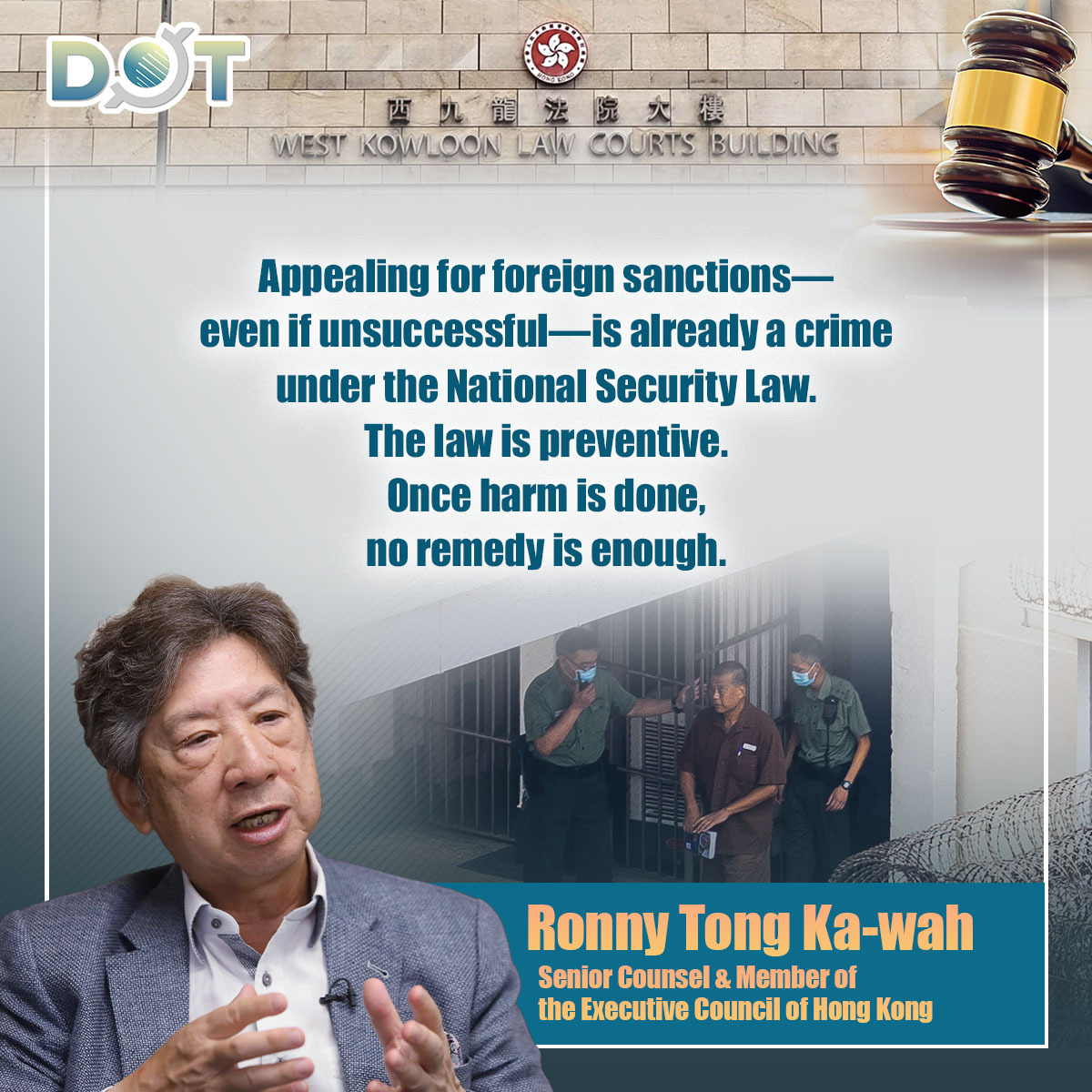
Following the conviction of Jimmy Lai, Executive Council member and senior barrister Ronny Tong Ka-wah stated today (Dec. 16) on a radio program that the court's ruling aligns with the basic principles of common law.
He emphasized that the basis for the conviction of "collusion" lies in actual contact with foreign forces and the undertaking of hostile actions. According to Tong, any act—even if it does not succeed in persuading the foreign party—is already a violation of the law.
Tong also pointed out that in the real world, law and politics cannot be completely separated. He warned that foreign powers may exploit the case to stir up political pressure on both the Hong Kong and central governments. In this context, officials from both levels of government must speak out clearly to push back against political interference and establish a clear boundary.
Speaking on a commercial radio program, Tong explained that the three judges involved in the case handled the matter entirely based on common law principles. He cited Article 29 of the National Security Law, which states that any person who conspires with foreign or external forces to endanger national security is committing a criminal offense.
He stressed that the article clearly defines what constitutes "collusion," and that this case helps further clarify its application. He noted that mere interaction with overseas organizations does not constitute collusion, but appealing to foreign political forces to impose sanctions on China or Hong Kong is a criminal act.
Tong reiterated that the National Security Law is a preventive measure. He clarified that the mere act of requesting foreign sanctions, even if not implemented, already constitutes a crime. "Some things must be stopped before they happen, because once they do, the consequences can be irreversible," he said. "Even if someone is executed afterward, it would be too late."
Later on social media, Tong further stated that asking a foreign country to harm one's own nation is an act of betrayal, which no state would tolerate, and that such behavior constitutes a serious criminal offense. He urged that no one should take the risk of testing the law.
He added that the offense of collusion includes the intention to induce foreign forces to harm national interests through the use of sanctions or other hostile actions. Therefore, if someone publicly calls for such actions with the goal of capturing the attention of external forces, this indirect transmission of a message may already constitute a criminal offense.
Following the verdict, several Western countries expressed opposition to the court's ruling. In response, the Hong Kong SAR Government issued a strong statement expressing deep dissatisfaction and firm opposition to what it described as false and slanderous remarks about the case.
Tong commented that Hong Kong society has become relatively rational in handling such issues, but he is most concerned that unfriendly foreign countries will seize on the case to exert political pressure. He believes that a unified response from Hong Kong officials is necessary to establish a political "defensive line".
Related News:
Opinion | Jimmy Lai's convicted: National security safeguarded




Comment