






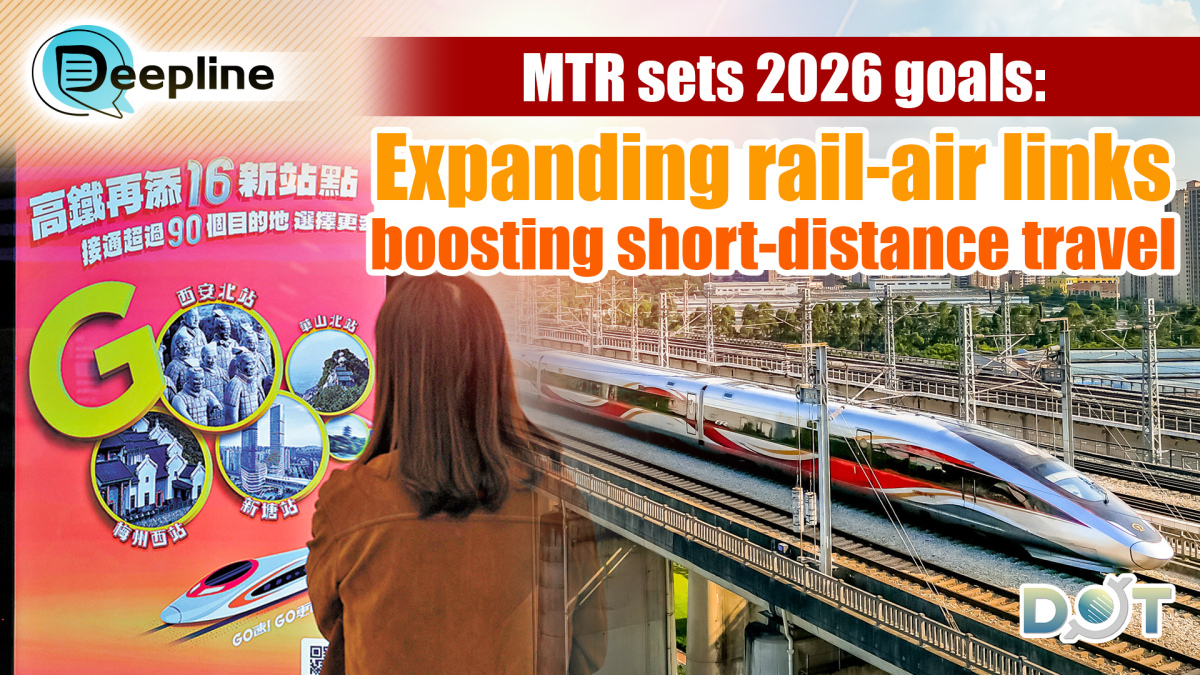
MTR reviewed its 2025 work yesterday (Jan. 14), stating that it not only set new records for annual, monthly, and daily passenger numbers but also surpassed the milestone of 100 million cumulative passenger trips last year. Looking ahead to 2026, MTR outlined three key work priorities: expanding tourism-related services and promoting a "high-speed rail + aviation" intermodal service, optimizing station facilities, and enhancing flexibility for short-distance travel, all aimed at continuously deepening integration between the two places.
Paul Wong Kah-ming, MTR's Chief of Cross-Boundary Segment, noted that in 2025, Hong Kong's high-speed rail recorded over 30 million passenger trips, representing a year-on-year increase of nearly 17%. Passenger volume exceeded 3.2 million in August, and on Dec. 27, during the Christmas holidays, it reached 140,000 trips, setting three new records for annual, monthly, and daily ridership.
He emphasized that since its inauguration in 2018, Hong Kong's high-speed rail has successfully surpassed the milestone of 100 million cumulative passenger trips, becoming a vital link for travelers between the Mainland and Hong Kong.
New direct services to Eastern China cities starting Jan. 26
In terms of network coverage, Hong Kong's high-speed rail continues to expand and upgrade. Wong revealed that starting Jan. 26, the high-speed rail network will add 16 major cities and tourist destinations in Eastern China, including Nanjing and Hefei, increasing the number of direct destinations from West Kowloon Station to 110, further strengthening transportation connectivity between the two places.
As integration between Hong Kong and the Chinese mainland deepens, high-speed rail travel has become an increasingly integral part of Hong Kong people's daily life. Wong noted that in terms of passenger composition, the proportion of Hong Kong residents among total passenger trips has gradually increased from about 30% during the initial operation period to 47% currently, with the remainder comprising mainland and overseas travelers.
West Kowloon Station has also become the most popular land crossing port for mainland visitors. Surveys indicate that approximately 70% of high-speed rail passengers travel for leisure tourism, with the convenience of high-speed rail favored for short, medium, and long-distance trips alike.
In response to market demand, Hong Kong's high-speed rail has introduced multiple innovative services and convenience measures.
Wong mentioned that the Flexi-trip Arrangement, launched earlier, provides same-day train change flexibility for passengers traveling between Hong Kong and Shenzhen. Currently, over 2,000 people use this service daily. As for the multi-ride tickets aimed at frequent cross-boundary travelers, annual sales exceeded 20,000 last year, proving popular due to ticket discounts and convenience.
Short-distance passengers account for 80%, highlighting GBA's "one-hour living circle" potential
Regarding the optimization of station experience, Hong Kong's high-speed rail has also made continuous efforts. West Kowloon Station has not only introduced specialty dining, retail shops, and financial service merchants but also launched experiential activities, offering passengers a travel experience that goes beyond mere transportation.
Currently, short-distance routes within a 3-hour journey are the most popular among travelers, with 80% of passengers being short-distance travelers. The fastest travel times are just over 10 minutes to Shenzhen and 47 minutes to Guangzhou South, showcasing the unique advantages of the Greater Bay Area's (GBA) "one-hour living circle."
Looking ahead to 2026, Wong announced three key work priorities for Hong Kong's high-speed rail. The first priority is to further expand tourism-related services. On one hand, MTR will continue to collaborate with the industry to promote high-speed rail tours and explore connections with mainland specialty tourist trains. On the other hand, it will promote a "high-speed rail + aviation" intermodal model, partnering with travel agencies and airlines to offer combined ticket discounts for train and air travel, creating a bidirectional travel option. This will facilitate mainland travelers transiting through Hong Kong for international flights and overseas travelers transiting through Hong Kong for high-speed rail trips to the mainland.
Second, continuously improving station facilities and service quality to enrich passengers' travel experience. Regarding whether the area of the station is sufficient, Wong said that the team has been closely monitoring the entire passenger journey from arrival at the station, clearance checks, to boarding. In the future, MTR will continue optimizing passenger flow management to ensure a smoother travel process.
Lastly, continuing to expand network coverage and enhancing flexibility for short-distance travel to fully unleash the potential of the "one-hour living circle." Regarding plans to expand the Flexi-trip Arrangement to more cities, Wong noted that the service currently mainly applies to short-distance routes with high-frequency services, such as Shenzhen North and Futian, which have over 100 daily round-trip services. In the future, MTR will study the feasibility of optimizing the service based on changes in market demand.
(Source: Wen Wei Po; Journalist: Zhang Ming; English Editor: Darius)
Related News:
Record high! HK high-speed rail passenger volume surpasses 30 mn, up 17% year-on-year




Comment