






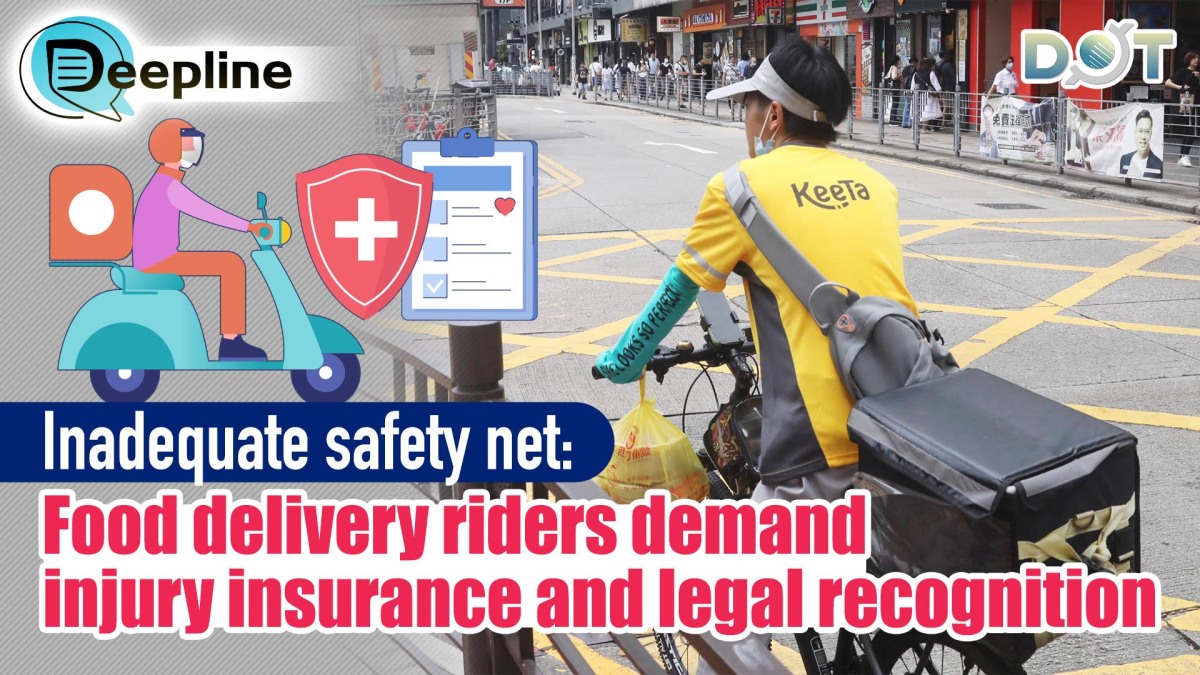
Secretary for Labour and Welfare Chris Sun earlier mentioned plans to legislate this year to protect the rights of emerging digital platform workers, such as couriers, including clarifying issues related to accident insurance compensation.
The Federation of Hong Kong Transportation and Logistics Industry Trade Unions believes that workers on food delivery platforms lack effective safeguards for basic rights such as work injury, retirement, and minimum wage protections, and that rights related to occupational safety and training are even more out of reach. Therefore, together with the Hong Kong Food Delivery Workers' Union, they submitted a submission to the Labour Department yesterday (Jan. 7) to provide input on improving the protection mechanism.
'Platforms cannot evade responsibility'
Wai San-yuen, Chair of the Hong Kong Food Delivery Workers' Union, told Wen Wei Po that since the food delivery platform Deliveroo ceased its Hong Kong operations last year, only two food delivery platforms remain, weakening the bargaining power of delivery workers and lowering the per-order delivery rates. Platform workers also face issues such as algorithm-based order assignment systems and inadequate work environment support.
He thus hopes legislation will be enacted as soon as possible to improve the compensation for work injuries among platform workers.
Chu Hon-chung, Chair of the Federation of Hong Kong Transportation and Logistics Industry Trade Unions, believes that while couriers sign agreements with platforms as "partners," the nature of their work is identical to that of employees—they complete labor tasks directed by the platform and receive remuneration, meeting the characteristics of an employment relationship. Therefore, platform companies should not use "freedom to go online" as a way to evade responsibility.
He hopes the government will expedite legislation to address this, including ensuring that when calculating work injury compensation for platform workers, the base should be their total income earned across all platforms, including tips, service fees, and urgent delivery fees.
Three demands and four suggestions
They raised three core demands, including:
- The scope and compensation level for work injury protection for platform workers should be no lower than the standards set by the Employees' Compensation Ordinance, covering injuries, occupational diseases, and death-related compensation, with protection also applicable during typhoons, rainstorm warnings, and other extreme conditions.
- The system for work injury compensation should retain or incorporate the coverage periods under the platforms' existing insurance policies, including one hour before going online, one hour after going offline, and during online work periods.
- Legislation should clearly define platform workers as "independent workers," distinct from contractors/partners, employees, and self-employed individuals, providing a legal basis for resolving issues such as work injury, retirement protection, and minimum wage.
Additionally, they proposed four suggestions, including:
- Streamline and standardize the application mechanism by adding an online function for reporting work injuries in the apps of each platform, unifying and simplifying the application forms and processes across different insurance companies to improve application efficiency.
- Update the statutory list of occupational diseases to include conditions such as lower limb strain and plantar fasciitis caused by long-term physical labor, and request the government to establish an expert and stakeholder task force to comprehensively review and update the statutory occupational disease list as needed.
- Strengthen the functions of the Labour Department's Coordination Group for Protecting Platform Workers by establishing a fast-track complaint channel to handle labor disputes and issues related to platform policy adjustments.
- Establish a unified regulatory system by forming an industry regulatory committee comprising representatives from labor, employers, and the government. This committee should develop supporting measures around the four pillars of legal framework, protection, regulation, and cooperation to foster win-win development in Hong Kong's platform economy.
Inadequate accident protection: How to deal with work injuries?
Work injury incidents among Hong Kong's food delivery workers are often related to traffic accidents caused by rushing to deliver orders or adverse weather. Chu, a bicycle delivery worker, told Wen Wei Po that he fell and fractured his right thumb while delivering for a food delivery platform, requiring surgery. After submitting complete medical evidence approved by the Hospital Authority to the platform for compensation, the claim process has been delayed for four to five months.
To make it worse, the platform has only responded with "under processing" without providing a clear outcome, noting that "the case can only be settled and calculated after the sick leave ends." He has submitted medical certificates, but the platform continues to repeatedly inquire about sick leave information and has yet to provide compensation.
"(The platform) only offers WhatsApp online customer service, with no physical contact phone number or clear office address, making it impossible to lodge complaints offline. Grassroots delivery workers, especially those unfamiliar with mobile phone operations or with lower education levels, find it even harder to communicate effectively with online customer service. Additionally, the efficiency of customer service responses is low. Although they claim 'one-on-one follow-up,' suspected case backlogs and staff shortages lead to untimely follow-up in practice."
Wai also noted that delivery workers include motorcycle riders, bicycle riders, and "walkers." Riders often suffer injuries from slips on rainy and slippery roads or collisions with vehicles, leading to fractures or even death. Walking delivery workers are prone to slips, trips, sprains, or strains while rushing on slippery roads.
According to him, among severe work injury cases, the most heartbreaking was a Pakistani delivery worker who was run over by a bus on Kwun Tong Road while delivering food and later died in the hospital. His family applied for insurance compensation from the platform in September last year, with a compensation amount of HK$1 million under the relevant insurance regulations. However, the compensation application is still in process, and the outcome remains unclear.
"Previously, an accident resulted in a fractured bone in a South Asian delivery worker, rendering him unable to work for three months." The platform only provided a daily compensation of HK$60, with a cap on the maximum claimed days. For total disability, the maximum compensation period is only five weeks, at HK$3,900 per week or no more than 75% of the delivery worker's average weekly service fee before the accident."
(Source: Wen Wei Po; Journalist: Chung; English Editor: Darius)
Related News:
Keeta expands to Qatar, plans entry into Brazil in coming months




Comment