






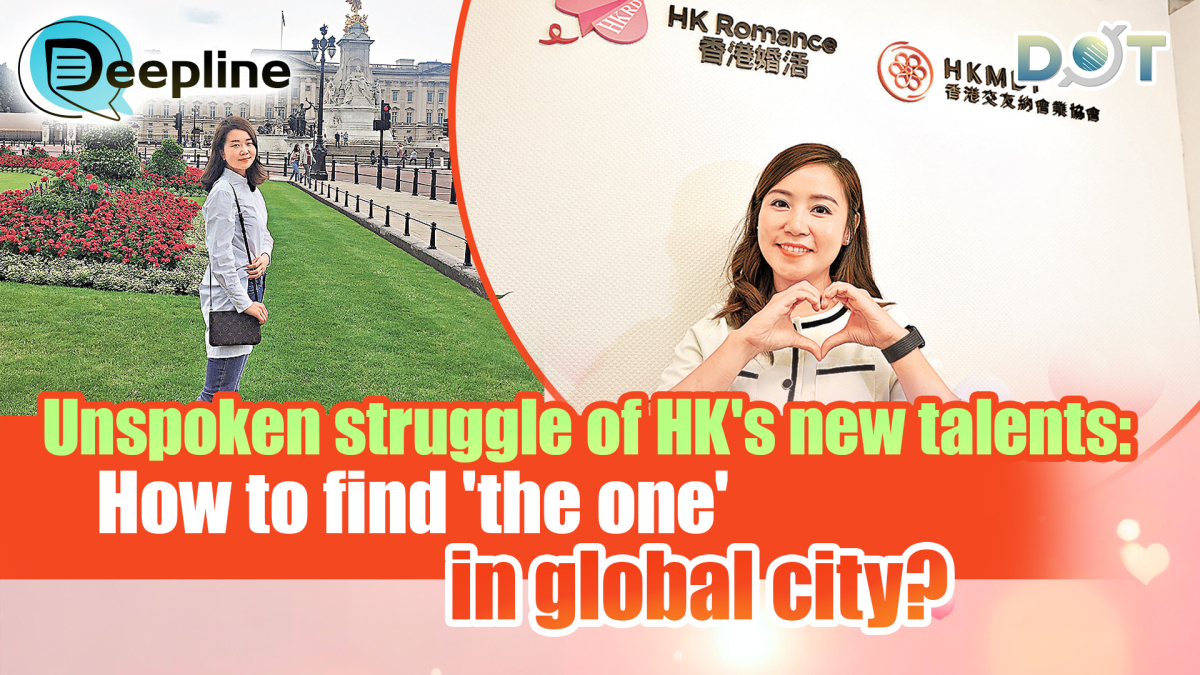
Hong Kong, a vibrant international metropolis, attracts talent from around the globe. They come to the city through talent schemes, bringing with them professional expertise and dreams, with the hope of establishing roots. However, they encounter unique challenges in a more personal realm: marriage and relationships. With high incomes and advanced qualifications, finding someone to date isn't difficult, but finding a like-minded partner with whom they feel confident spending the rest of their life is far from simple.
At a networking event, a female participant who graduated from a prestigious US university introduced herself in a way that resonated with many single high-achievers.
"I have a house, a car, a cat, and a dog. I would rather not serve a 'father' nor take care of a 'son.' I just want a partner who shares my values, starting a relationship based on our common interests."
Jesse Shang, Founding President of the Hong Kong Top Talent Services Association (HKTTSA), shared in an interview with Wen Wei Po that this straightforward and clear expression reflects the confidence of today's highly educated youth in their self-identity and their pragmatic attitude toward relationships.
"Among the community of single high-end talents, the greatest challenge often lies in differing values." Compared to the past, he noted, the concept of the "right age for marriage" has noticeably shifted, and being unmarried at 35 is no longer considered unusual.
"Most of these talents are graduates of the world's top 100 universities, with international perspectives, and their criteria for choosing a partner differ significantly from traditional views," Shang said. He noted that they are more inclined to first seek "partners-in-activity"—such as companions for pet ownership, sports, or cultural interests—before considering a romantic relationship, which is also a new trend in contemporary youth socializing.
Everyone seeks a partner who shares their values
For Carrie, a finance talent from Shanghai, finding romance in Hong Kong feels more like a game that requires active participation. Having come to Hong Kong nearly a year ago under a talent scheme, she laments that Cantonese is like an "invisible wall"—without it, integrating into local culture or even finding a partner is difficult.
"Although I am fluent in Mandarin and English, knowing some Cantonese makes work and life much more convenient," she says. In her spare time, Carrie studies Cantonese and has enrolled in related courses. She finds it somewhat regrettable that some who have been in Hong Kong for over a decade and obtained permanent residency still do not speak Cantonese.
Carrie holds a master's in finance from the University of London and chose to develop her career in Hong Kong because the city serves as a bridge connecting mainland China and the world, aligning with her background.
However, the adaptation process hasn't been easy: "After arriving, I needed to adapt to Hong Kong's financial market environment, social interaction patterns, and language challenges, especially during the first two years, which were particularly tough."
Marrying later? Common
Carrie, in her early thirties, adopts a flexible approach to marriage and relationships, firmly believing that fate cannot be manipulated. She has no intention of seeking a partner through matchmaking agencies or paid services but prefers relationships to develop naturally, such as through friends, alumni associations, or work settings.
"In fact, I've participated in events organized by talent associations or other institutions, which help expand my circle, foster idea exchange, and ease the confusion and pressure faced by new arrivals," she says.
Furthermore, Carrie has never used dating apps, believing offline interactions are more natural and reliable.
Regarding her criteria for a partner, Carrie has no specific restrictions based on birthplace or profession but hopes the other person has at least a college degree. After all, "Similar educational backgrounds help facilitate communication in terms of understanding and values." She particularly emphasizes that language and cultural differences are significant factors affecting relationships—for example, whether the other person and their family can accommodate her Cantonese proficiency and her mainland-born background.
Housing has always been a challenge for Hong Kong residents, but Carrie holds an open attitude: "Renting is also acceptable. There's no need to be bound by the pressure of buying a home; a house is not a prerequisite for happiness." Initially, she struggled with Hong Kong's cramped living spaces but has gradually adapted.
"Although the cost of living in Hong Kong is high, with a stable job, it's manageable," Carrie says. Currently, her greatest challenge remains the language barrier—for instance, when colleagues communicate mostly in Cantonese, she finds it hard to integrate due to her limited understanding.
In the future, Carrie aspires to establish roots in Hong Kong, establish a family, and raise children. "Building a better self leads to a better future. I will continue to maintain a calm mindset and be tolerant in all things. 'Come, stay, and live well!'"
Those "Hong Kong drifters" who have come to the city are finding emotional belonging in their own ways. They may not be in a hurry to marry, but they yearn for genuine connections. They face language and cultural barriers, yet also see the possibilities of diversity and integration. In this search, they are not only looking for partners but also seeking their own place and meaning in this city.
As Carrie says, fate cannot be forced, but when one actively learns Cantonese, engages with the community, and opens themselves up, the "invisible wall" quietly lowers, and the bridge connecting hearts is gradually being built.
(Source: Wen Wei Po; Journalist: Nicholas Lai; English Editor: Darius)
Related News:
Deepline | News under pressure: Traditional media struggles in era of traffic




Comment