





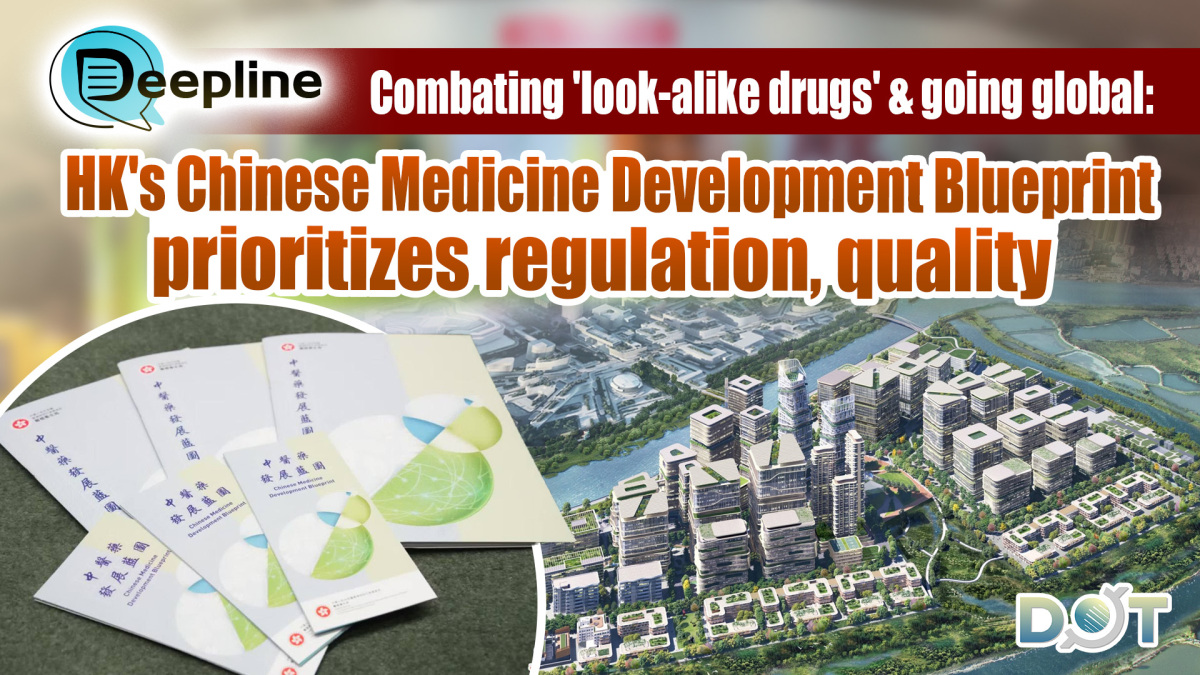
Traditional Chinese medicine (TCM) is a treasure of Chinese civilization. To promote the development of TCM, the Health Bureau yesterday (Dec. 18) unveiled Hong Kong's first-ever Chinese Medicine Development Blueprint (Blueprint), outlining a vision encompassing 5 major areas, 8 goals, and 20 actions. The blueprint aims to drive comprehensive, high-quality, and high-level development of TCM, including strengthening the quality management of Chinese medicines.
Wen Wei Po had previously conducted in-depth investigations into counterfeit Chinese proprietary medicines (commonly known as "look-alike drugs") in the market. The blueprint devotes considerable attention to this issue, proposing measures starting with aspects such as ingredients and product names. It also suggests amending legislation to expand the definition of Chinese proprietary medicines to regulate potentially misleading products. Furthermore, the government will progressively specialize in TCM practice and leverage Hong Kong's unique advantage of "relying on the motherland and connecting with the world" to assist the nation in promoting TCM globally.
Speaking at a press conference yesterday, Secretary for Health Lo Chung-mau stated that this year marks a milestone for TCM development in Hong Kong. Following the 7th Guangdong-Hong Kong-Macao Greater Bay Area Conference on Inheritance, Innovation, and Development of Traditional Chinese Medicine held in Hong Kong earlier this month, and the commencement of services at the Chinese Medicine Hospital of Hong Kong (CMHHK) and the Permanent Government Chinese Medicines Testing Institute Building last Thursday (Dec. 11), the Blueprint has now been released.
The Blueprint aims to build upon the existing foundation of Chinese Medicine (CM) development by formulating a comprehensive plan to advance its all-around, high-quality, and high-level development. It capitalizes on Hong Kong's advantage of being backed by the nation's robust TCM capabilities while possessing an internationalized healthcare system, regulatory framework, standard-setting, and clinical research strengths.
The Blueprint sets short-term (1-3 years), medium-term (4-6 years), and long-term (over 6 years) goals and action plans for key areas, covering five major domains: CM Services, CM Profession, Chinese Medicines Development, Cultural Inheritance, and Go Global. It also proposes 8 goals and 20 actions.
Commissioner for Chinese Medicine Development of the Health Bureau, Vincent Chung, explained that short-term goals involve quickly launching key projects, such as expediting the implementation of specialized disease services at the Chinese Medicine Hospital.
"Medium-term goals focus on improving and growing related work... For example, with specialized disease services, it's important to build a solid patient base and develop these services well, along with having enough training resources to prepare CM practitioners with specialized skills like acupuncture."
As for the long-term goals, they require sustained accumulation over more than six years, such as promoting Hong Kong's CM clinical guidelines and pathways for international sharing. This involves first maturing the relevant services and training, then inviting international counterparts for observation and study. The specific timeline depends on task complexity and execution difficulty.
Wen Wei Po had previously tracked and investigated "look-alike drugs" and unregistered/non-compliant products sold on the market. Assistant Director of Health (Chinese Medicine) Edmund Fong noted that the chaotic market for related products claiming to be Chinese proprietary medicines is prevalent in Hong Kong and Macao, causing public confusion and necessitating regulation.
One action in the Blueprint is to strengthen CM quality management, proposing to expand the definition of Chinese proprietary medicines through legislative amendments to regulate potentially misleading products.
Simultaneously, the government will address issues related to ingredients and product names. Products claiming to contain medicinal Chinese materials will be classified as Chinese proprietary medicines and must register before market sale. For products that have names very similar to popular Chinese proprietary medicines but do not contain the same ingredients, a list will be added to the law that includes the names of well-known Chinese proprietary medicines to stop people from avoiding regulations.
Fong also stressed the importance of enabling the public to learn to identify genuine and effective Chinese proprietary medicines. Therefore, a new round of publicity campaigns is planned for the end of the first quarter next year to educate the public on identifying properly registered Chinese proprietary medicines.
The Hospital Authority responded, stating it will fully cooperate with the government's policy direction in promoting CM development and jointly build Hong Kong into a bridgehead for CM's global expansion.
The Blueprint suggests combining traditional strengths with modern technology from a global viewpoint to improve research and clinical trials in Chinese medicine, enhance quality management, develop talent, encourage innovation, and promote the standardization and modernization of Chinese medicine. This involves thoroughly examining the rules for registering Chinese proprietary medicine to meet international standards, using the SAR government's Chinese Medicines Testing Institute to set Chinese medicine standards, and looking into the possibility of creating "Hong Kong standards" that could become international quality benchmarks for Chinese medicinal materials to help with trade across regions and countries.
According to Lo, during the formulation of the Blueprint, reference was made to national TCM policies and opinions from the National Administration of Traditional Chinese Medicine and the National Medical Products Administration. Extensive consultations were also conducted with the local TCM industry and relevant stakeholders.
"The Blueprint is designed to align with the nation's overall TCM development strategy, fully considering Hong Kong's 'one country, two systems' principle and the strengths of its CM system... It aims to promote Hong Kong's better integration into the construction of the Greater Bay Area as a highland for TCM development and the nation's broader TCM development landscape, while assisting TCM in going global."
(Source: Wen Wei Po; Journalist: Zhang Xian; English Editor: Darius)
Related News:
Deepline | Undercover expose: Dual sales tactics for 'look-alike' drugs target tourists in HK
Journalist's View | Herbal medicine trick in HK: Tourists beware of deceptive pharmacy practices




Comment