






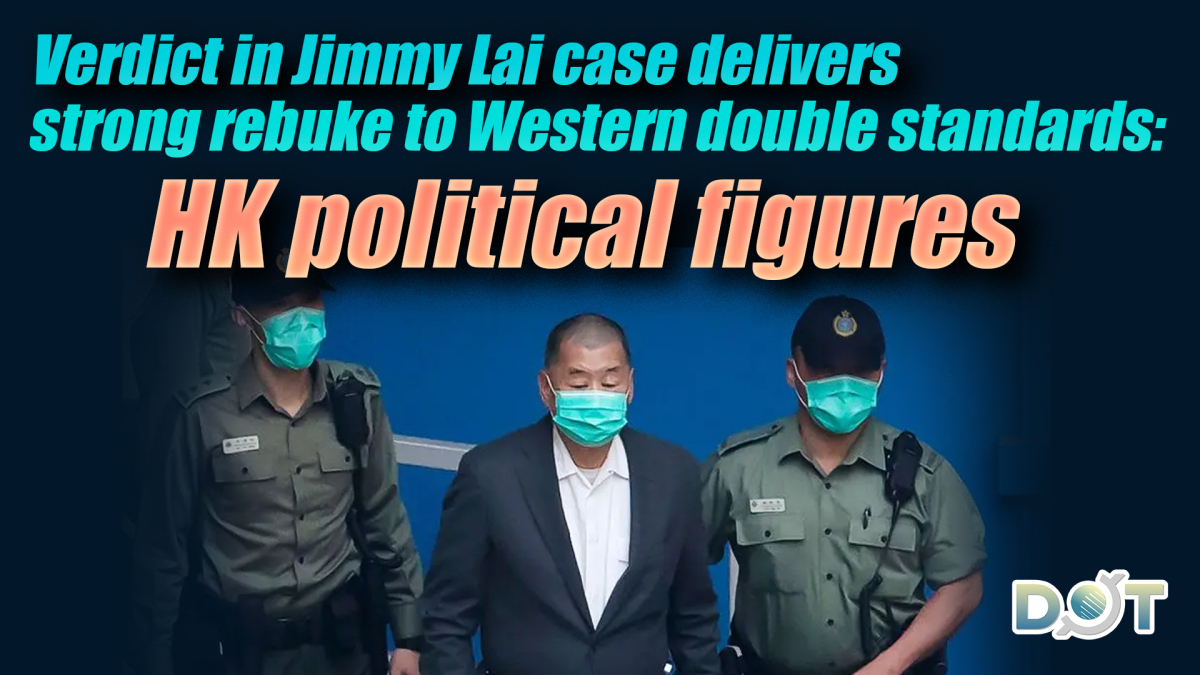
On Dec. 15, Hong Kong's High Court delivered a ruling regarding Jimmy Lai—an anti-China activist and the former owner of Apple Daily—along with three companies accused of violating the National Security Law. Several political and legal figures said that Lai is a main architect and participant in a series of anti-China incidents since Hong Kong's handover. His conviction underscores the rigidity and fairness of Hong Kong's rule of law, demonstrating that such disruptive influences cannot persist in the territory.
Kevin Sun, a Hong Kong delegate to the National People's Congress, mentioned that during the trial, Western anti-China forces propagated rumors of "political persecution" and "religious oppression," creating a facade of a "human rights crisis" in an attempt to politicize Hong Kong affairs. However, the facts presented during the transparent court proceedings dispelled these false accusations: Lai actively requested solitary confinement and received appropriate medical care, and his legal team did not raise objections.
The claim of being "banned from receiving communion" was merely a self-produced farce; the truth is that he voluntarily relinquished such arrangements. This ruling, he said, strongly counters the Western "double standards." While Western powers uphold their national security laws, they criticize Hong Kong's National Security Law. In reality, no country can tolerate actions that utilize media to incite rebellion and collude with foreign forces.
Eliza Chan, a member of the National Committee of the Chinese People's Political Consultative Conference and an unofficial member of the Hong Kong Executive Council, said that Lai is a key planner and participant behind a series of anti-China incidents since the return. He has abused public opinion tools to incite hatred, escalate confrontation, and encourage support for violent activities, acting as a behind-the-scenes provocateur during the 2019 riots, leading to extremely negative consequences.
Furthermore, Lai openly invited foreign forces to intervene in Hong Kong affairs, sought foreign sanctions against China and the Hong Kong SAR, and even boasted about "fighting for America." He is considered the main culprit colluding with external forces to jeopardize national security, posing a serious threat to the country's sovereignty, security, and development interests.
A trial process based on facts
Zhang Zuojiao, a member of the National Committee of the Chinese People's Political Consultative Conference and an Executive Committee member of the All-China Women's Federation, stated that this conviction showcases the rigidity and fairness of Hong Kong's rule of law. The case underwent a public hearing that lasted 156 days, with the court examining 2,220 pieces of evidence and over 80,000 pages of documents and hearing testimonies from 14 prosecution witnesses, while Lai himself took the stand for 52 days. The 855-page ruling detailed the entire process of the trial based on the law. The treatment of the case, grounded in facts and legal principles, thoroughly debunked the external forces' so-called "political persecution" claims and affirmed the independence and fairness of Hong Kong's judiciary.
Christopher Wong, vice president of the SAMLAW and a member of the Chinese Association for Hong Kong and Macao Studies, noted that the court cited extensive articles, witness testimonies, and records of Lai's contacts with foreign political figures, which proved that he pushed for foreign sanctions against the Hong Kong and Chinese governments, misleading and inciting citizens to hate the government.
"The court determined that his actions surpassed the boundary of press freedom and constituted incitement and a threat to national security."
He also said this ruling highlights the judiciary's delineation between "freedom of speech," "freedom of the press," and "national security" in national security cases. It also demonstrates that the National Security Law effectively fortifies national security, safeguarding the lives and properties of Hong Kong citizens, while warning potential criminals that Hong Kong is no longer the "unregulated cage" of the past; those who undermine national security will pay a heavy price.
(Source: Wen Wei Po)
Related News:




Comment