






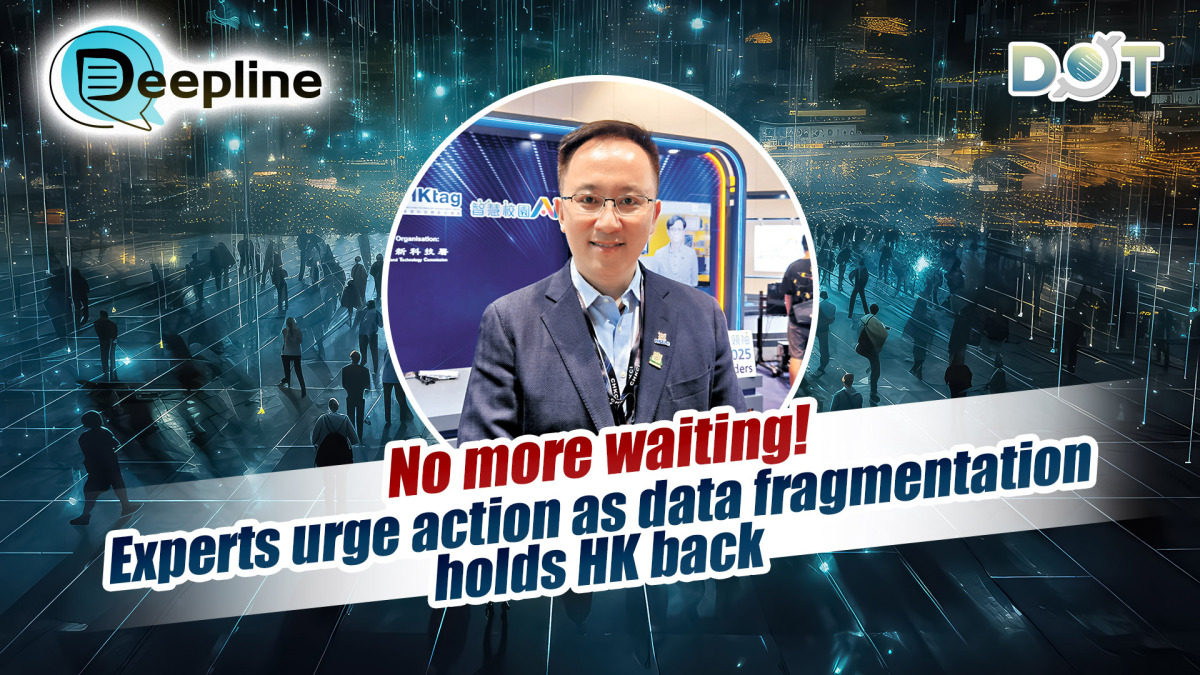
Recently, cities in the Chinese mainland, including Beijing, Shanghai, Guangzhou, and Shenzhen, have successively established data exchanges and actively developed data trading and services. According to projections by mainland media, by 2030, the market size of China's data trading industry is expected to reach 515.59 billion yuan.
In contrast, Hong Kong is still in its early stages overall. Currently, there is no data exchange in Hong Kong. Although initiatives like the Hong Kong Monetary Authority's "Commercial Data Interchange" and the Science Park's "data sharing platform" are related to data trading, the existing data in Hong Kong remains "fragmented." Industry insiders point out that Hong Kong has sufficient conditions and a pressing need to establish a data exchange, especially as the city urgently requires economic re-transformation. Actively developing data trading and services would allow Hong Kong to become one of the global data trading hubs, bringing new highlights to its development.
Eddie Cheung, founder and president of the Hong Kong Technology Advancement Group, stated that as a financial center, Hong Kong generates a vast amount of data daily. Coupled with its unique position of being "backed by the motherland and connected to the world," establishing a data exchange in Hong Kong to process mainland data before trading it globally would create an enormous volume. However, the challenge lies in taking the first step.
Compared to the dozens of data exchanges in the Mainland, Hong Kong is significantly lagging. Currently, mainland data can not only be packaged and traded but also used to derive additional products, putting it on a completely different level from Hong Kong. Cheung acknowledged that the trading volume of mainland data exchanges is not yet high, with a considerable gap compared to A-shares, but it is not too late for Hong Kong to catch up. Beyond legislation and government promotion of data application, cooperation from the business sector could help the entire public realize the practicality and economic benefits of data, though this is a massive undertaking.
Need to establish commercialization standards first
"At the enterprise level, various industries must first establish data standards. At the government level, privacy issues need to be revisited and legislated. Furthermore, there should be gradual efforts to educate the public on data application culture, helping ordinary people understand the business opportunities in the data industry and the concepts of data usage. Only then can such awareness take root in Hong Kong." He added, "In today's world, data is a 'new resource.' Those who can effectively develop, integrate, process, and utilize it will gain a competitive edge. That's why data is hailed as 'new gold'—a highly valuable asset."
However, "everyone, including enterprises, views data as a personal asset. Without significant incentives and a shared mechanism, individuals and businesses will not share their data." Cheung believes that "aside from the Mainland, this is challenging globally. In capitalist societies like Hong Kong and many Western countries, companies view their data as proprietary and are unwilling to share it for free. Selling it is also difficult due to the lack of open trading channels, data commodity standards, and concerns about violating privacy regulations. Therefore, developing data trading in Hong Kong is an uphill battle."
Increasing societal consensus on data sharing
He believes that data trading typically involves "business-to-business (B2B)" transactions. The first step could be similar to developing a stock exchange: the government should encourage industries to establish data standards, set data prices, and implement data certification and trading methods. Then, businesses could collaborate to form a data exchange, after which government regulation could be introduced. Before the exchange is established, the government should also educate the public on the benefits of sharing data and pave the way for revising privacy regulations.
An example was given by Cheung: a well-known property management company once told him they had no issue sharing data from their parking facilities to coordinate parking spaces. However, other property developers were unwilling because the data involved information such as the number of parked cars, which could potentially lead to other business opportunities. They felt they would "lose out" by sharing the data, even if they couldn't pinpoint exactly what they would lose. This reluctance to exchange data among enterprises highlights one of the key challenges the government must address in breaking down the mindset of vested interests.
When asked whether people might be even less willing to provide their data for free if they believed personal information could be sold, Cheung responded that public education is crucial. For instance, the government should share existing use cases and examples with the public to help society understand the real benefits and gains from data exchange. This would allow such a culture to gradually take root in Hong Kong, paving the way for further promotion of data trading.
Advocating the use of real examples to demonstrate the benefits of data utilization
He suggested starting with civic education: "The government should lead by example and highlight the benefits of data exchange across multiple levels. For instance, in the Mainland, data from desert control projects in Xinjiang, such as the types and quantities of plants, water usage, and irrigation frequency, have been shared with multiple provinces and cities. Under the principle of common prosperity, large-scale data exchanges have been smoothly implemented nationwide. When citizens experience the benefits firsthand, they will naturally embrace the culture of data exchange."
Cheung noted that Hong Kong should strengthen its efforts in this regard. For example, the Housing Bureau, Labour and Welfare Bureau, and Hospital Authority currently exchange data to identify elderly individuals living alone, who are at high health risk. This data helps social workers detect issues among solitary elderly individuals early.
However, Cheung noted that the government adopts a low-profile approach when using such data. He emphasized the need for the government to take the lead in demonstrating data exchange, its benefits, and how it can extend to public services, which is of great importance.
(Source: Wen Wei Po; Journalist: Chow Siu-kei; English Editor: Darius)
Related News:
Deepline | From assistant to auteur: Nick Cheuk's 13-year screenwriting odyssey




Comment