






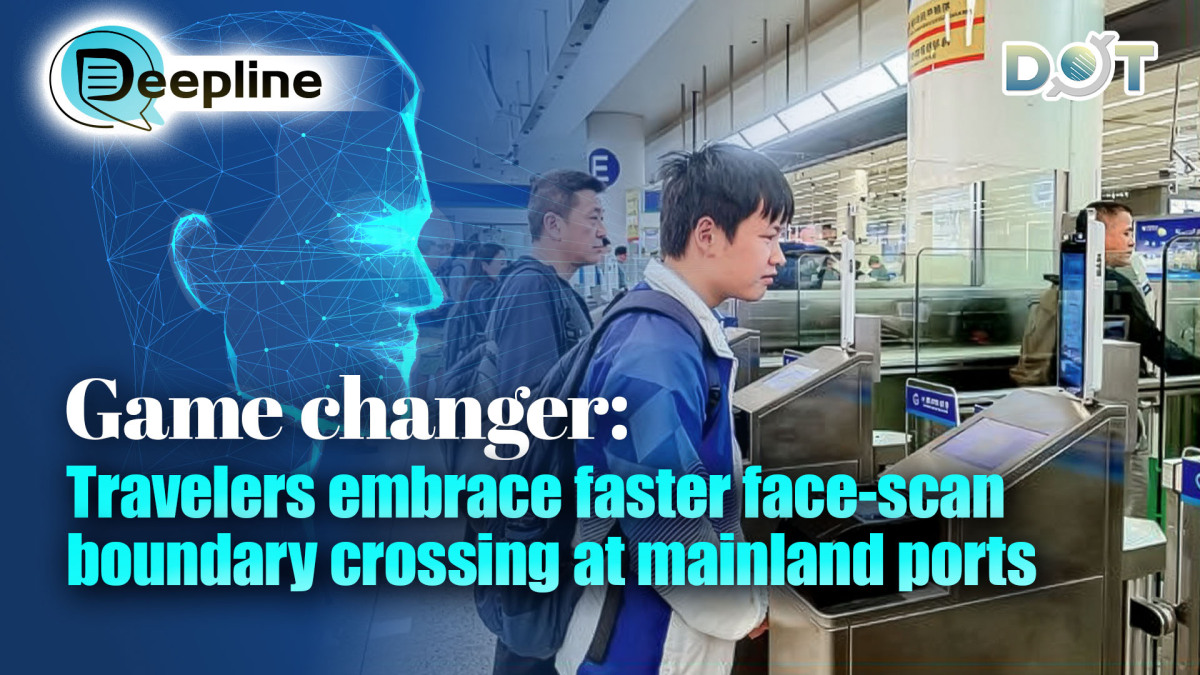
The National Immigration Administration implemented several measures to facilitate immigration management services starting yesterday (Nov. 5). These measures include expanding the facial recognition smart clearance system to multiple mainland ports such as Liantang, Luohu, Futian, and Huanggang. Eligible individuals traveling between Hong Kong, Macao, and the mainland can now use facial recognition for clearance, speeding up the immigration process.
A Wen Wei Po reporter observed at Liantang Port at 10 a.m. yesterday that a large number of citizens preparing to go to Shenzhen had gathered at the scene. Passenger flow was orderly, with both manual channels and smart express channels open at the port. Approximately 60% of the citizens chose to use the smart express channels for clearance.
To further guide citizens in experiencing the smart services, continuous broadcast announcements played in the hall, reminding citizens that they could clear immigration using facial recognition. Many citizens subsequently switched to using the smart channels for facial recognition clearance.
Facial recognition and fingerprint scanning
The reporter later tested the "facial recognition" clearance as a traveler, finding the entire process simple and efficient. The reporter queued in one channel with about 10 people ahead; there was no long wait. The entire process, from the back of the queue to successful clearance, took only 8 minutes, with a compact and efficient overall clearance rhythm.
Upon reaching the gate, the reporter first faced the recognition screen of the smart channel. The system quickly scanned and automatically displayed the reporter's personal information for verifying document numbers and names. The screen showed a message confirming whether to use facial recognition for clearance. After the reporter clicked confirm, the first gate of the smart express channel opened. After entering, the reporter scanned their fingerprint to verify their identity. After these two steps, the second gate opened, and clearance was completed smoothly. The entire process took only about 20 seconds.
Port staff were sufficient. When some elderly individuals encountered hiccups during the operation due to not yet being accustomed to the new clearance method, staff promptly stepped forward to assist, enabling them to complete the clearance process smoothly.
Efficient boundary-crossing satisfies travelers
In the Futian Port arrival hall, Ms. Lee, a Hong Kong resident, shared her experience after using the "facial recognition" clearance for the first time: "The staff enthusiastically guided me through the operation. I just needed to stand there and look at the camera, and the gate opened. The whole process was simple and easy to understand."
"Moreover, I didn't need to fumble for my documents anymore, nor worry about delays due to unfamiliarity with the operation. This method is really friendly for us elderly people."
It is understood that as of 10:30 a.m. that day, one out of every four passengers entering Shenzhen through Futian Port chose the facial recognition.
Mr. Wang from Guangzhou, who studies in Hong Kong, had previously experienced the convenience of facial recognition at Shenzhen Bay Port.
"This time, I used facial recognition clearance at Huanggang Port, combined with the non-contact e-channel on the Hong Kong side. I managed to clear immigration without showing any physical documents at all. This saves a lot of time."
Facial recognition clearance was first piloted at Shenzhen Bay Port and Zhuhai's Gongbei Port as early as November last year. By October this year, over 10.83 million inbound and outbound travelers had used facial recognition at Shenzhen Bay Port, while nearly 24 million inbound and outbound travelers had used it at Gongbei Port since its implementation.
Hengqin: One face scan simultaneously completes Zhuhai and Macao immigration checks
Compared to the smart modes at other ports, the cooperative smart express at Hengqin Port is more convenient. A technically responsible person from the Zhuhai Entry-Exit Border Inspection Station noted that Hengqin Port currently uses the "cooperative inspection, one-time release" inspection model. Therefore, the "facial recognition" smart clearance also achieves "one face scan"—by verifying fingerprints and facial features, immigration procedures for both Zhuhai and Macao can be completed simultaneously.
A relevant responsible person from the Hengqin Immigration Inspection Station said, "This intelligent upgrade of the cooperative express channels launched by the National Immigration Administration at Hengqin, achieving document-free clearance, is the latest achievement in the hardware connectivity construction of the Hengqin-Macao port."
It is reported that Hengqin Port will additionally build 46 "cooperative inspection self-service channels" with smart clearance functionality next year, which is expected to increase clearance capacity by at least 65%. In the future, the immigration departments of both sides will gradually expand smart clearance to other suitable ports and continue to explore more convenient and diverse clearance models.
(Source: Wen Wei Po, Ta Kung Pao)
Related News:




Comment