






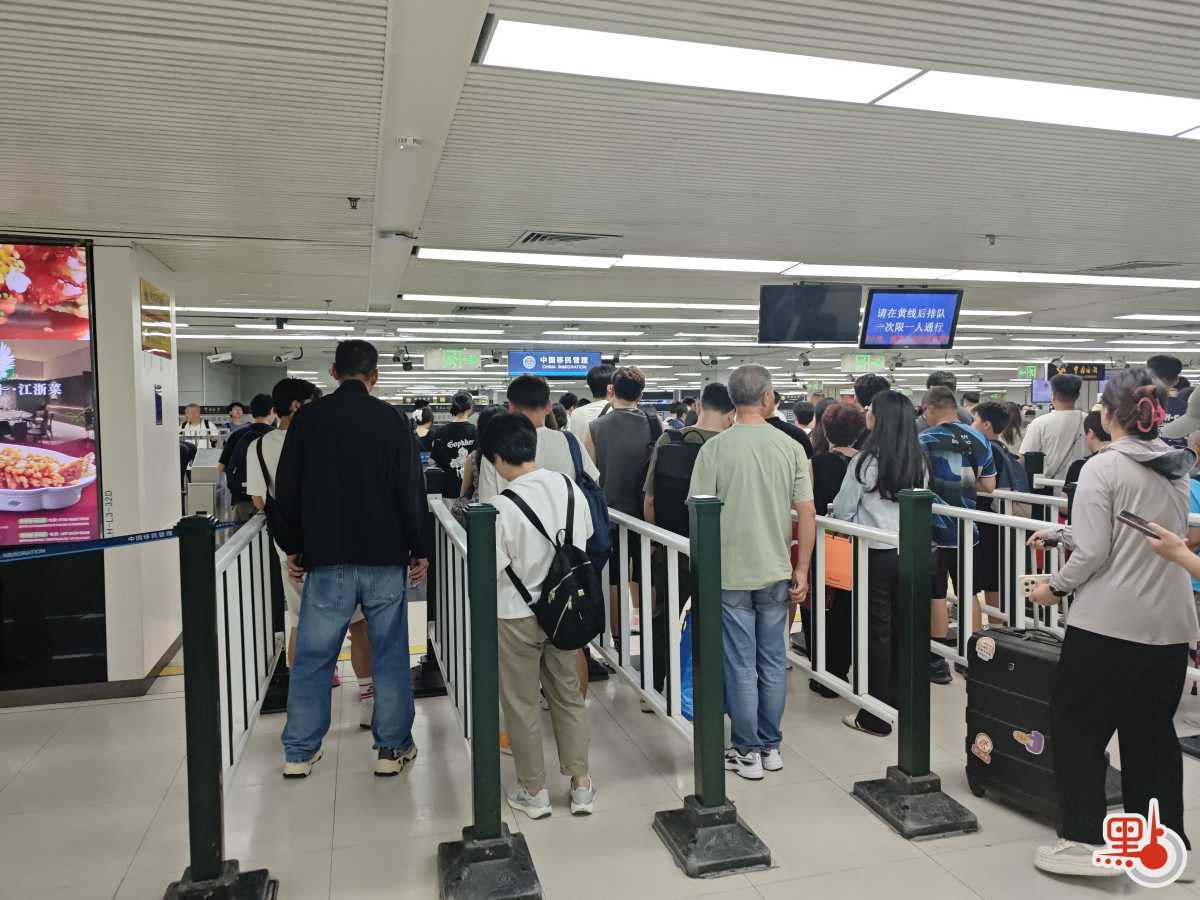
The National Immigration Administration announced today (Nov. 3) that it will implement 10 innovative measures to support the expansion of open services for high-quality development, six of which will take effect on Nov. 5, including the expansion of the pilot implementation scope for the talent endorsement for Hong Kong and Macao.
According to CCTV News on Nov. 3, in order to actively serve and promote high-level openness and high-quality development, the National Immigration Administration today (Nov. 3) released 10 immigration and exit-entry management policy measures.
1. Expand the pilot implementation scope of the talent exit endorsement for Hong Kong and Macao
Starting Nov. 5, 2025, based on Beijing, Shanghai, and the Guangdong-Hong Kong-Macao Greater Bay Area, the talent exit endorsement for Hong Kong and Macao will be implemented across the entire Yangtze River Delta, Beijing-Tianjin-Hebei region, and all national free trade pilot zones. Outstanding talents, research talents, cultural and educational talents, healthcare talents, legal talents, and other talents working in the aforementioned regions can apply for multiple-entry talent visas to Hong Kong or Macao, valid for 1 to 5 years, with each stay not exceeding 30 days, based on certifications issued by talent management departments and qualified employers.
2. Implement nationwide processing for Mainland residents applying for family visit visas to Taiwan
Starting Nov. 5, 2025, mainland residents wishing to visit relatives in Taiwan can submit their family visit visa applications to any public security exit-entry management agency at the county level or above across the country, with procedures consistent with their household registration location.
3. Promote smart customs clearance at certain ports of entry with Hong Kong, Macao, and Taiwan
Starting Nov. 5, 2025, following the implementation of "facial recognition" smart customs clearance at Shenzhen Bay and Gongbei Port, this system will be promoted at Shanghai Hongqiao Airport, Xiamen Gaoqi International Airport, Wutong Ferry Terminal, Guangzhou Pazhou Passenger Terminal, Nansha Passenger Terminal, and various entry points in Shenzhen, among others. Mainland residents aged 14 and above holding valid Hong Kong and Macao travel permits and multiple-entry valid visas for family visits, business, talents, and other categories, as well as Hong Kong and Macao residents (including non-Chinese nationals) holding valid permits to enter the mainland, and Taiwan residents with valid 5-year permits to enter the mainland, who agree to the collection and verification of facial and fingerprint information for boundary inspection, may choose to use the smart rapid passage "facial recognition" channel at these ports. Those with restricted civil capacity must be accompanied by a legal guardian when using the smart rapid passage for entry and exit.
4. Support the efficient cross-boundary flow of production factors in the Hetao Shenzhen-Hong Kong Science and Technology Innovation Co-operation Zone
Starting Nov. 5, 2025, the following convenience measures will be implemented in the Hetao Shenzhen-Hong Kong Science and Technology Innovation Co-operation Zone. For mainland talents working in research institutions and technology innovation enterprises within the cooperation zone, after filing with the management department of the Shenzhen area, public security exit-entry management agencies may issue a 3-year multiple-entry talent visa to Hong Kong and Macao without requiring talent certification upon application. Emerging and start-up enterprises will be allowed to handle business registrations for Hong Kong and Macao without tax liabilities in the first year, with preferential quotas for key enterprises in high technology and high-end manufacturing. Dedicated passages will be established at Huanggang and Futian Port, allowing personnel from enterprises in the Shenzhen area to enter and exit through the Futian Free Trade Zone No. 1 Channel, providing expedited boundary inspection services for personnel frequently entering and exiting the cooperation zone, and offering appointment services for urgent entry needs due to major projects or important events. A green channel will be opened for vehicles transporting research materials in and out of the cooperation zone, optimizing customs inspection methods and enhancing efficiency.
5. Expand the scope of 24-hour direct transit without inspection
Starting Nov. 5, 2025, the 24-hour direct transit policy without exit-entry boundary inspection will be replicated at 10 international airports: Tianjin Binhai, Dalian Zhoushuizi, Nanjing Lukou, Fuzhou Changle, Qingdao Jiaodong, Wuhan Tianhe, Nanning Wuxu, Haikou Meilan, Chongqing Jiangbei, and Kunming Changshui. Passengers holding international connecting tickets for transit within 24 hours who transfer directly at any of these airports to a third country or region without leaving the airport will be exempt from exit-entry boundary inspection procedures.
6. Increase the number of ports in Guangdong Province for the 240-hour visa-free transit policy
Starting November 5, 2025, five additional ports will be added for the 240-hour visa-free transit policy: Guangzhou Pazhou Passenger Terminal, Hengqin, the Hong Kong-Zhuhai-Macao Bridge, Zhongshan Port, and the West Kowloon Station of the Guangzhou-Shenzhen-Hong Kong High-Speed Railway. The total number of ports applicable for the 240-hour visa-free transit policy will increase from 60 to 65. Citizens from 55 countries eligible for the visa-free transit policy holding valid international travel documents and confirmed connecting tickets may enter the country without a visa at any of the 65 open ports in 24 provinces (autonomous regions and municipalities) and stay in designated areas for no more than 240 hours. During their stay, they may engage in activities such as tourism, business, visiting relatives, etc. Activities requiring prior approval, such as work, study, and news reporting, still require a visa for entry. Those who qualify for mutual visa exemption agreements with China or unilateral visa-free policies may follow the respective regulations.
7. Expand the scope of pilot cities for "full online processing" of issuing and reissuing exit-entry documents for Mainland residents
Starting Nov. 20, 2025, the number of existing pilot cities will increase from 20 to 50. Residents aged 16 and above in pilot cities (excluding registered national staff and active military personnel) can apply online through the National Immigration Administration's government service platform to issue or reissue ordinary passports, Hong Kong and Macao travel permits, and Taiwan travel permits without needing to visit an exit-entry window, providing greater convenience for Chinese citizens in processing their exit-entry documents. The list of 30 newly added pilot cities includes: Shijiazhuang in Hebei, Taiyuan in Shanxi, Hohhot in Inner Mongolia, Dalian in Liaoning, Changchun in Jilin, Wuxi, Xuzhou, Changzhou, and Suzhou in Jiangsu, Huzhou, Jiaxing, Shaoxing, and Jinhua in Zhejiang, Nanchang in Jiangxi, Yantai and Weifang in Shandong, Wuhan in Hubei, Changsha in Hunan, Foshan, Huizhou, Dongguan, Zhongshan, Jiangmen, and Zhaoqing in Guangdong, Nanning and Guilin in Guangxi, Haikou in Hainan, Guiyang in Guizhou, Lanzhou in Gansu, and Yinchuan in Ningxia.
8. Facilitate Mainland residents holding family visit visas to renew similar visas in Hong Kong and Macao
Starting Nov. 20, 2025, mainland residents holding family visit visas to Hong Kong and Macao may apply for renewal of similar visas through the China Travel Service in Hong Kong and the China Travel Service in Macao if the permitted stay period does not meet their continued stay needs, with applications submitted at least 7 working days prior to the expiration of their stay.
9. Expand the scope of ports issuing one-time valid travel permits for Taiwan residents to enter the Mainland
Starting Nov. 20, 2025, the number of ports issuing one-time valid travel permits for Taiwan residents to enter the mainland will increase from the existing 58 to 100. Taiwan residents without valid entry-exit documents to the mainland may apply for one-time valid travel permits upon arrival at the ports, and upon approval, they may receive the documents for entry. The list of 42 newly added ports includes: Tianjin Port, Manzhouli (Airport), Manzhouli (Road), Erenhot (Railway), Erenhot (Road), Dandong Port, Yingkou Port, Hunchun (Road), Heihe (Port), Tongjiang (Port), Fuyuan Port, Raohe Port, Luobei Port, Dongning, Suifenhe (Road), Lianyungang Port, Yantai Port, Rizhao Port, Weihai Port, Shidao Port, Longyan Port, Guangzhou Pazhou Passenger Terminal, Shekou Port, Huanggang, Luohu, Zhuhai Port, Hengqin, Hong Kong-Zhuhai-Macao Bridge, Gongbei, Zhongshan Port, Shantou Port, Jieyang Chaoshan Airport, Youyi Pass, Dongxing, Lijiang Sanyi Airport, Mohan (Railway), Mohan (Road), Hekou (Road), Lanzhou Zhongchuan Airport, Dunhuang Mogao Airport, Kashgar Laining Airport, and Horgos (Road).
10. Implement online reporting for foreigners' entry cards
Starting Nov. 20, 2025, foreigners coming to China can fill out entry-related information online through the National Immigration Administration's government website, government service platform, "12367" App, and WeChat (Alipay) mini-programs, as well as by scanning the entry card reporting code on their mobile devices. For those who do not meet the online reporting conditions, they may fill out their entry information by scanning a QR code or using on-site intelligent devices upon arrival at Chinese ports, or by completing a paper foreigner entry card. The following seven categories of foreigners are exempt from reporting: those holding the People's Republic of China permanent residence identity card, those holding Hong Kong and Macao residents' permits to enter the mainland (non-Chinese nationals), those holding group visas or qualifying for group exemption, those transiting for 24 hours without leaving the designated area of the port, those entering and exiting by cruise and returning with the original cruise, those using the rapid passage for entry, and foreign staff of transport vehicles.
A relevant official from the National Immigration Administration stated that these 10 measures are innovative initiatives to support the expansion of open services for economic and social development, deeply learning and implementing the spirit of the 20th Central Committee's Fourth Plenary Session. The National Immigration Administration will continue to deepen reforms and innovations in immigration management services, fully promote high-level openness, serve high-quality development, and contribute greater efforts in immigration management to accelerate the construction of a new development pattern.
Related News:
Policy Address 2025 | Talent policy shows tangible results, fueling sustained economic growth




Comment