






Hong Kong's first astronaut and payload specialist, Lai Ka-ying, is expected to return to Earth early Monday morning after a six-month mission aboard the Tiangong space station. Before departure, she received a symbolic gift named "Happiness," carrying wishes for Hong Kong's prosperity and for peace and well-being among its people.
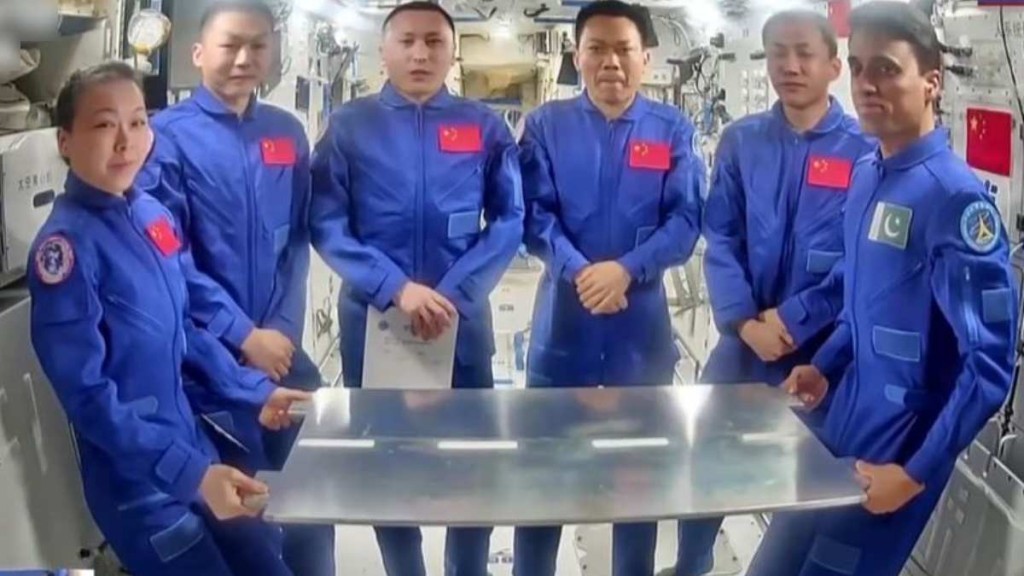
Footage aired on Saturday showed a handover ceremony involving the six crew members of Shenzhou-23 and Shenzhou-24, during which the keys to the space station were transferred. Lai, crewmate Zhang Zhiyuan, and Pakistani astronaut Muhammad Zeeshan Ali are scheduled to return aboard the Shenzhou-23 return capsule, with Zhang serving as commander for the return mission. Ali is the first foreign astronaut to take part in the mission.
Meanwhile, astronaut Zhu Yangzhu will remain in orbit for another six months as part of a year-long stay experiment, alongside Shenzhou-24 commander Tang Hongbo and crew member Wu Yi. Zhu bid farewell to Lai and Zhang, wishing them a safe and smooth journey home and saying they would meet again in Beijing next year.
Wu presented Lai with the gift "Happiness," and Lai thanked the crew for the precious token from Tiangong. Ali said their friendship was unbreakable.
The return window is expected to open at around 5 a.m. on Nov. 30, with the capsule set to land at the Dongfeng landing site in Inner Mongolia. The landing is scheduled before dawn, when conditions will still be dark and extremely cold. A comprehensive drill has been conducted at the site, with ground units—including command, search, communications, and medical monitoring teams—deployed alongside five helicopters assigned to command and communications, medical rescue, and ambulance duties. Drones will also provide overhead lighting to support ground crews operating in the darkness and freezing temperatures of the Gobi Desert.
Return windows are determined by orbital mechanics rather than preference, and the spacecraft can land safely within the designated zone only at specific times. A monitoring and support network—including BeiDou satellites, tracking stations, patrol aircraft, infrared sensors, and radar—will track the capsule throughout its descent.




Comment