






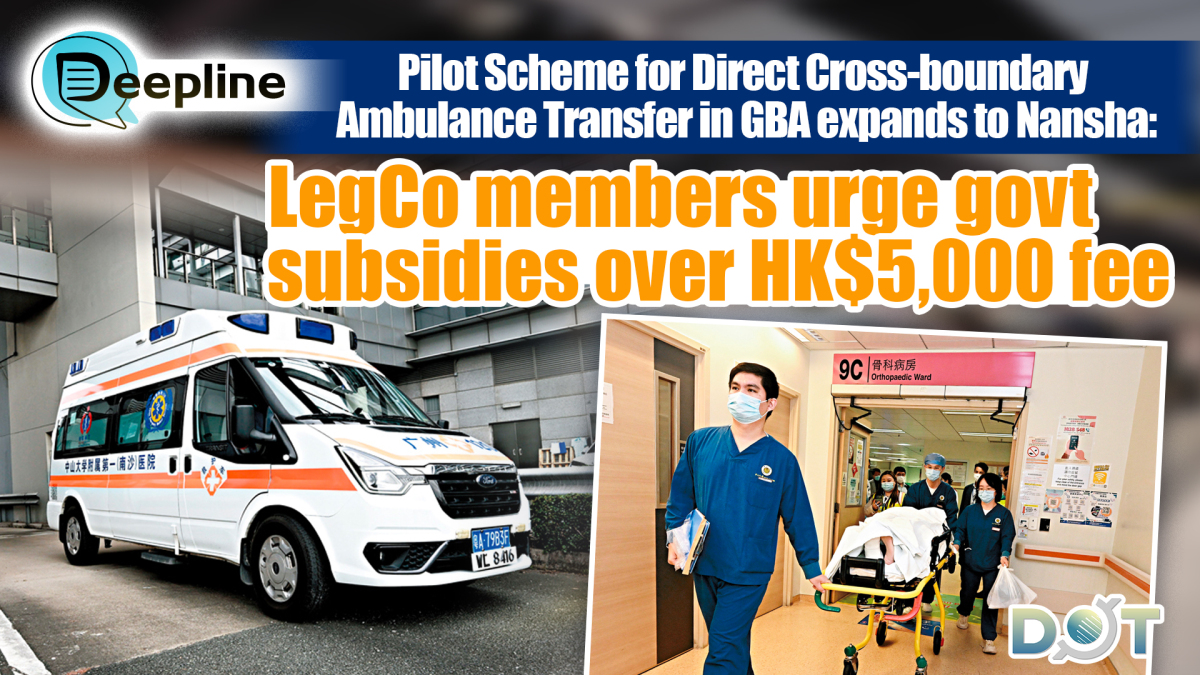
Previously, patients who fell ill and were hospitalized in the mainland or Macao and wished to return to Hong Kong for continued treatment could only transfer between ambulances at the border — a time-consuming process that increased risks. The "Pilot Scheme for Direct Cross-boundary Ambulance Transfer in the Greater Bay Area" was designed to address this pain point.
The Hong Kong SAR Government announced yesterday that it had, together with the People's Government of Nansha District, Guangzhou, conducted a northbound transfer drill for the scheme a few days ago, testing the route and immigration arrangements for an ambulance traveling cross-boundary from Prince of Wales Hospital to the Nansha campus of the First Affiliated Hospital of Sun Yat-sen University under simulated patient transport conditions. The government said that as of mid-November this year, 30 patients had been transferred from designated hospitals in Shenzhen, Zhuhai, Nansha, and Macao (namely the University of Hong Kong-Shenzhen Hospital, Zhuhai People's Hospital, the Nansha campus of the First Affiliated Hospital of Sun Yat-sen University, and Conde S. Januário General Hospital in Macao) to designated public hospitals in Hong Kong for treatment; another three patients had been transferred from designated public hospitals in Hong Kong to designated hospitals in Shenzhen and Zhuhai.
In his 2025 Policy Address, the Chief Executive proposed that the SAR Government, together with the Guangdong and Macao governments, would systematically expand cross-boundary ambulance transfer arrangements, including implementing two-way transfers. In March this year, Hong Kong implemented two-way transfer arrangements with Shenzhen, Zhuhai, and Macao.
Dr Lo Chung-mau, Secretary for Health of the SAR Government, said: "The successful completion of the northbound transfer drill from Hong Kong to Nansha by the Guangdong and Hong Kong government departments lays the foundation for expanding the pilot scheme's two-way transfer arrangements to Nansha. The SAR Government and relevant mainland departments will implement measures as soon as possible to accelerate medical integration in the Greater Bay Area." The pilot scheme has been operating well overall since its launch on Nov. 30, 2024. According to professional medical assessments, the patients involved have ongoing hospitalization needs and are relatively stable, but are unable to cross the border on their own and are not suitable for transferring between ambulances at existing control points.
Wong Kwok, a LegCo member from the Hong Kong Federation of Trade Unions (FTU), told Wen Wei Po that while every additional service point is welcome, only 30 patients have been transferred from the mainland and Macao to Hong Kong since the scheme began — a relatively low overall usage rate. He believes that in reality, Hong Kong people's demand for cross-boundary medical transfers is growing.
Six to Seven in Ten Cases Transferred to Hong Kong Are Severe or Emergency
The director of the FTU Shenzhen Consultation Service Centre pointed out that many Hong Kong people are hospitalized with sudden acute illnesses in the mainland and, due to high costs and lack of mainland medical insurance, urgently wish to return to Hong Kong for treatment as soon as possible. Of the emergency escort cases the centre handles regularly, about 60% to 70% involve severe or relatively urgent conditions, covering locations such as Shenzhen, Guangzhou, Dongguan, Zhongshan, and Huizhou.
Wong Kwok noted that the low usage rate is mainly due to two reasons. First is the cost: at the University of Hong Kong-Shenzhen Hospital, for example, patients using the cross-boundary direct ambulance must pay about RMB 5,000 out of pocket, whereas Hong Kong's emergency ambulance service is free of charge to patients. He observed that some Hong Kong people with less severe or urgent conditions prefer to arrange their own cross-boundary vehicles to return to Hong Kong, and he hopes the SAR Government will consider providing subsidies so that ordinary citizens can afford the service.
Second, the coverage is insufficient — the number of designated hospitals remains small. The director of the FTU Shenzhen Consultation Service Centre added that cases not eligible for the direct service still have to use the old "ambulance swap at the boundary" arrangement: a mainland ambulance delivers the patient to a boundary handover point, where the patient is lifted in and out and transferred to a Hong Kong ambulance — a process that increases risks, and after arrival in Hong Kong, the case is often treated as a common emergency. The FTU hopes the government will continue to expand coverage and add more service points so that more Hong Kong people in need can benefit.
(Source: Wen Wei Po | Editor: Liu Yu)
Related News:
Deepline | What is significance of choosing Qianhai as venue for APEC CEO Summit?
Deepline | Sanctions lobbying as 'politics'? A question any rule-of-law society must face




Comment