






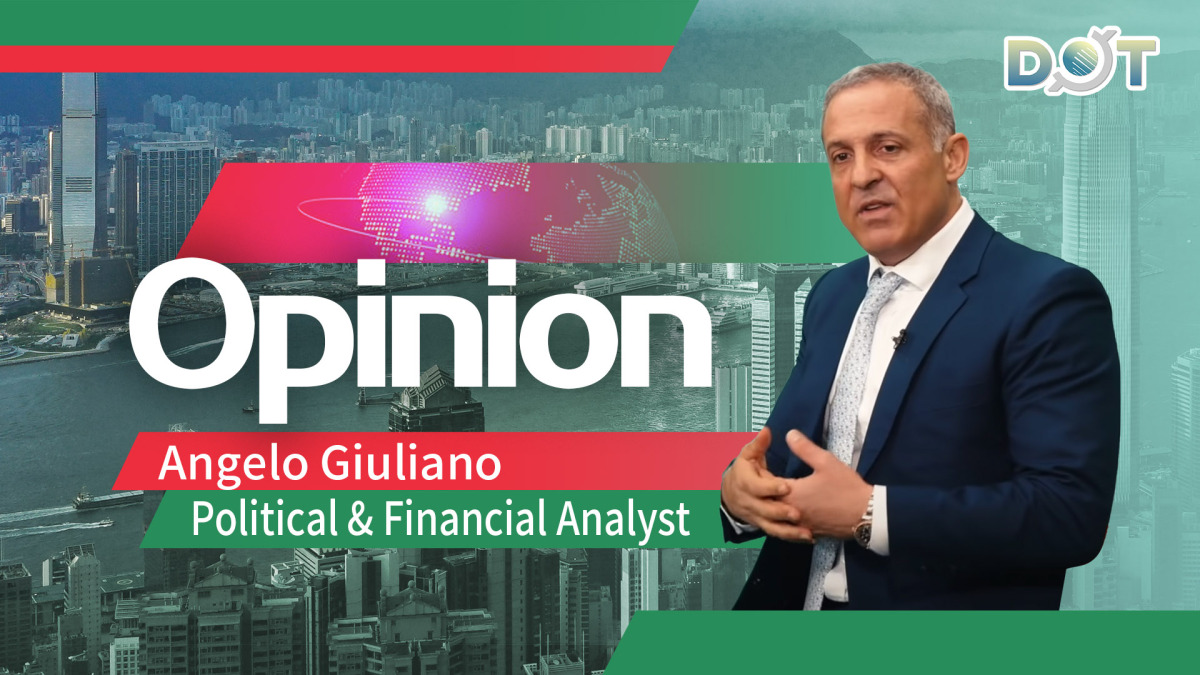
By Angelo Giuliano
The old image of China as a country producing cheap goods in low-end factories is years out of date. Yet this is still how many people in the West seem to imagine the Chinese economy. They continue to talk about China as the world's assembly workshop, apparently unaware of just how much has changed.
The best way to understand this transformation is to look at Shenzhen.
I have lived in Shenzhen, as well as Taipei, Kunming, Shanghai and, more recently, Hong Kong. I spent a year in Shenzhen, in Futian, right next to the iconic Coco Park. I feel lucky to have witnessed the city's development first-hand and to have experienced everyday life alongside Chinese people rather than living in an expat bubble.
Living in different Chinese cities gives you a perspective that is difficult to acquire from reading reports or following international news. You see the changes in everyday life, the infrastructure, the businesses and the way people work. And in Shenzhen, perhaps more than anywhere else, the thing that stands out is the speed at which things happen.
From a small fishing town to a global economic centre
To understand Shenzhen, we first have to go back to Deng Xiaoping.
Deng was the father figure behind China's reform and opening-up policy and one of the central political architects of the Shenzhen project. In the late 1970s, China was beginning to explore a different approach to economic development. Deng supported the idea of creating special economic zones where new policies could be tested without immediately applying them across the entire country.
In 1980, Shenzhen was officially designated as one of China's first Special Economic Zones.
The objective was to attract foreign investment, encourage private enterprise, develop manufacturing and experiment with new ways of doing business. It was a significant departure from the economic model that had previously dominated China.
The idea was relatively simple: experiment, observe the results, learn from mistakes and expand what worked.
Shenzhen became the testing ground.
Deng personally visited the city in 1984 and publicly supported the experiment at a time when there were still doubts about the direction of reform. His backing mattered. It gave political weight to a project that would eventually become one of the most important examples of China's economic transformation.
Other Special Economic Zones and development zones followed. The experience gained in Shenzhen helped shape the country's wider reform process.
What began as an experiment in opening up a relatively small area to new economic policies eventually became a model for much broader development.
Today, the transformation is difficult to comprehend. The former fishing town has become one of China's leading centres for technology, advanced manufacturing, finance and international trade.
The numbers tell part of the story
Shenzhen's economic figures give some idea of the scale of this development.
Research and development spending represents approximately 6.67% of the city's GDP, placing it among the most research-intensive cities in China. Strategic emerging industries account for around 43% of its economy.
Its foreign trade reached approximately US$787 billion in the first ten months of 2026. The city also has more than 2,600 AI companies above the designated size and over 1,000 core robotics companies.
Shenzhen's GDP reached approximately US$557 billion in 2025.
To put that into perspective, this is almost the same size as the entire economies of Thailand or Austria. It is larger than the economies of Norway, Vietnam, the Philippines and Hong Kong individually.
We are talking about one Chinese city, not an entire country.
These figures are impressive, but they still do not fully explain what makes Shenzhen different.
The real advantage: speed and an enormous ecosystem
There is a saying in Shenzhen that it can take roughly 30 minutes to source the components for a new idea.
Spend an evening in Huaqiangbei, in Futian, and you begin to understand what people mean.
Even at 9 pm, shops are open, suppliers are available and people are negotiating orders over WeChat. Electronic components, equipment, engineers and manufacturers are concentrated in an environment where businesses can find what they need without having to organise a complicated international supply chain.
This is one of Shenzhen's greatest advantages.
An entrepreneur with an idea can speak to suppliers, source components, find manufacturing partners and start developing a prototype remarkably quickly. Engineers, component suppliers, manufacturers and businesses operate within the same enormous ecosystem.
The distance between an idea and a finished product is much shorter when so many parts of the production process are close together.
This is not simply about having cheap labour or large factories. It is about the concentration of knowledge, suppliers, technical skills, manufacturing capacity and business relationships.
It is a complete industrial ecosystem, and it helps explain why Shenzhen has become such an important centre for hardware, electronics, robotics and emerging technologies.
The Greater Bay Area and the changing face of China
Shenzhen is also at the heart of China's Greater Bay Area, an economic region linking nine cities in Guangdong with Hong Kong and Macao.
The region brings together technology, finance, advanced manufacturing, logistics and international trade. Each city has its own strengths, but their proximity creates opportunities for businesses to work across the region.
Hong Kong provides an international financial and commercial gateway, while Shenzhen has developed into a major technology and manufacturing centre. The wider region connects these capabilities with an enormous industrial and consumer market.
The geographical proximity is something I experience regularly.
China has also become much easier and more convenient to travel around. I now go from Hong Kong to Shenzhen quite often, sometimes simply for the weekend. Door to door, including the border crossing, the journey takes me around an hour and a half.
Think about that for a moment. One of China's major technology hubs is practically a weekend trip from Hong Kong.
For anyone who remembers the China of previous decades, the changes are remarkable.
APEC puts Shenzhen on the global stage
This is why the APEC spotlight on Shenzhen matters. The city is not simply hosting an international event. It is presenting a very different picture of modern China to the outside world.
Even international media outlets such as Reuters have been reporting on the new generation of Shenzhen companies and their ambitions in international markets.
Of course, Shenzhen still faces challenges. Competition is intense, businesses must constantly adapt and international trade tensions create uncertainty. But none of that changes the scale of what has been built.
A fishing village in 1980. A global technology and manufacturing powerhouse in 2026.
That is the Shenzhen miracle.
And behind the original vision was Deng Xiaoping, whose decision to turn Shenzhen into a testing ground for reform helped set this transformation in motion.
Perhaps it is time people stopped talking about China as though it were still the world's assembly workshop. The country has moved far beyond that description, and Shenzhen is one of the clearest examples.
Having lived there, I have seen the transformation up close. If you have spent time in Shenzhen, you will understand exactly what I mean.
The views do not necessarily reflect those of DotDotNews.
Read more articles by Angelo Giuliano:
Opinion | Why China didn't colonize the world
Opinion | Procedure versus results: China, the West, and who is really more democratic?




Comment