






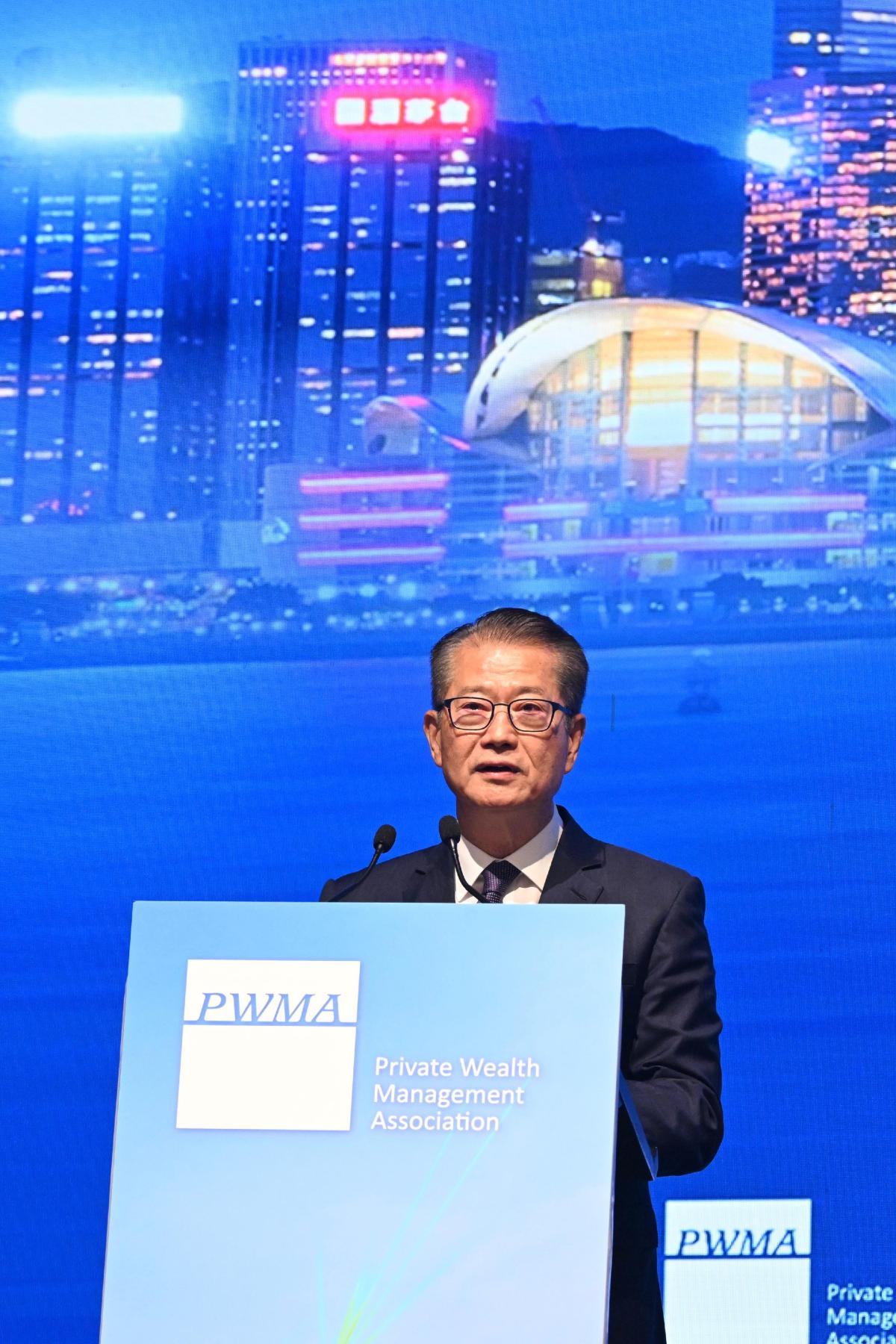
Following is the keynote speech by the Financial Secretary, Mr Paul Chan, at the PWMA Wealth Management Summit 2026 today (Nov. 5):
Amy (Chairman, Executive Committee, Private Wealth Management Association (PWMA), Ms Amy Lo), Vivien (Chief Executive Officer and Managing Director, Private Wealth Management Association, Ms Vivien Khoo), Kelvin (Chairman, Securities and Futures Commission, Dr Kelvin Wong), Eddie (Chief Executive, Hong Kong Monetary Authority, Mr Eddie Yue), Consuls-General, distinguished guests, ladies and gentlemen,
Good morning. It is a pleasure to return to the PWMA Wealth Management Summit. I thank Amy and the Association for bringing us together.
For an industry that believes in diversification, you have gathered a remarkable amount of expertise in one room. I am glad to see that the benefits far outweigh the concentration risk.
Let me begin with congratulations on another successful year. According to the Securities and Futures Commission (SFC) survey released in July, assets under management by the industry grew by 20 per cent to over HK$42 trillion, and Hong Kong is now the largest cross-boundary wealth management centre in the world.
Your new Hong Kong Private Wealth Management Report tells a similarly encouraging story. Some 77 per cent of member firms surveyed reported stronger demand to open accounts or book client assets in Hong Kong, and 94 per cent are moderately or highly optimistic about our prospects over the next five years.
That optimism is widely shared. Earlier this week, the Global Financial Leaders' Investment Summit brought some 280 international financial leaders to Hong Kong, including around 120 group chairmen and chief executives. In my conversations with them, the sentiment towards Hong Kong was decidedly positive, and a number of them told us they intend to increase their investment and headcount here. International capital is casting a fresh vote of confidence in this city.
That confidence is reinforced by our policy to drive the private wealth management sector forward. Our tax concession for family-owned investment holding vehicles is now well established, and Hong Kong is home to over 3 300 single family offices, up 25 per cent in two years. The New Capital Investment Entrant Scheme has received some 4 300 applications, representing an expected HK$150 billion of investment. And we have introduced legislation to further enhance the preferential tax regimes for funds, single family offices and carried interest, which we aim to pass by the end of this year.
The platform is in place. The more interesting question is what the business built on it will look like. Let me offer three observations, framed as open questions, because the answers will be written by you. They come down to where wealth is moving, where it is being created, and who will hold it.
The first question is: where is wealth moving? The global economy is being reconfigured. Geopolitical fragmentation is reshaping supply chains. Conflict in the Middle East has pushed up energy prices, and inflation with them. Sovereign borrowing and investment in new technologies are competing for the same pool of capital.
The result is that interest rates have turned upwards again. In September, the Federal Reserve heightened rates for the first time in three years, the European Central Bank has raised twice in this year, and the 10-year US (United States) Treasury yield has been trading at around 5 per cent.
What does a structurally higher rate environment mean for your business and your clients? For more than a decade, near-zero rates pushed investors out along the risk curve in search of yield. That logic has now reversed. Cash earns a return again, and so capital is no longer cheap and becomes more risk averse. Duration, credit quality and leverage - the fundamentals that a decade of cheap money allowed investors to set aside - matter once more.
Higher rates and greater uncertainty are also redrawing the map of capital. Investors are diversifying across markets and currencies, Hong Kong is a clear beneficiary of capital inflow. Total deposits in our banking system grew by 7.7 per cent, reaching HK$20.9 trillion, in the first nine months of this year. Our initial public offering market raised a record HK$388 billion over the same period, second in the world. And with many of our listed companies still trading at a discount to their international peers, that valuation gap is once again drawing in global capital.
Further to the US and Europe, capital is coming from the Chinese Mainland, and from Southeast Asia, Central Asia and the Middle East. So do your teams, your booking capabilities and your product shelves reflect this new client geography?
The second question is: where is wealth being created? The answer, increasingly, is technology, and above all AI (artificial intelligence). Technology is now the largest source of wealth among the world's billionaires. For example, in the Chinese Mainland, the fortunes of billionaires grew by more than 20 per cent to US$1.8 trillion last year, with technology among the biggest contributors.
These are a different kind of client. They are younger, often still running their companies, and some wealth is still tied up in a private business. They understand risk, know venture and private markets well, and care more about the next opportunity than about preserving the last one. So what is their investment appetite, and how do you serve a client whose wealth is less liquid, concentrated and growing fast?
In this part of the world, we are seeing that wealth take shape in real time. Mainland companies are going global, and Hong Kong is their gateway and platform. In the first three quarters of this year, 116 companies listed here. A-plus-H listings accounted for nearly 70 per cent of the funds raised, and technology companies in AI, semiconductors and robotics made up more than half. With some 500 active listing applications, the pipeline remains deep.
Every listing and every exit unlocks liquidity, and liquidity creates wealth that needs to be managed. Are you positioned to capture it at source?
The third question is: who will hold the wealth? A generational transfer on a historic scale is under way. For example, in the United States alone, well over US$100 trillion is expected to change hands over the next two decades, and much of it will pass first to surviving spouses, the great majority of them women. Asia is a generation behind in this cycle, but the entrepreneurs who built the first fortunes of the Chinese Mainland and the region are now planning their succession, and the same pattern will follow here.
So who will your next clients be? More of them will be women. More will be the second generation. And their priorities will differ from those of their parents.
For a sense of those priorities, consider the Festival of Connoisseurs, which has brought wealthy families to Hong Kong this week around art, design, wine and craftsmanship. It points to two aspirations. The first is lifestyle: culture, arts and exceptional experiences are part of the purpose of wealth, not an afterthought, and the asset universe extends from equities and bonds to collectibles and passion assets.
The second is meaning. The next generation wants their wealth to do good, not just do well. Impact and green investing are moving from the margin to the core of the portfolio. So are you prepared to discuss a carbon-credit strategy and a work of art in the same conversation?
Ladies and gentlemen, these are open questions, and I have more confidence in your answers than in mine. But the direction is clear. Your next client will be more international, more entrepreneurial, more likely to be younger, with women increasing in number, and looking for both return and purpose. Hong Kong gives you the platform to serve them: the security of our institutions, the opportunities of the Mainland and the region, and a government committed to broadening both. The answers will be written here, by you.
I wish the Summit every success. Thank you.
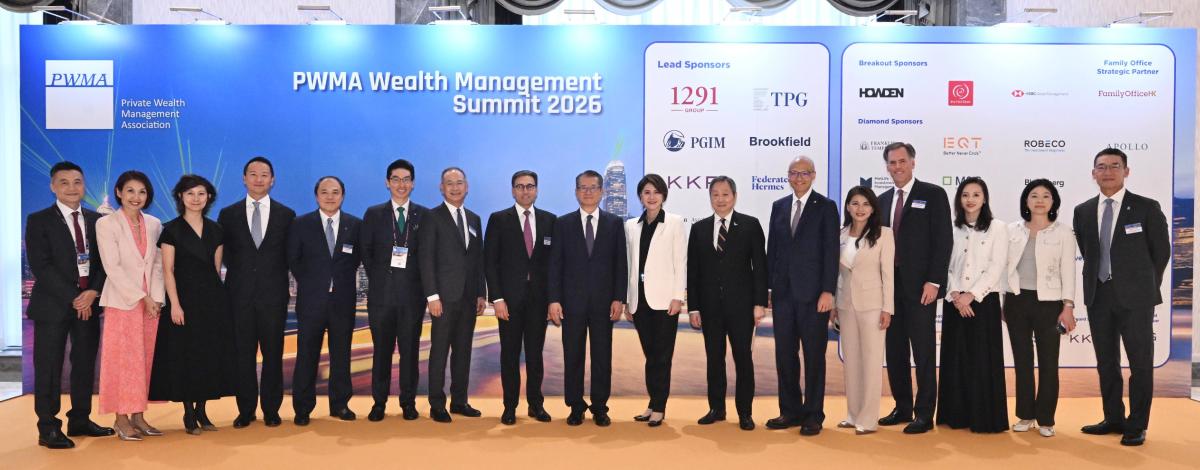
(Source: ISD)
Related News:
'Hong Kong's Participation in the 27th Shenzhen Reading Month' commences in Shenzhen




Comment