







By Philip Yeung
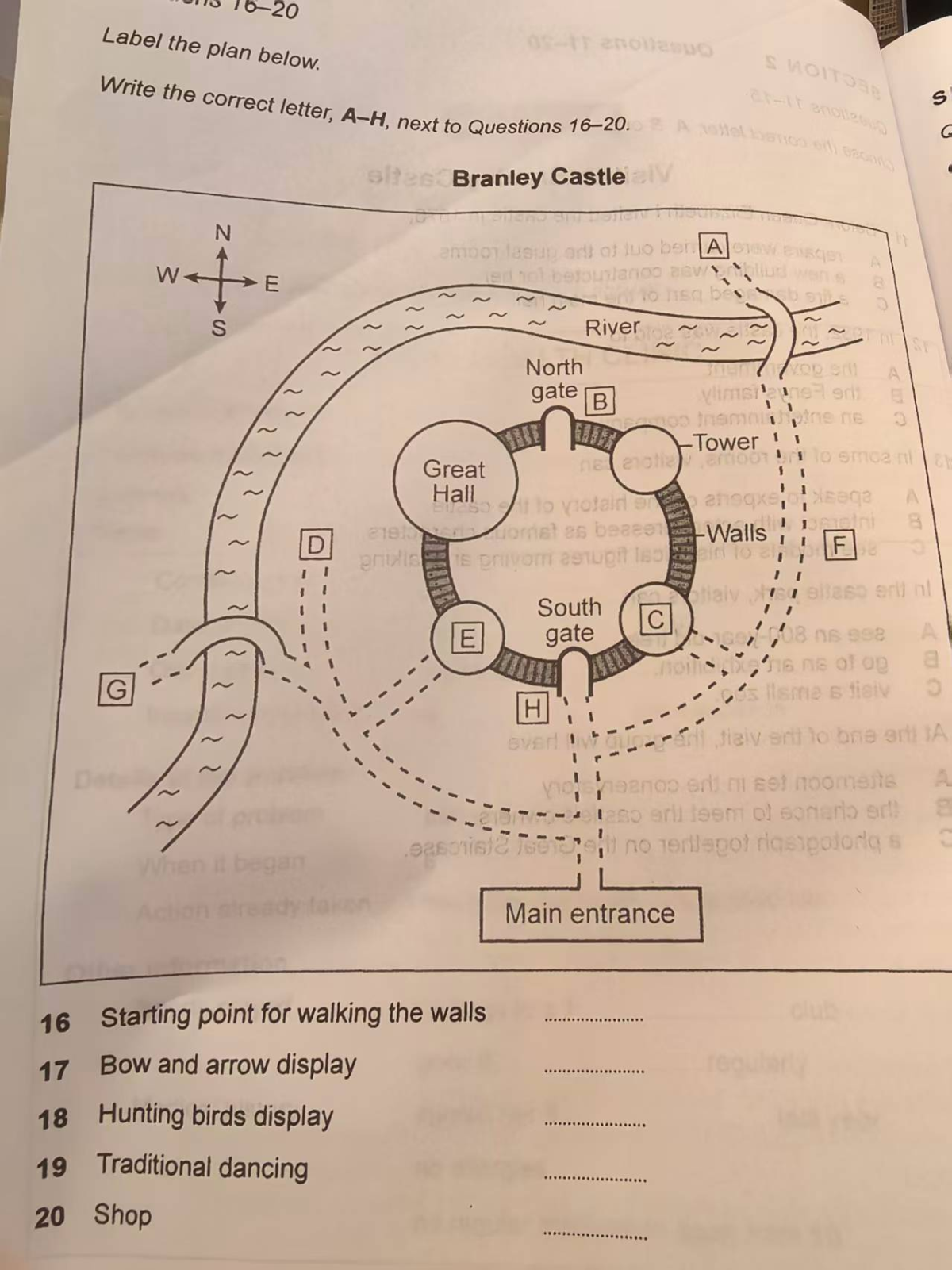
If you are of sound mind and body, and plan to take the IELTS test, you will come to see the design flaws in IELTS questions. In a question in the Listening Paper in the Cambridge IELTS authentic test practice, edition 14, test 2, there is a question about where the Hunting Birds Display Area is located. According to the instructions, it is supposed to be situated somewhere PAST the tower (See map below). The correct answer is F, which clearly comes BEFORE you reach the tower. And yet the correct choice requires you to ignore what your eyes tell you. In all my adult years, I have never seen an exam question that deliberately sets out to mislead the test-taking public as they try to make sense of this maze of a map. At the end of the test, you may seriously begin to doubt your own sanity.
Take a listen to the instruction that accompanies the map: "…If you go from the main entrance in the direction of the south gate, but turn right before you get there instead of going through it, you'll see it on your right past the first tower." Please note that only B is PAST the tower. But if you pick B, you answer incorrectly, and you will be penalized accordingly. Your test score thus becomes a matter of luck, rather than of linguistic ability.
I thought this was a test of the test-taker's listening skills, not one's sense of direction in trying to navigate an ancient castle. Whoever designed this test has forgotten the true purpose of IELTS. Granted, the language used in the instructions is simple enough. But when the directions are inaccurate, and even misleading, the question defeats its purpose. I challenge any native English speaker to follow the instructions and arrive at the correct answer.
The common complaint against the IELTS test is that it seems designed to arouse a state of high anxiety among test-takers by overwhelming them with a load of distracting or confusing details, becoming puzzles that must be solved within a very tight time. With one's future riding on the outcome of the test, their nervousness is already through the roof. Even Sherlock Holmes would have stumbled over this test. Clarity is missing from the design of the test.
If I may be cynical, I would say that the deceptive directions will result in higher failure rates and therefore generate more revenue from repeat test-takers. But this is grossly unfair, if not unethical. It is simply wrong to put test-takers through bouts of needless anxiety as you laugh all the way to the bank.
May I suggest that in future, IELTS test papers steer clear of misleading and disorienting questions. Stick to everyday scenarios that are comprehensible, not esoteric or outlandish materials.
Of the 4 papers, I would say that the Speaking test is the fairest of them all. The speaking tasks are reasonable and well-designed, and actually serve the legitimate purpose of assessing the test-taker's language proficiency.
IELTS designers should not stray away from their principal role and responsibility of determining whether a test-taker meets the threshold of linguistic preparedness for academic study in higher education. It should not tarnish its reputation as a reliable predictor of students' language ability.
Cambridge sits at the top of the world's leading universities. It has a duty to uphold the highest standards in language testing, while subserving the noble mission of universities. It is high time IELTS lived up to its expectations. Benefiting from the vulnerabilities of test-takers, in the Asian market and elsewhere, runs counter to its nobility of purpose.
The views do not necessarily reflect those of DotDotNews.
Read more articles by Philip Yeung:
Opinion | An open letter to Cambridge University: Have we misplaced our trust in IELTS?



Comment