






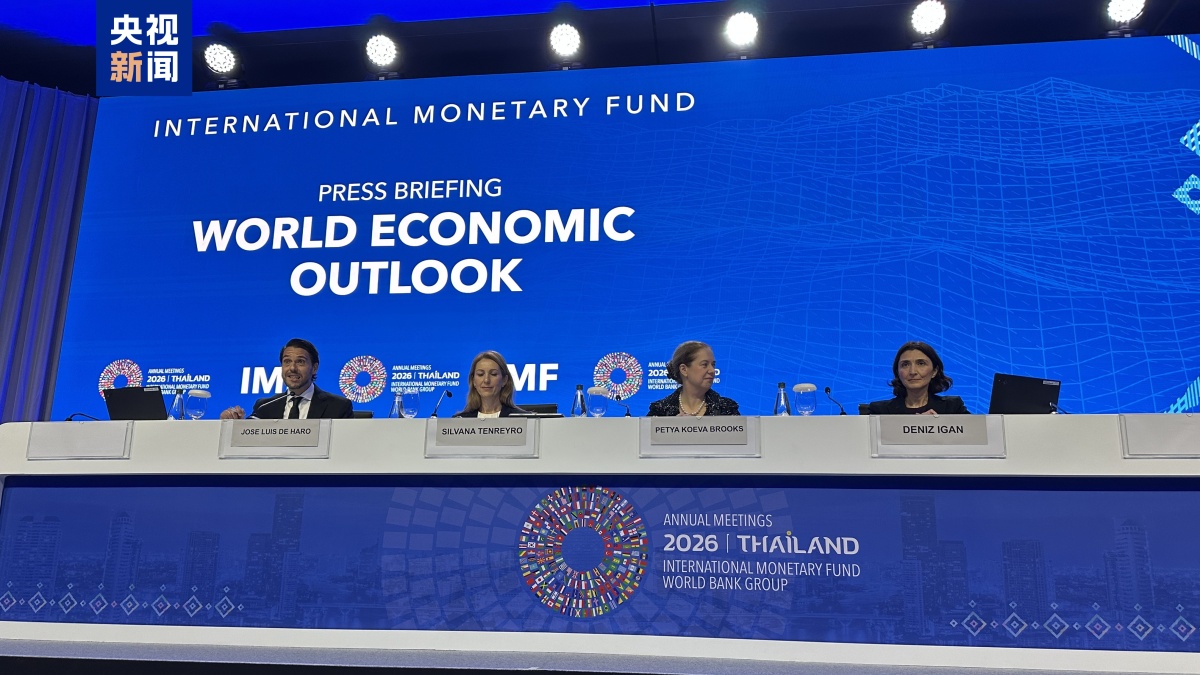
The International Monetary Fund (IMF) released its latest World Economic Outlook report on Oct. 13, slightly raising its forecast for global economic growth this year to 3.1%, 0.1 percentage point higher than its July projection. The IMF said an artificial intelligence (AI) investment boom has boosted some economies, offsetting the drag from Middle East conflicts on others.
The IMF and World Bank Group 2026 Autumn Meetings are being held in Bangkok, Thailand, from Oct. 12 to 18. The World Economic Outlook report released during the meetings forecasts that global growth will slow from 3.5% in 2025 to 3.1% in 2026, before rebounding to 3.4% in 2027. Advanced economies are expected to grow 2.1% this year, up 0.4 percentage points from July. Emerging markets and developing economies are expected to grow 3.7% this year, down 0.1 percentage point from July.
Among major advanced economies, the US economy is expected to grow 2.3% in both 2026 and 2027, supported by consumption, fiscal policy and technology investment. The euro area is expected to grow 1.1% and 1.2% respectively, reflecting continued drags from high energy prices and weak consumer confidence.
The IMF said global growth is diverging because countries are affected differently by war-induced energy shocks and AI-related demand. Better-performing economies combine energy supply resilience with close links to AI hardware supply chains. By contrast, many energy-importing countries with limited connection to the technology cycle face higher import costs, weaker currencies and lower real incomes.
The IMF estimated that shipping disruptions in the Strait of Hormuz could reduce global growth by 0.9 percentage point this year, but the net impact would be slightly eased by factors including rerouted Gulf oil exports, higher crude output elsewhere and releases from strategic petroleum reserves.
Saudi Arabia's economy is expected to shrink 3.3% in 2026, a downward revision of 5 percentage points from July. Commodity producers hit harder by energy production and transport disruptions, including Bahrain, Iraq, Kuwait and Qatar, are expected to see double-digit contractions this year.
The IMF warned that global oil inventories are sliding toward warning levels that could trigger sharp price spikes. The average oil price in 2026 is estimated at US$95.74 per barrel, up about 41% from 2025.
The report projected that global headline inflation will rise from 4.1% in 2025 to 4.7% in 2026, before falling back to 4.1% in 2027.
Related News:




Comment