






The Aichi-Nagoya Asian Games came to a close on Oct. 4 after a two-week competition, with China topping the gold medal table for the 12th consecutive edition.
From the opening ceremony's grand staging to athletes' uniforms and competition venues, Chinese technological innovation and design excellence played a pivotal role across the Games. Several Chinese brands and their engineering delivered integrated solutions that highlighted the strength and adaptability of China's manufacturing and creative industries.
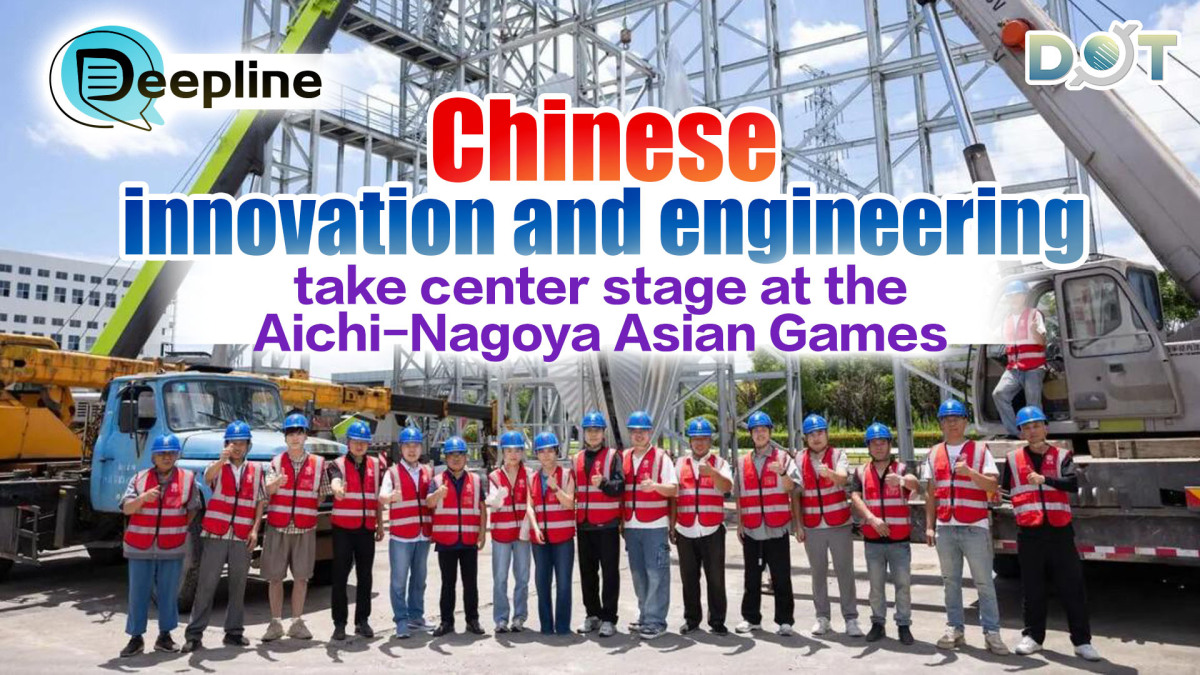
Following the lighting of the main cauldron, the opening ceremony featured a sequence of choreographed performances and visual spectacles. The stage engineering, design, and development of the main cauldron tower, digital content, and on-site implementation for the grand ceremony were all carried out by a project team from Dafeng Industry, a Chinese provider of integrated solutions for cultural, sports, and tourism industries based in east China's Zhejiang province.
Working closely with organizers, the team managed everything from creative direction and production to system integration and operational management. Powered by proprietary Chinese software and hardware, the unified platform guaranteed seamless coordination of all critical ceremony elements.
Nagoya's coastal location presented significant environmental challenges. Prone to typhoons and seasonal downpours, the region requires outdoor structures to meet rigorous standards for wind resistance, seismic safety, waterproofing, and structural redundancy.
"The real challenge wasn't any single piece of equipment; it was integrating dozens of interdependent subsystems. Even a millisecond-level delay in lighting, stage machinery, projection, or audio could cascade into a major disruption," said Xu Huiwen, technical director of the opening and closing ceremonies of the 20th Asian Games and technical director of the stage design institute of Dafeng Industry.
Multiple challenges of the project have been resolved through a two-site coordination model.
A team in Zhejiang province's Hangzhou was responsible for refining the technical plans and developing digital content. Using digital twin technology, it simulated wind patterns and lighting effects around the main cauldron tower at the Nagoya site, assessed the potential risks posed by typhoons and heavy rain in advance, and carried out coordinated testing of stage-design subsystems as well as cross-border reviews online.
Meanwhile, the company's smart manufacturing base in Yuyao, Ningbo, Zhejiang, was responsible for equipment manufacturing. The entire main cauldron tower was produced there, underwent multiple rounds of stress tests and extreme-condition testing, and was packed and shipped to Japan in August 2026. By completing extensive debugging and testing in China ahead of time, the team significantly reduced the workload of on-site construction in Japan.
This is not the first time the team has worked on an international multi-sport event. Dafeng Industry's technical solutions have previously been used at major events including the Jakarta Asian Games, Beijing Winter Olympics and Hangzhou Asian Games.
The company also provided stage support for the G20 Hangzhou Summit, building extensive experience in delivering large-scale engineering projects across the entire process and across national borders.
The company is now continuing to explore ways to take its equipment, creative solutions, and technical standards overseas. Its technologies and services have been deployed in more than 100 countries and regions around the world.
Around the Asian Games venues, volunteer Makino moved through the stands in a forest-green uniform, helping guide spectators.
"It's incredibly lightweight and breathable. It wicks moisture efficiently and dries quickly, which makes a huge difference in humid conditions," Makino said.
The uniform is made by Chinese sportswear brand 361 Degrees. As an official partner of the Games, 361 Degrees has provided official sportswear for torchbearers, torch relay runners, volunteers, and technical officials. The garments utilize advanced quick-dry, ultra-light fabrics engineered to withstand repeated laundering without losing performance. Each cut was optimized through biomechanical modeling and motion-simulation studies, ensuring athletes and staff remain agile and comfortable during prolonged outdoor activity.
Design details also feature in the uniforms of several national and regional delegations. The uniform for the Cambodian delegation draws inspiration from the architectural contours of Angkor Wat, while the uniform for the Mongolian delegation incorporates imagery of the grasslands.
For this Asian Games, 361 Degrees customized competition uniforms for six national and regional delegations and provided competition and training equipment for the Olympic Council of Asia Refugee Team. This is reportedly the fifth consecutive Asian Games that 361 Degrees has served, with more than 5.4 million pieces of sportswear supplied in total.
Inside the gymnastics venue, a technical support team from Taishan Sports, a Chinese supplier of sports equipment and services based in east China's Shandong province, was carefully inspecting the equipment. Half a month before the opening, members of the team arrived in Japan in batches and began installing equipment at the competition, warm-up, and training venues.
Athletes and coaches are familiar with their technical routines, but may not necessarily know the ins and outs of competition equipment. Taishan's specialists remain on-site throughout the Games to monitor performance and coordinate rapid responses.
"Our protocols leave no room for deviation," noted Wang Wei, chief engineer of the support team. "We conduct a full systems check exactly one hour before every session -- a non-negotiable standard."
In addition to gymnastics, Taishan Sports is providing complete sets of competition equipment and one-stop event support for 16 sports at these Asian Games, including wushu, wrestling, and cycling.
Since equipping the 1990 Beijing Asian Games, the company has maintained an unblemished record: zero malfunctions, zero safety incidents, and zero formal complaints.
"From products to services and standards, and from elite competition venues to the mass market, we have always forged ahead with the mindset of climbers, reaching for greater heights," Wang said. "We aim to see Chinese sports brands shine even more brightly on the world stage."
(Source: People's Daily | Editor: Liu Yu)
Related News:
Deepline | Longer trips, richer experiences: National Day holiday reveals shifting tourism trends




Comment