






Hong Kong has "the best chance in many decades" to move towards an innovation economy and strengthen its position in life and health technology, with its access to the Mainland market, international outlook and growing policy support giving the city a strong foundation to build a competitive innovation ecosystem, according to Professor Li King-chuen, Founding Dean of the School of Medicine at The Hong Kong University of Science and Technology (HKUST).
Speaking to DotDotNews after the Life and Health Technology panel at the Global Youth Powerhouse Summit 2026 in HK, Professor Li said the city was "well situated" to develop the sector, citing its proximity to the Mainland and access to a market of 1.4 billion people, particularly in health and wellness.
"HK is actually well situated," Li said, highlighting three major advantages: its connection with the Mainland, its international exposure and its ability to bring ideas and talent from around the world.
With government policies now providing greater support, he described the current period as a critical moment for HK.
"We have probably the best chance in many decades to move into innovation economy and come out ahead of most economies in the world," he said.
Four 'I's to turn ideas into impact
Li said HK should first identify gaps in its innovation ecosystem and invest in areas where it has a competitive advantage, with the goal of opening up the entire pipeline from ideas to products and ultimately global markets.
He also reiterated his four "I's" framework for innovation: Ideation, Investment, Implementation and Impact.
"The first step is Ideation. That means you need to have new ideas. If there's no new ideas, there's no innovation," he said.
The second step is Investment. Even when an idea exists, it remains just an idea without financial backing.
Investment must then be followed by Implementation—turning an idea into a prototype and eventually a product.
The final step is Impact: expanding the product, getting it adopted around the world and reaching the largest possible market.
He also stressed the importance of proprietary data in the development of artificial intelligence and health technology.
"We have lots of people, good opportunities to collect large amount of data that's proprietary," he said, adding that proprietary data would be "the most important" asset in an increasingly intelligent world.
Li said HK would need to take a long-term view when investing in emerging industries, even if returns might not come immediately.
"If we lose money in the first 10 years, but if we come out ahead, we will own the world," he said.
He added that Hong Kong and the Mainland had strong potential to succeed if they could identify where to place their bets, build up their competitive advantages and open the entire innovation pipeline.
Northern Metropolis could reshape HK's health-tech ecosystem
Professor Lok Yuk-lam, Founding President of the HK Bio-Med Innotech Association, said the development of the Northern Metropolis could fundamentally reshape HK's innovation and technology ecosystem.
Lok said the HKSAR Government's decision to devote a significant portion of land to high technology, education, innovation, biotechnology, green technology and artificial intelligence represented an unprecedented opportunity for the city.
"I would say it's going to be a new HK," he said.
He pointed to the arrival of major enterprises as a potential catalyst for a wider industrial ecosystem, with smaller companies expected to cluster around major "anchor" businesses.
Citing JD.com as an example, Lok said more major Mainland enterprises were expected to establish a presence in the area.
He compared the potential development with Taiwan's semiconductor industry, where the presence of TSMC has helped attract thousands of companies to form a wider industrial ecosystem.
"So I think HK's new initiative is gonna happen in the same way," he said.
Lok acknowledged that building a new innovation ecosystem would not be easy, particularly during the first five years, but he stressed that the strategy, planning and roadmap were already geared towards developing the new ecosystem.
Rather than simply copying established innovation centres such as Silicon Valley or Boston, Lok said HK should develop its own model.
"We're going to have a new formula," he said. "That's why I think we're working very hard to build a new hybrid Silicon Valley, or bigger than Boston science park."
From health-tech investment to real-world benefits
Lok also highlighted how closer integration with the Mainland could allow HK residents and patients to benefit more directly from advances in healthcare and biotechnology.
He said HK had historically made limited use of drugs and other healthcare products from the Mainland, but this could gradually change as new initiatives develop.
"The HKSAR Government were hardly using any drugs or anything from the Chinese Mainland," Lok said.
"Now, with a new HK, with a new initiative, I think it is going to slowly start using the services and products from the Mainland."
Looking further ahead, Lok said the cost advantage of advanced medical treatments in the Mainland could attract patients from around the world.
He predicted that within 10 years, cancer patients seeking gene and cell therapies could increasingly travel to China, where treatment costs could be "one fifth of the cost or maybe even less" compared with other markets.
"So HK and the Mainland, they pay that piggyback economy," he said, suggesting that the city could benefit from the development of a broader Mainland healthcare and biotechnology ecosystem.
Health-tech takes centre stage at youth summit
Organized by the Hong Kong Youth Professional Global Advocacy, the summit entered its third edition this year and brought together political and business leaders, corporate representatives and young professionals to discuss Hong Kong's strategic opportunities amid a changing global economic landscape.
The summit was held following the release of HK's first five-year plan and the 2026 Policy Address, which set out the city's development priorities for the coming years.
The summit focused on several key areas, including artificial intelligence, geopolitics, education, capital markets, life and health technology, and startup financing.
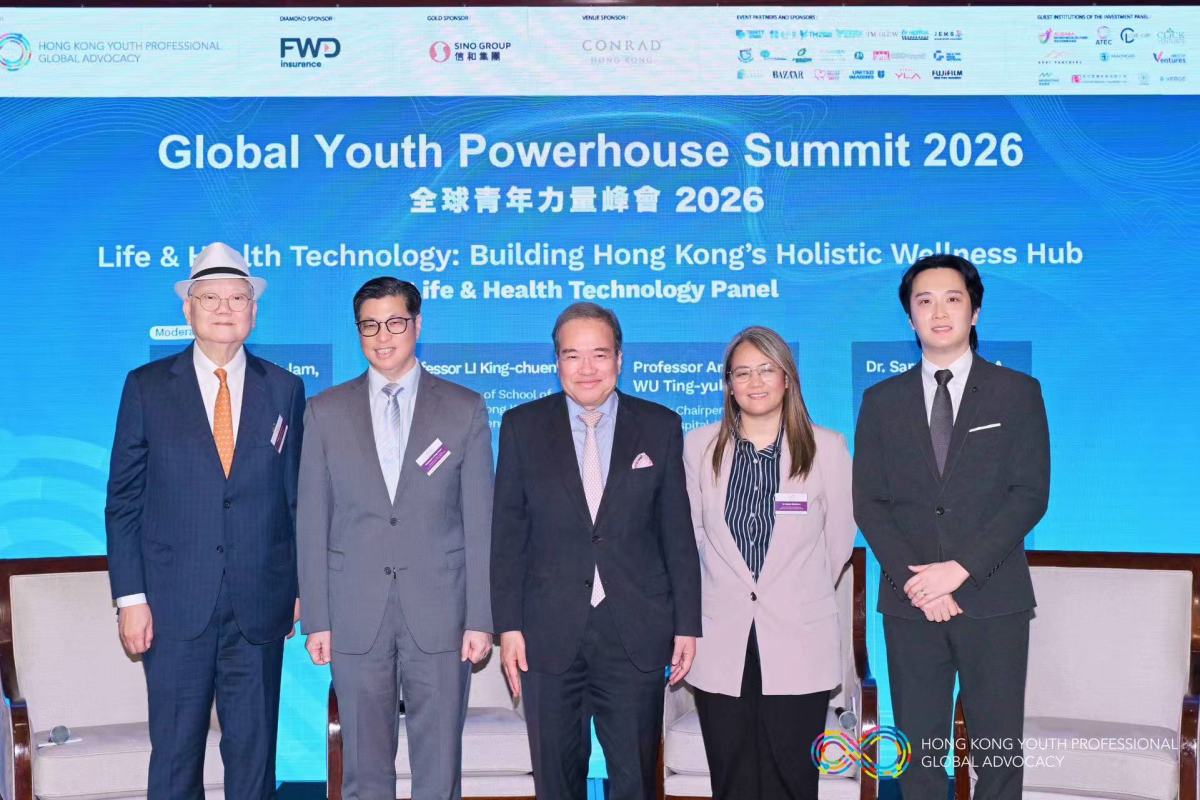
The Life and Health Technology Panel was moderated by Lok and featured Li, Dr. Sarah Salvillia, Group Chief Health Partnerships Officer, FWD Life Insurance, and Professor Anthony Wu, former Chairman of the Hospital Authority and Non-Executive Chairman of Trinity Medical Group.
The panel explored how artificial intelligence and other emerging technologies could strengthen HK's competitiveness in healthcare and life and health technology.
(Reported by Zoey SUN, Ian LAU)
Related News:




Comment