






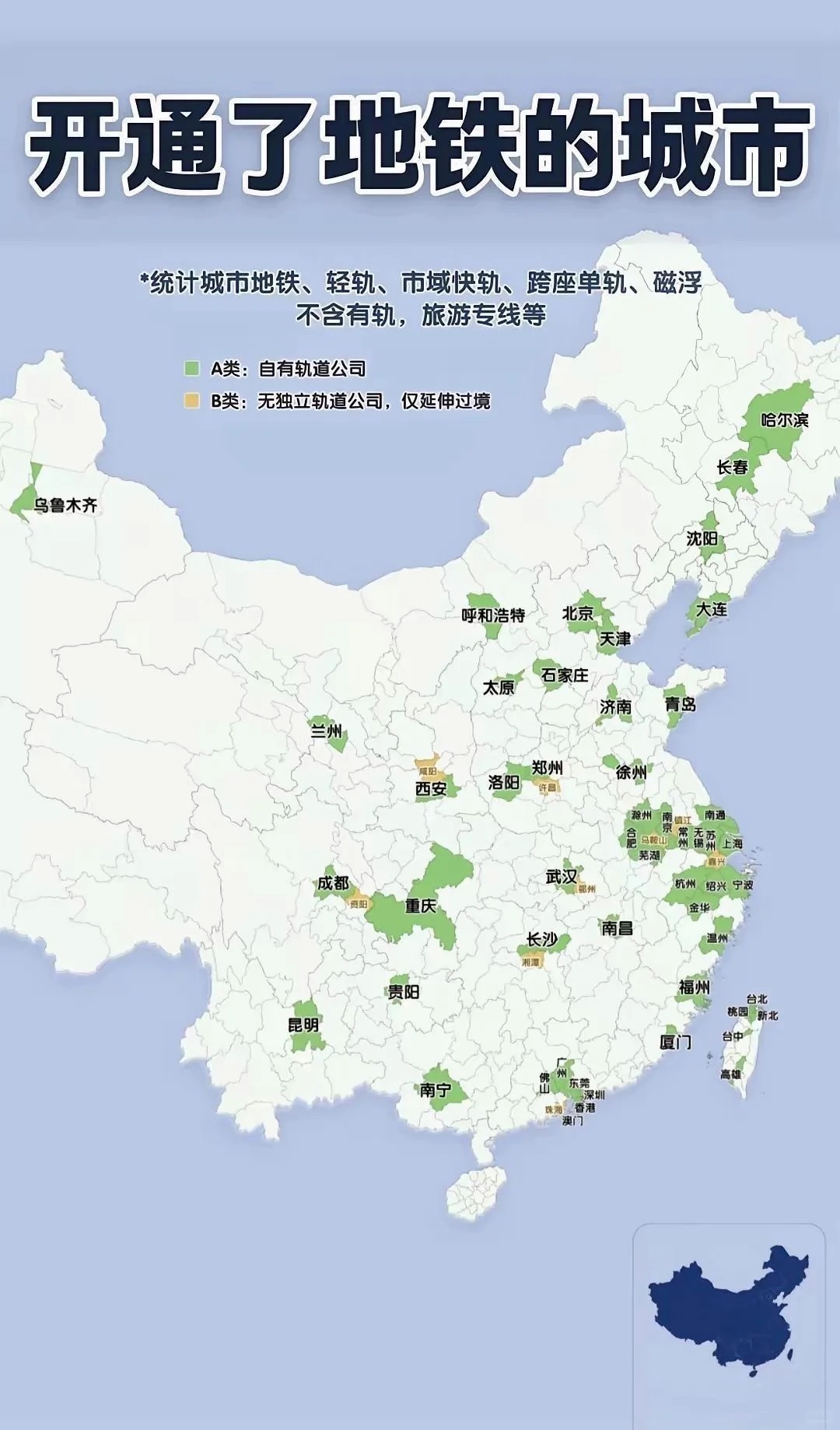
Metro systems have become one of the most effective ways to ease traffic congestion and improve commuting efficiency in major cities. But how many "metro cities" are there in China today? The answer is larger than many people expect—and, by several measures, China now ranks No. 1 globally by a wide margin.
Before looking at the numbers, it is worth clarifying a common point of confusion: "urban rail transit" is not exactly the same as "the metro." In practice, urban rail can include heavy metro lines as well as light rail, suspended monorails, trams, maglev services, and suburban rapid rail. Some operators run multiple types of rail under the same company, while others do not even use the word "metro" in their name—Hong Kong's MTR and Taiwan's "MRT" systems are typical examples. Definitions also vary over whether a "metro" must be fully underground.
For official statistics, the most authoritative reference comes from China's transport authorities. According to the Ministry of Transport's Urban Rail Transit Operations Data Bulletin (August 2026), a total of 54 mainland cities had opened urban rail transit services. Within that figure, 43 cities had opened metro systems (including light rail), covering 286 lines in operation.
These 43 cities include the four municipalities directly under the central government—Beijing, Shanghai, Tianjin, and Chongqing—along with economically strong coastal cities such as Shenzhen, Ningbo, Qingdao, and Dalian, and most provincial capitals or autonomous region capitals. Only four capitals are listed as still without metro systems: Lhasa (Tibet), Xining (Qinghai), Yinchuan (Ningxia), and Haikou (Hainan). In the far northwest, Urumqi opened its metro system in 2018.
A small number of non-capital, prefecture-level cities have also built metro lines, including Luoyang in Henan, which is described as the first non-capital prefecture-level city in central and western China to launch a metro system.
The above mainland statistics do not include Hong Kong, Macao, and Taiwan. If those regions are added, the number of Chinese cities with metro or light-rail services would rise to around 50, while the number with broader forms of urban rail transit would reach around 60.
By province, Jiangsu is highlighted as having the most "metro cities"—six in total: Nanjing, Suzhou, Wuxi, Changzhou, Xuzhou, and Nantong. Guangdong is cited as another major province with metro networks in four cities: Guangzhou, Shenzhen, Foshan, and Dongguan. The report also points to a milestone in ridership: Shenzhen Metro's average daily passenger volume has exceeded 10 million.
Globally, roughly 60 countries and more than 200 cities operate metro systems, and China remains the world leader regardless of definition. Some international comparisons may surprise readers: India is described as ranking behind China with more than 20 metro cities as of early 2026 (depending on counting methods), while the United States has about 15, Japan about 13, and the United Kingdom, by a strict definition, about three.
The expansion of China's metro networks accelerated mainly from the 1990s through the early decades of the 21st century—for example, Shanghai (1993), Guangzhou (1997), and Shenzhen (2004). Recently, however, growth in the number of new "metro cities" has slowed as construction and operations require massive long-term investment. The article explains that national authorities set stricter entry thresholds, including requirements such as minimum levels of public budget revenue, GDP, and urban resident population, and that during the 14th Five-Year Plan period, new approvals for additional metro cities were not granted.
As a result, some cities have had their plans effectively paused. Quanzhou in Fujian is cited as a prominent example: it proposed a metro plan in 2017 but has not received approval due to population requirements. The article adds that among China's "trillion-yuan GDP cities" (based on 2025 figures), Quanzhou is one of only two without a metro system, the other being Tangshan in Hebei, which joined the trillion-yuan club in 2024.




Comment