






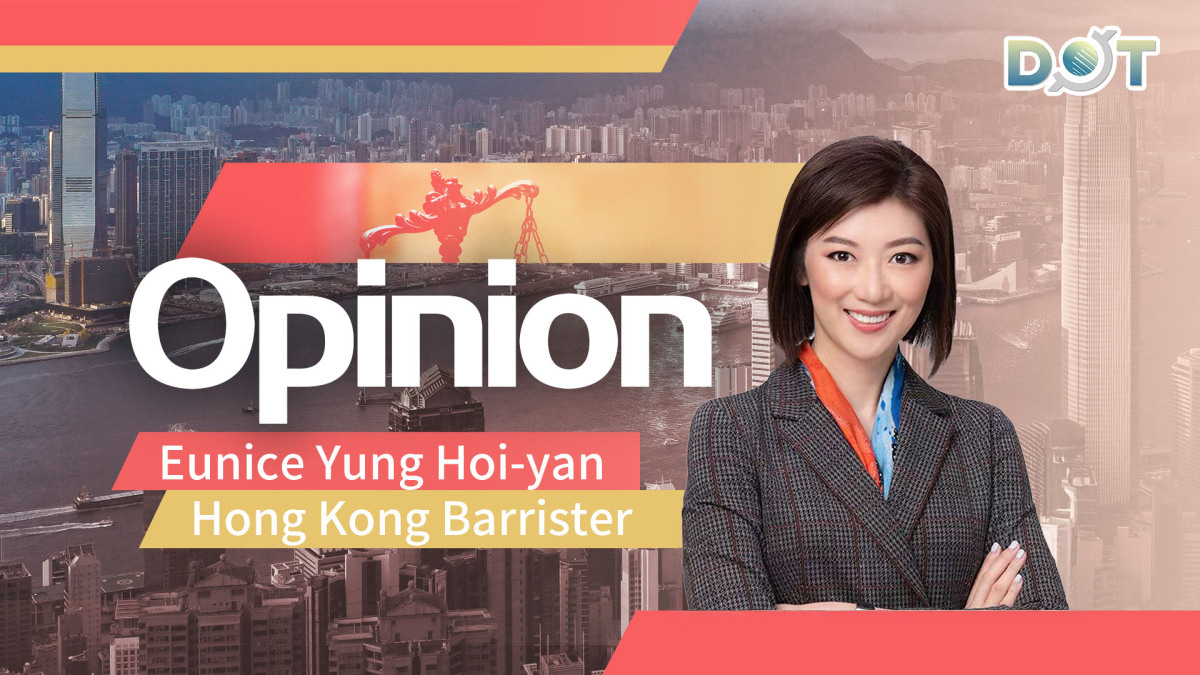
By Eunice Yung, Vice-Chairperson, New People's Party
Two years ago, I argued that Hong Kong stood at an inflection point too consequential to leave to piecemeal departmental initiatives, and I proposed a comprehensive Hong Kong AI Development Blueprint to meet it. My case was simple: Hong Kong needed a top-level, whole-of-government AI strategy that matched ambition with accountability and innovation with rigorous risk management. Reading through the 2026 Policy Address and the inaugural Hong Kong Five-Year Plan (2026–2030), I find that case substantially affirmed. But affirmation is the easy part. The government has now built the thing I asked for; the harder question is whether it will run it with the discipline that justifies the money and trust already spent on it.
Start with what genuinely impresses me: the "AI for All" program is not government talking about AI; it is government trying to put AI literacy into the hands of people who would otherwise be left behind by it—over 200 training courses by early 2028 and an 18-month workplace campaign reaching some 40,000 employees. I want to be clear about why this matters to me. Every AI strategy I have seen from other jurisdictions leads with GDP contribution and competitiveness rankings. This is the first Hong Kong document I've read that leads with an ordinary worker's ability to keep up. That is the right instinct, and I intend to hold the government to it, not just praise it.
Institutionally, the consolidation of AI governance under the Digital Policy Office, alongside the Committee on AI+ and Industry Development Strategy and a seven-area risk framework, tells me something has genuinely changed. For years, the defining feature of Hong Kong's digital transformation was fragmentation—bureaus testing tools in isolation, learning nothing from each other, and occasionally duplicating the same pilot twice. If this consolidation holds, it will be the first time AI governance in Hong Kong has been designed in from the start rather than bolted on after something has already gone wrong. I say "if it holds" deliberately. Committees are cheap to announce and expensive to keep functioning once the novelty wears off. I will be watching for whether this one still exists with the same authority in eighteen months.
Where I think the government deserves real credit is in refusing to let AI stay an abstraction confined to government back offices. The AI Efficacy Enhancement Team's 30 completed projects matter less to me individually—a drone here, an assessment tool there—than what they represent cumulatively: a government finally testing AI on itself before asking residents to trust it. The 1823 hotline overhaul is the clearest proof of this. Anyone who has ever called that line with a genuine complaint knows what "inconsistent handling and long queues" actually feels like on the receiving end. If AI-assisted tools can fix that, it is not a technology story; it is a dignity story.
The AI for Welfare Lab is where I think the real test of "AI for All" sits, and it deserves more scrutiny than it will probably get. HK$300 million is a serious commitment, and identifying at-risk individuals faster is an unambiguously good goal. But I would push the government harder here than I would on almost any other initiative in this plan: an algorithm that flags "risk" among elderly or vulnerable residents is also an algorithm that can quietly encode bias about who gets attention and who gets overlooked. Efficiency inside a welfare system is not the same success metric as fairness inside one. I want to see how this lab defines and audits that difference before I call it a success story rather than just a well-funded pilot.
On building safety, I'll admit some of the fixes here sound almost too obvious to need announcing—real-time flood alerts, drone inspections of lift shafts—and yet they matter precisely because they weren't happening before. Buildings that flood without warning and lift shafts that go unchecked between statutory inspections are not abstract risks in public housing; they are the kind of thing residents have quietly tolerated for years because no one offered a better system. My view is that this should have come sooner, but I would rather see it arrive late than not at all.
The water network commitment is the one part of this plan I find genuinely bold, and it deserves to be said plainly: phasing out every cast iron and asbestos cement pipe within a decade is not a modest target. Anyone who has lived through a water seepage dispute with a neighbor knows how corrosive—literally and socially—these failures become when nobody can agree on where a leak started. A 20 to 30 percent cut in bursts and serious leaks within five years is the kind of number that will either be quietly celebrated in a future policy address or quietly abandoned. I intend to ask which, on the record, well before five years are up.
Now, to the part of this plan I think the government has actually undersold by presenting it as infrastructure rather than an argument. San Tin, Hung Shui Kiu, the Lok Ma Chau Loop, and HKSTP—taken individually, these read like a list of construction projects. Taken together, they are a bet, and it's worth being honest about what the bet actually is. The government is wagering that if you build distinct, specialized nodes—one for AI+ applications and high-performance computing, one for advanced semiconductor manufacturing, one for cross-border research collaboration with Shenzhen, and one for raw computing capacity—talent and capital will sort themselves into the right places without being told to. That is a much bigger gamble than any single hectare figure suggests, because ecosystems don't emerge from good zoning. They emerge from researchers and firms actually deciding, individually, that one specific site is worth uprooting for. Nothing in this plan yet tells me why a semiconductor engineer chooses Hung Shui Kiu over Shenzhen, or why an AI researcher chooses San Tin over Singapore. The physical hardware is arriving. The reason to come is still, largely, unwritten.
The Lok Ma Chau Loop is the one site here that actually confronts this problem head-on, and I think it deserves more attention for that than it has received. Cross-border data flow is not a technical detail—it is the single biggest structural obstacle to Hong Kong ever functioning as a genuine node in Greater Bay Area AI collaboration, and everyone in this sector knows it. Selecting roughly 10 AI and biotech firms for an early pilot while about 100 others in the same park wait their turn is a sensible way to de-risk a hard problem. But I want to be direct about the test this creates for the government's own credibility: if that pilot scales cleanly to the rest of the park's tenants within a reasonable window, this becomes the model for solving cross-border data friction across the whole Northern Metropolis. If it stalls or quietly becomes a permanent perk for a favored few, it will tell every other firm in the pipeline exactly how much to trust the next "pilot" this government announces.
So here is where I actually land on the physical build-out, stripped of the site-by-site tour: the hardware is largely built or under way, and the institutional software—governance under the Digital Policy Office and the Committee on AI+—is largely mapped out, even where specific pieces like deepfake regulation still need finishing. That is genuinely no small achievement, and I don't want to undersell it by focusing only on what's missing. But building the platform was always the easier half of this project. The government now has to prove the platform can hold people, not just house them—and that is a test measured in tenant retention and hiring numbers, not in ribbon-cuttings. I would rather see one site fully alive with working researchers than four sites half-occupied by very impressive architecture.
Which is why transparency is no longer a nice-to-have footnote to this plan—it is the actual mechanism by which we will know if any of this worked. With this much public capital already committed across four major sites, the government owes residents regular, plain reporting on tenant uptake, hiring outcomes, and actual usage, not just construction milestones dressed up as progress. I said this two years ago about the Blueprint in general. I am saying it again now, more specifically, because the stakes are larger and the money is already spent.
On the SME side, I'll say something less comfortable than the government's own framing suggests: targeted AI adoption support through bodies like HKPC is necessary, but necessary is not the same as sufficient, and it is not the same as effective. Hong Kong's SMEs are the backbone of this economy precisely because there are so many of them, run by people with no spare capital and no spare time to experiment with new technology on faith. My real question isn't whether this support exists—it does—but whether it reaches the shopkeeper who has never touched an AI tool, or whether it mostly subsidizes firms sophisticated enough to have adopted AI on their own anyway. That is not a rhetorical distinction. It is the difference between policy that expands the AI economy and policy that just makes the existing winners slightly more efficient.
Deepfake governance is where I think this plan's good intentions meet its greatest urgency gap. Proposals for expanding the legal framework to detect and remove AI-generated fraudulent content are welcome, but I want to be blunt: a public consultation process, however necessary procedurally, moves at a pace that has nothing to do with how fast this harm is actually spreading. The residents most exposed to AI-impersonation scams—older, less digitally literate—are precisely the residents least equipped to wait out a consultation timeline. I understand why government moves carefully on legislation. I am asking it to move carefully and quickly, because right now the scammers are not waiting for anyone's timeline but their own.
What I take from this Policy Address and Five-Year Plan, ultimately, is not a finished success story but a genuinely serious first draft of one—serious enough that my main criticism of the government has shifted. Two years ago, my concern was that there was no coherent plan at all. Today, my concern is narrower and, in some ways, harder to resolve: will this government report on itself with the same rigor it is now asking residents to trust it with? A blueprint is easy to announce. A program is harder to sustain. Turning that program into a record of actual outcomes—measured, published, and defended in public—is the only thing that will tell us, a few years from now, whether this was Hong Kong's AI moment or just its most expensive AI announcement. I intend to keep asking that question, from wherever I stand.
The views do not necessarily reflect those of DotDotNews.
Related News:




Comment