






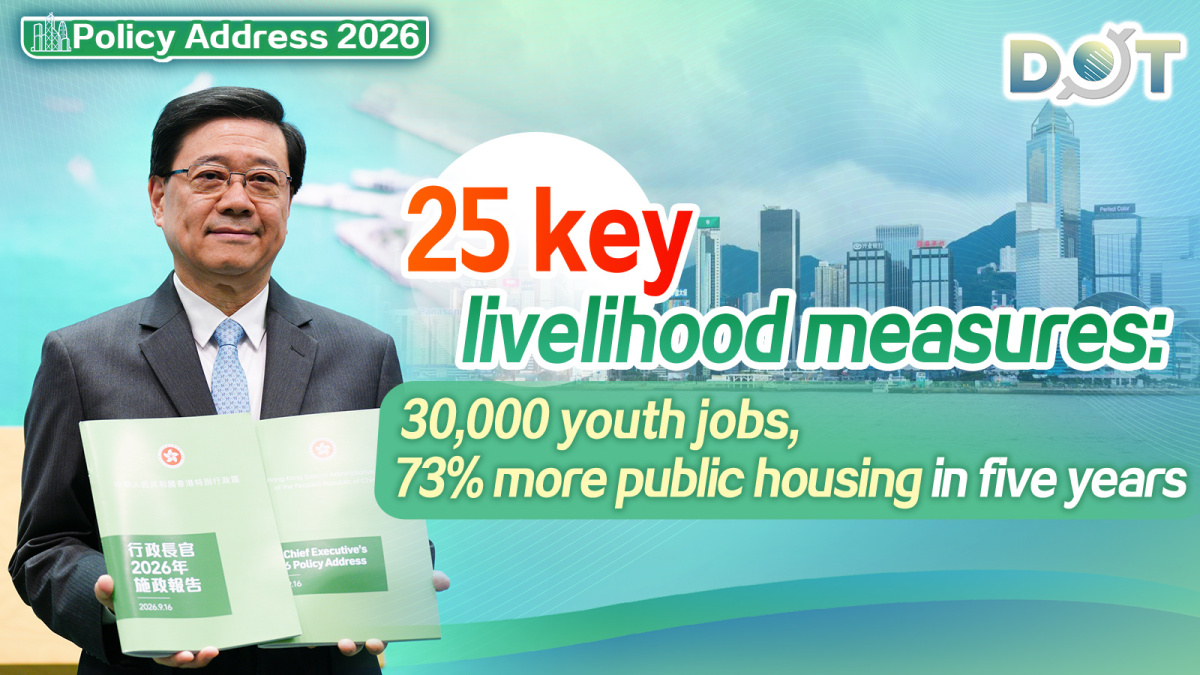
Hong Kong Chief Executive John Lee on Wednesday (Sept. 16) announced the Hong Kong Special Administrative Region's first five-year plan for economic and social development of the Hong Kong Special Administrative Region (2026-2030) and delivered his 2026 Policy Address.
DotDotNews has rounded up 25 key measures closely related to people's livelihoods and well-being.
Supporting youth employment and development
The Government will launch the "30,000 Youth Employment and Internship Programme" and the "HYAB–United Nations Youth Leaders Internship Programme", and establish the "International Youth Talent Exchange Bases".
Developing quality education
The Government will launch a free digital education platform providing learning resources powered by large AI language models, raise school standards, promote the digitalisation of kindergarten administration, and expand both the quality and quantity of student hostel facilities.
11 measures to encourage childbirth
The Government will extend the HK$20,000 newborn baby incentive for another three years, provide a HK$20,000 stamp duty concession for home purchases, raise the newborn incentive for second and subsequent children to HK$30,000 and increase relevant tax allowances. It will also make the "School-based After School Care Service Scheme" permanent, without a quota.
Public housing supply entering a "harvest period"
The Government will work towards reducing the Composite Waiting Time for Subsidized Rental Housing to 4.5 years by 2027. Public housing completions over the next five years are expected to increase by about 73% compared with the previous four-year period. The target of completing 30,000 Light Public Housing units will also be brought forward to March next year.
Improving hospital services
HK will establish its first integrated day hospital. The Government will increase the capacity of day cataract surgery centres by about 5,500 cases, raise the service capacity of day radiology diagnostic centres by about 40%, and increase the service capacity of day radiotherapy centres.
Strengthening Chinese medicine services
Outpatient quotas at the Chinese Medicine Hospital of Hong Kong will more than double, while 24-hour inpatient services will be introduced. The 18 Chinese Medicine Clinics cum Training and Research Centres will also launch pilot specialist outpatient services.
11 measures on mental health
The Government will continue the three-tier emergency mechanism for schools, establish an additional Integrated Community Centre for Mental Wellness, and roll out the "Healthy Mind Pilot Project" at District Health Centres across HK.
Community services
Two additional Community Living Rooms will be established to serve 10,000 subdivided-unit households. A community pharmacy programme will also be launched, initially covering four districts, together with the introduction of a community drug formulary.
Caring for the elderly
The Government will provide an additional 3,000 service vouchers and add 13 new facilities, including Neighbourhood Elderly Centres and residential care homes for the elderly. A "Young-Old Mentorship Programme" will be introduced to enable older people to share their skills and experience. A mobile version of the JoyYou Card will also be launched to make it more convenient for elderly people to travel.
Supporting carers
The Government will increase the living allowance for low-income carers by 10%, launch "Community Dining Hall", and introduce a pilot scheme to import foreign domestic helpers with elderly-care skills and experience.
Supporting people with disabilities
About 460 additional places will be provided for day services, residential care and pre-school rehabilitation services.
Supporting ethnic minorities
The Government will strengthen the support provided by Ethnic Minority Care Teams to elderly people from ethnic minority groups, arrange for outstanding ethnic minority individuals to share their experiences, and adopt learning materials specifically designed for non-Chinese-speaking students.
10 measures to support SMEs
The Government will provide funding to help small and medium-sized enterprises explore more emerging markets, extend free credit assessment services for 20,000 enterprises for another year, provide more support and funding for AI applications, support e-commerce and brand development, and accelerate trade financing.
Labour protection
New legislation will be formulated to protect delivery workers. Cross-departmental efforts to combat illegal employment will also be strengthened, while industry "anti-illegal-worker ambassadors" will be appointed to help collect intelligence.
Developing diverse talent
The Government will extend the additional HK$1,000 monthly training allowance for registered apprentices for two years, launch free online courses for the public on AI applications in the workplace, and review the Continuing Education Fund.
Green and sustainable development
The Government will increase the number of fast-charging stations to 5,000 within five years, providing additional support for about 250,000 electric vehicles. The number of smart recycling bins will be increased to about 3,000 sets, while about 2,500 smart food-waste recycling bins will be installed across HK, achieving a target of one bin per public housing block.
Replacing or repairing ageing water mains
Over the next five years, the Government will replace or repair a total of 350 kilometres of ageing water mains with a relatively high risk of leakage, at an average of 70 kilometres a year.
In the initial years, the work will focus on cast iron and asbestos cement water mains in areas such as Shau Kei Wan, Wong Tai Sin and Kwai Tsing, where there are larger numbers of public housing estates and elderly residents. The Government aims to fully phase out all cast iron and asbestos cement water mains within 10 years under the programme.
Building an "AI City Brain" integrated city management system
The Government will actively study the development of an "AI City Brain" integrated city management system. Using advanced technologies including artificial intelligence, big data and the Internet of Things, the system will enable real-time cross-departmental data sharing and intelligent analysis.
It will provide real-time monitoring of urban management and operational conditions, risk alerts, immediate forecasting and coordinated responses, serving as an intelligent hub for urban management and safety governance.
Seven actions for AI risk governance
The Government will take seven actions on AI risk governance, including combating crimes involving AI, strengthening protection for underage users, and promoting assessments of AI-related ethical risks.
Reforming the system for building maintenance in old buildings
The Government has introduced a smoking ban at construction sites and will advance priority reforms in areas including fire safety and engineering regulation. It will also conduct legal research into criminalizing bid-rigging and explore ways to better assist members of the public in dealing with professional issues.
A comprehensive reform will be carried out after the independent commission submits its report.
Three-tier mechanism for handling building management disputes
A mediation-led three-tier mechanism will be introduced to handle building management disputes.
District councillors will intervene at an early stage to mediate neighbourhood issues and concerns over building management, with disputes to be resolved through friendly negotiations where possible.
If the problems cannot be resolved, district councillors will refer residents to professional mediation services, including the Free Mediation Service Scheme for Building Management established by the Home Affairs Department.
If the disputes still cannot be satisfactorily resolved, legal action may then be considered.
51 flood prevention projects
The Government will implement 51 flood prevention projects, including the construction of flood barriers, detention ponds, drainage tunnels and wave walls to strengthen HK's response to extreme weather.
Enhancing the 1823 service to ensure faster referrals and resolution
The Digital Policy Office will use AI technology to identify recurring issues among cases received by 1823. This will allow government departments to review the issues and formulate targeted solutions, shifting from "governance after complaints" to a proactive approach in which problems are addressed before complaints are made.
Improving government services through "AI+"
The Government will accelerate the orderly and secure adoption of artificial intelligence and innovative technologies to improve the efficiency and precision of decision-making support and public services.
Applications will cover areas including public housing management, healthcare, environmental protection, public works and social welfare.
Strengthening primary healthcare services
The Hospital Authority's general outpatient services will be expanded by about 220,000 places a year. The capacity of health assessment services for the elderly will more than double, while two District Health Stations will be upgraded into District Health Centres.
Related News:
Policy Address 2026 | HK targets sports bodies, major AI conference




Comment