






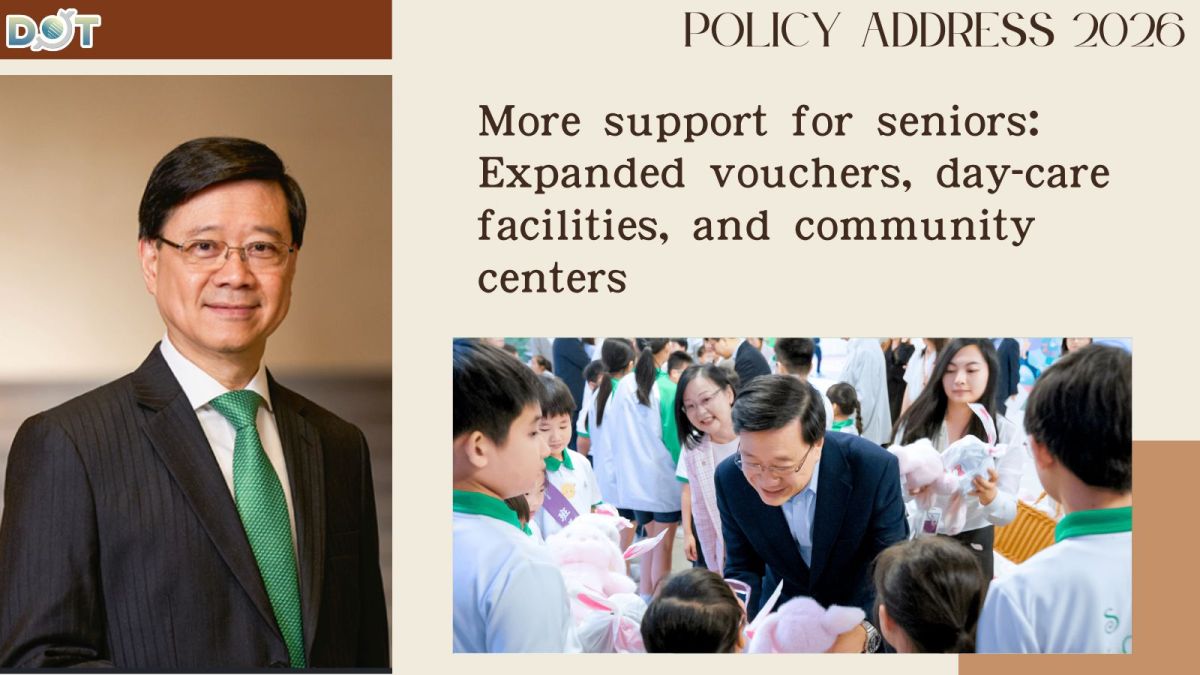
Hong Kong's 2026 Policy Address sets out a renewed approach to coping with an aging society, building on the establishment of the Working Group on Ageing Society Strategies announced last year. Its report—due to be released later this month—will recommend around 70 measures across 11 areas, spanning healthcare, technology, the economy, transport, elderly care, finance, lifelong learning, social participation, and age‑friendly urban design.
Building security: aging in place, with institutional care as backup
Reaffirming the principle of "aging in place as the core, with institutional care as backup," the government will expand community-based support. In the 2027–28 financial year, the number of Community Care Service Vouchers will rise by 2,000 to 18,000, while Residential Care Service Vouchers will increase by 1,000 to 8,000. Five new subsidised day-care facilities will be added, providing about 200 places, and five new Neighbourhood Elderly Centres are expected to serve about 5,000 people a year.
Residential care capacity and service options will also grow. The government will set up three new residential care homes providing about 400 places, pilot the use of newly built government care-home premises for self-financed operation by the sector, and continue expanding the Guangdong Residential Care Services Scheme—which currently includes 29 participating homes and accommodates over 1,400 Hong Kong elderly residents. Further policy work will explore improving incentives for elderly-care facilities in new private developments and strengthening end-of-life care in subvented homes with extra resources over three years.
To make cross-boundary healthcare more accessible, the government will explore expanding service points under the Elderly Health Care Voucher Greater Bay Area Pilot Scheme to include community health centers operated by participating institutions and add more pilot medical institutions. Separately, a pilot will admit foreign domestic carers with advanced elderly-care training and experience to better support older people living at home.
Building worth: active aging and mobility benefits
To enhance older people's sense of purpose, the government will launch a three-year "Young‑Old Mentorship Programme" to create mutual-support networks, encourage contribution, and support social integration. On mobility concessions, the Labour and Welfare Bureau will work with Octopus Cards Limited to introduce a mobile JoyYou Card by the end of this year, allowing eligible users to enjoy the $2 flat fare or 80% discount without a physical card and potentially receive useful updates via app notifications.
Building capability: a gerontechnology ecosystem
Technology will play a bigger role in elderly support. In addition to ongoing subsidies for welfare units to procure or rent relevant products, the Hong Kong Housing Authority will pilot household gerontechnology equipment for elderly singletons of advanced age and all‑elderly households in selected public housing estates, with gradual expansion to other estates. The government will also earmark HK$100 million for a Gerontechnology Promotion Scheme to encourage local tech companies to develop and refine elderly-care products and solutions.




Comment