






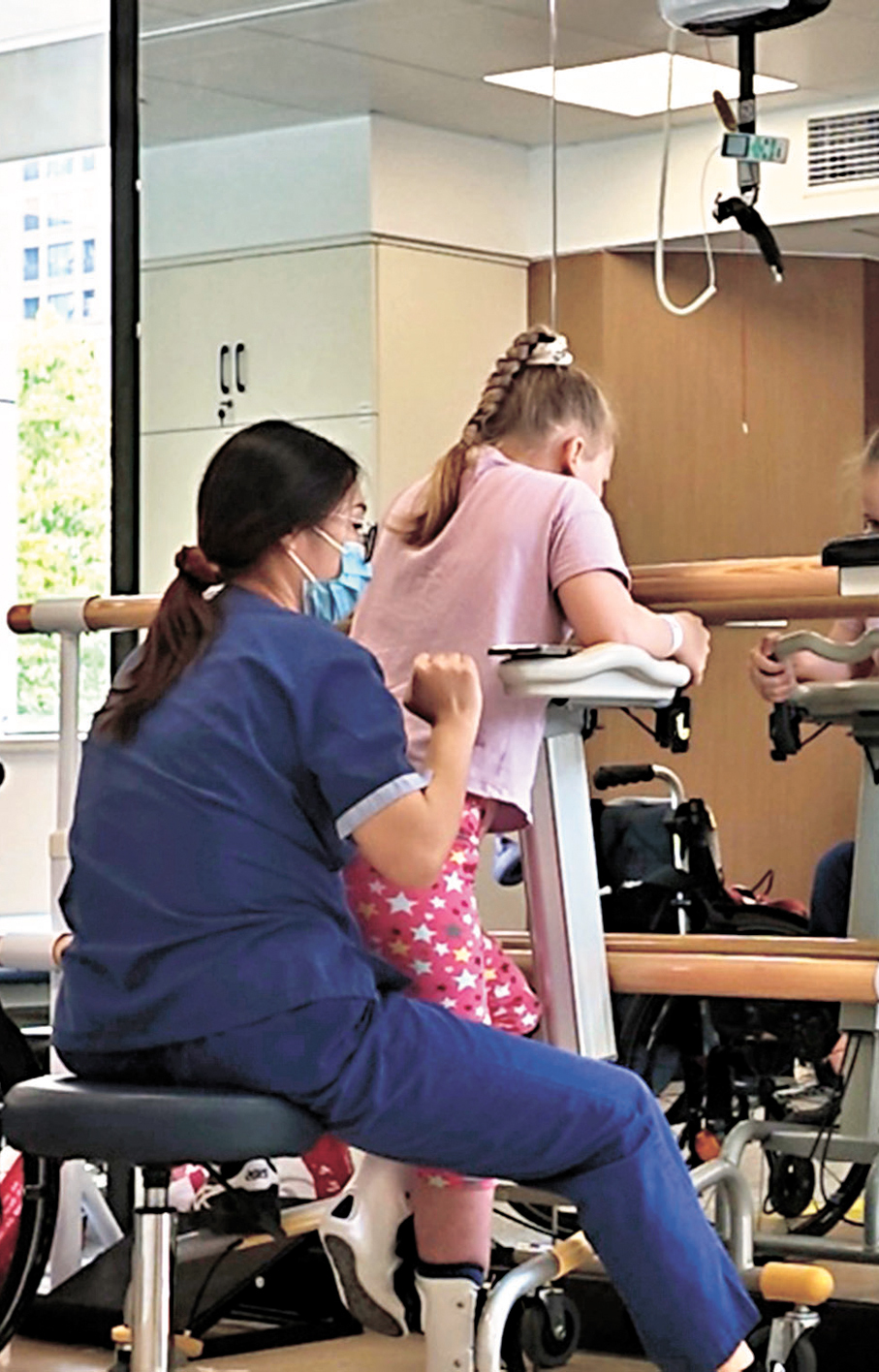
Paraplegia caused by spinal cord injury is widely regarded as one of the toughest challenges in modern medicine. Recently, a 12-year-old Russian girl, Vera, who lost the ability to walk after a traffic accident, traveled thousands of kilometers to Hangzhou seeking treatment at the Second Affiliated Hospital of Zhejiang University School of Medicine (SAHZU).
With support from a China-developed "closed-loop spinal cord neurointerface" technology, Vera has been able to step forward again with a walker, becoming the first overseas patient with severe spinal cord injury in China to achieve autonomous stepping under assistance of the technology, according to the hospital team.
"I like walking," Vera said in hesitant English as she moved forward on a walker in the hospital's spinal cord injury clinical research ward—words that moved many on site. Only months earlier, doctors in Russia had warned her family that she might be bedridden for life.
Vera is from Moscow. In June 2025, a car accident severely damaged her thoracic spinal cord. She lost motor function in both legs and most sensation as well. Her mother took her to multiple hospitals in Russia, where Vera underwent eight months of rehabilitation with little improvement in lower-limb function.
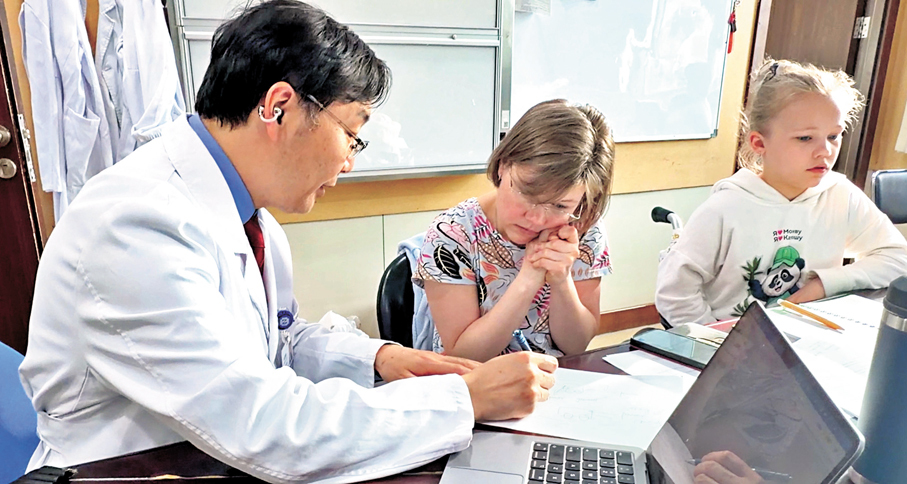
Determined to identify a solution, the family looked for alternatives and eventually contacted SAHZU's International Medical Services Department through the Russian Embassy in China. The hospital organized remote multidisciplinary consultations, carefully assessed her condition, and weighed treatment details and long-haul travel risks before advising that she could come to Hangzhou.
For the family, the decision involved practical concerns ranging from language barriers and medical costs to postoperative expectations and living arrangements abroad. Hospital staff addressed their questions in detail, helping them proceed with the trip in hopes that Vera could regain the ability to walk.
Not every paraplegic patient is eligible for the procedure. Zhu Junming, associate director of neurosurgery and a professor at SAHZU, explained using an analogy: the spinal cord functions like an information "highway." After injury, signals from the brain often cannot pass through strongly enough to drive movement.
A key prerequisite for closed-loop spinal neurointerface treatment, Zhu said, is that the patient must retain some residual neural pathways—meaning the brain can still generate motor signals, even if they are weak.
After Vera was admitted in early April 2026, Zhu's team conducted comprehensive, fine-grained assessments, including combined electrical stimulation tests involving the motor cortex as well as cervical and thoracic spinal segments, together with electromyography (EMG), to map actual neural conduction. The results suggested that while Vera's neural signals were significantly weakened, the pathways were not completely severed—meeting the surgical indications.
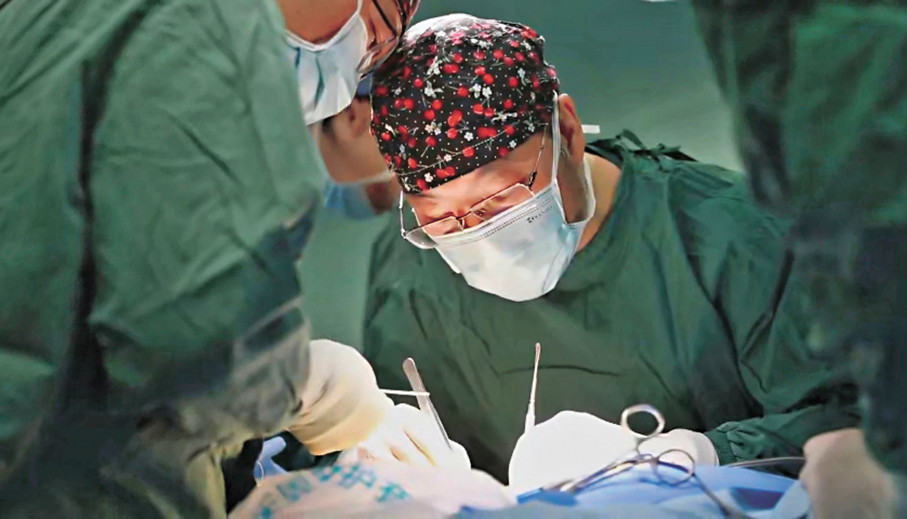
On April 11, the long-awaited operation took place. Through a minimally invasive incision in the thoracolumbar region, Zhu's team implanted two sets of multi-contact stimulation electrodes on the dorsal side of the spinal cord, outside the dura. With multiple independent contacts, the electrodes can target and modulate different muscle groups for the left and right lower limbs.
A pulse generator was implanted subcutaneously at the same time—described by the team as a customized "signal amplifier." Rather than replacing the brain's commands, the system is intended to amplify the brain's weak motor output, help signals bypass the injured segment, and re-activate lower-limb muscles.
The team noted that pediatric cases present added complexity. Because Vera is still growing, future physical development could increase the risk of electrode displacement. The surgery therefore required additional planning space to adapt to growth, raising technical difficulty. During the procedure, neurosurgeons worked closely with engineering specialists, testing electrode contacts point by point and repeatedly adjusting stimulation parameters to ensure accurate targeting—laying the groundwork for subsequent rehabilitation.
Successful implantation was only the first step. Regaining standing and walking requires extensive rehabilitation. Unlike conventional rehabilitation that focuses mainly on preventing complications and maintaining function, the closed-loop model aims to rebuild the patient's own voluntary motor ability, the hospital said.
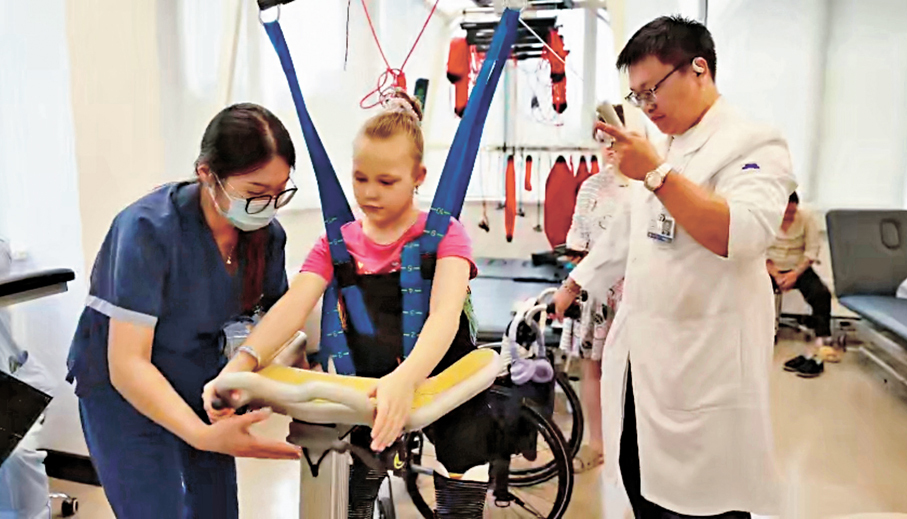
To support this, SAHZU formed a multidisciplinary task group involving neurosurgery, bioengineering, rehabilitation, electrophysiology and other teams. Xiong Bing, deputy director of the rehabilitation department (acting head) and deputy chief physician, said the team sets weekly training goals—such as strengthening specific muscle groups or achieving bedside transfers, sitting up and standing—then works with engineers to design parameter plans. Adjustments focus on activating and restoring hip flexion strength and ankle dorsiflexion to improve gait stability.
Over nearly five months, based on Vera's performance in each training session and with assistance from AI algorithms, the team conducted more than 20 rounds of combined adjustments to stimulation parameters and intensity. Training covered multiple scenarios—leg lifting while seated, weight-shifting while standing, stepping practice and cycling—each paired with specific stimulation programs to better align external stimulation with Vera's movement intention.
Therapists implemented step-by-step, systematic training with repeated practice of leg lifting, weight transfer and stepping. The electrical stimulation amplified outgoing brain signals, while rehabilitation strengthened the brain–spinal cord–muscle connection, helping remodel neural networks and gradually convert external assistance into Vera's own muscle strength.
With daily training, Vera's progress continued. One month after surgery, she could stand steadily with assistive devices, and voluntary lower-limb effort began to appear. The team also observed improving sensation, including a gradual downward shift in the level of sensory recovery and restored feeling in the soles of her feet, along with increased hip range of motion—reportedly exceeding expectations.
After three months of closed-loop rehabilitation, Vera was able to step forward with assistive devices and independently walk more than 10 meters.
Vera is expected to return to Russia in mid-September. Before her departure, the team developed a home rehabilitation plan and arranged regular online follow-ups. Xiong said the short-term goals had been achieved, and the next step would be to gradually reduce reliance on the walker, aiming to transition to crutches for balance. Based on observed treatment response and the advantages of device parameter tuning, the team believes that as Vera continues to grow and develop, achieving normal walking may be possible.
Paraplegia caused by spinal cord injury is widely regarded as one of the toughest challenges in modern medicine. Recently, a 12-year-old Russian girl, Vera, who lost the ability to walk after a traffic accident, traveled thousands of kilometers to Hangzhou seeking treatment at the Second Affiliated Hospital of Zhejiang University School of Medicine (SAHZU).
With support from a China-developed "closed-loop spinal cord neurointerface" technology, Vera has been able to step forward again with a walker, becoming the first overseas patient with severe spinal cord injury in China to achieve autonomous stepping under assistance of the technology, according to the hospital team.
"I like walking," Vera said in hesitant English as she moved forward on a walker in the hospital's spinal cord injury clinical research ward—words that moved many on site. Only months earlier, doctors in Russia had warned her family that she might be bedridden for life.
Vera is from Moscow. In June 2025, a car accident severely damaged her thoracic spinal cord. She lost motor function in both legs and most sensation as well. Her mother took her to multiple hospitals in Russia, where Vera underwent eight months of rehabilitation with little improvement in lower-limb function.
Unwilling to give up, the family searched for alternatives and eventually contacted SAHZU's International Medical Services Department through the Russian Embassy in China. The hospital organized remote multidisciplinary consultations, carefully assessed her condition, and weighed treatment details and long-haul travel risks before advising that she could come to Hangzhou.
For the family, the decision involved practical concerns ranging from language barriers and medical costs to postoperative expectations and living arrangements abroad. Hospital staff addressed their questions in detail, helping them proceed with the trip in hopes that Vera could regain the ability to walk.
Not every paraplegic patient is eligible for the procedure. Zhu Junming, associate director of neurosurgery and a professor at SAHZU, explained using an analogy: the spinal cord functions like an information "highway." After injury, signals from the brain often cannot pass through strongly enough to drive movement.
A key prerequisite for closed-loop spinal neurointerface treatment, Zhu said, is that the patient must retain some residual neural pathways—meaning the brain can still generate motor signals, even if they are weak.
After Vera was admitted in early April 2026, Zhu's team conducted comprehensive, fine-grained assessments, including combined electrical stimulation tests involving the motor cortex as well as cervical and thoracic spinal segments, together with electromyography (EMG), to map actual neural conduction. The results suggested that while Vera's neural signals were significantly weakened, the pathways were not completely severed—meeting the surgical indications.
On April 11, the long-awaited operation took place. Through a minimally invasive incision in the thoracolumbar region, Zhu's team implanted two sets of multi-contact stimulation electrodes on the dorsal side of the spinal cord, outside the dura. With multiple independent contacts, the electrodes can target and modulate different muscle groups for the left and right lower limbs.
A pulse generator was implanted subcutaneously at the same time—described by the team as a customized "signal amplifier." Rather than replacing the brain's commands, the system is intended to amplify the brain's weak motor output, help signals bypass the injured segment, and re-activate lower-limb muscles.
The team noted that pediatric cases present added complexity. Because Vera is still growing, future physical development could increase the risk of electrode displacement. The surgery therefore required additional planning space to adapt to growth, raising technical difficulty. During the procedure, neurosurgeons worked closely with engineering specialists, testing electrode contacts point by point and repeatedly adjusting stimulation parameters to ensure accurate targeting—laying the groundwork for subsequent rehabilitation.
AI-assisted rehabilitation and repeated parameter tuning
Successful implantation was only the first step. Regaining standing and walking requires extensive rehabilitation. Unlike conventional rehabilitation that focuses mainly on preventing complications and maintaining function, the closed-loop model aims to rebuild the patient's own voluntary motor ability, the hospital said.
To support this, SAHZU formed a multidisciplinary task group involving neurosurgery, bioengineering, rehabilitation, electrophysiology and other teams. Xiong Bing, deputy director of the rehabilitation department (acting head) and deputy chief physician, said the team sets weekly training goals—such as strengthening specific muscle groups or achieving bedside transfers, sitting up and standing—then works with engineers to design parameter plans. Adjustments focus on activating and restoring hip flexion strength and ankle dorsiflexion to improve gait stability.
Over nearly five months, based on Vera's performance in each training session and with assistance from AI algorithms, the team conducted more than 20 rounds of combined adjustments to stimulation parameters and intensity. Training covered multiple scenarios—leg lifting while seated, weight-shifting while standing, stepping practice and cycling—each paired with specific stimulation programs to better align external stimulation with Vera's movement intention.
Therapists implemented step-by-step, systematic training with repeated practice of leg lifting, weight transfer, and stepping. The electrical stimulation amplified outgoing brain signals, while rehabilitation strengthened the brain–spinal cord–muscle connection, helping remodel neural networks and gradually convert external assistance into Vera's own muscle strength.
With daily training, Vera's progress continued. One month after surgery, she could stand steadily with assistive devices, and voluntary lower-limb effort began to appear. The team also observed improving sensation, including a gradual downward shift in the level of sensory recovery and restored feeling in the soles of her feet, along with increased hip range of motion—reportedly exceeding expectations.
After three months of closed-loop rehabilitation, Vera was able to step forward with assistive devices and independently walk more than 10 meters.
Vera is expected to return to Russia in mid-September. Before her departure, the team developed a home rehabilitation plan and arranged regular online follow-ups. Xiong said the short-term goals had been achieved, and the next step would be to gradually reduce reliance on the walker, aiming to transition to crutches for balance. Based on observed treatment response and the advantages of device parameter tuning, the team believes that as Vera continues to grow and develop, achieving normal walking may be possible.




Comment