






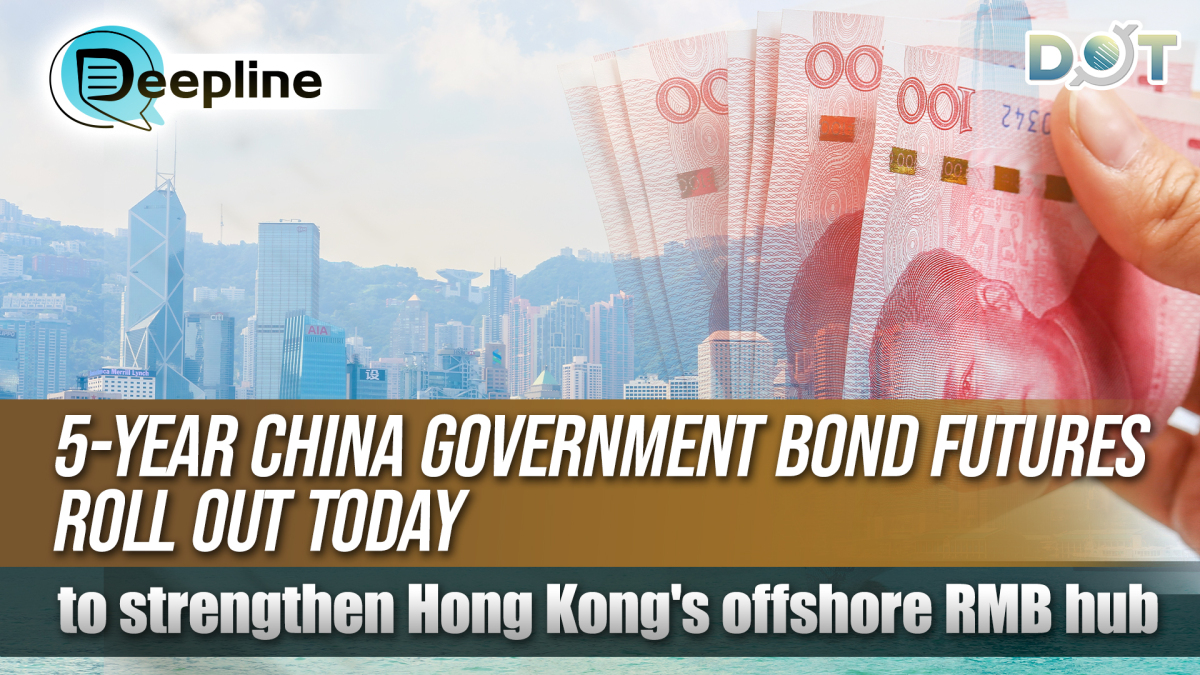
In recent years, international investors have shown growing interest in Chinese government bonds, and today the Hong Kong Exchanges and Clearing Limited (HKEX) officially launched 5-Year China Government Bond Futures—a move widely seen as a key step in promoting RMB internationalisation and deepening connectivity between the mainland and Hong Kong markets. As the only Chinese government bond futures product available in the global offshore market, it is denominated, traded and settled in RMB, filling a long‑standing gap in offshore market interest‑rate risk management tools.
Zhou Zhaoping, Senior Vice President of Fixed Income and Currency Product Development at HKEX, said that Treasury bond futures enrich Hong Kong's RMB product suite and carry profound significance for building a renminbi ecosystem. The product has been designated as a holiday‑trading contract, allowing trading during Hong Kong public holidays to meet global investors' cross‑time‑zone hedging needs, further consolidating Hong Kong's leading position as a global offshore RMB hub. As international investors steadily increase their holdings of Chinese bonds through connectivity channels such as Bond Connect, the launch of five‑year Treasury bond futures in Hong Kong at this juncture precisely fills the gap in offshore risk‑management tools, enabling investors to hedge interest‑rate risks more efficiently and thereby attracting more global long‑term capital to sustain and increase holdings of RMB government bonds.
This major financial innovation has received strong attention and support from regulators and government officials on both sides. Chief Executive John Lee stated that the national "15th Five‑Year Plan" explicitly supports Hong Kong in strengthening its role as a global offshore RMB hub, and the introduction of Treasury bond futures in Hong Kong will help attract international investors to participate in the mainland bond market and hold RMB government bonds for the long term, marking a critical step in improving the RMB product ecosystem. HKEX Chief Executive Officer Bonnie Chan emphasised that Treasury bond futures serve as an important complement to Bond Connect, offering offshore investors an efficient risk‑management tool and further reinforcing Hong Kong's status as an offshore RMB hub.
Zhou Zhaoping further noted that Treasury bond futures are a very mainstream and popular financial product in international markets—not only does mainland China have them, but economies such as the United States, Europe, Australia, Japan and South Korea have also launched similar products with active trading. Commonly available tenors in global markets include two‑year, five‑year, ten‑year, twenty‑year and thirty‑year maturities. Zhou believes that HKEX's choice of the five‑year tenor as the first product is a pragmatic move that aligns with mainstream international trends. In fact, Treasury bond futures are a highly efficient risk‑management tool; for investors holding RMB assets or liabilities, they allow interest‑rate risk hedging without altering the underlying asset‑liability structure. Since HKEX does not set or restrict the investor base, a wide range of market participants can participate according to their own trading needs, resulting in a highly diverse investor community.
Moreover, Treasury bond futures offer advantages such as low transaction costs, high liquidity and low credit risk. They are traded on margin, providing high capital efficiency and relatively low hedging costs; they are also exchange‑traded with transparent and efficient price discovery, and central counterparty clearing effectively reduces counterparty risk. Zhou stressed that this product is the only Chinese government bond futures product in the global offshore market, giving it unique advantages. Denominated, traded and settled in RMB, it holds far‑reaching significance for enriching Hong Kong's RMB product sequence and building the RMB ecosystem. More importantly, the product is designated as a holiday‑trading contract, allowing transactions during Hong Kong public holidays to meet global investors' trading needs across different time zones and holiday schedules, further expanding Hong Kong's competitive edge and market influence as an international financial centre.
The Chinese bond market has continued to expand and has now become the world's second‑largest, second only to the United States. As of June, the total outstanding market size had reached RMB 205 trillion. With the introduction of Treasury bond futures, overseas investors' interest in and allocation to the Chinese bond market are expected to strengthen further, helping to enhance the international influence and competitiveness of China's bond market. Fan Wenchao, Head of Fixed Income and Currency Product Development at HKEX, pointed out that China's bond market comprises three major segments: the interbank market, the exchange market and the bank counter market. Among them, the interbank market accounts for about 90% of outstanding volume and is the core venue for onshore bond issuance and trading; government bonds account for roughly 20% of that market, which is exactly the underlying asset for the Treasury bond futures.
China's interbank bond market has gradually opened to international investors since 2010, initially through a direct investment model allowing foreign institutions to open onshore accounts for RMB bond investment. In 2017, HKEX launched Bond Connect, enabling offshore investors to participate in the interbank market using international trading practices, greatly improving the convenience of foreign participation. Data show that after Bond Connect was introduced, foreign capital inflows into China's bond market increased significantly, with about 60% of offshore investors' transactions completed through this mechanism. Fan Wenchao said that the launch of Treasury bond futures provides offshore investors with a critical interest‑rate risk‑management tool, which is expected to further boost foreign investors' willingness to hold Chinese bonds, increase their allocation to RMB bonds, and thereby advance the internationalisation of China's bond market. At the same time, Treasury bond futures will act as an important catalyst for RMB internationalisation: they enrich the offshore RMB product system, strengthen the renminbi's functions in pricing, settlement and trading, indirectly enhance the attractiveness of and confidence in RMB assets, and further consolidate Hong Kong's strategic position as a global offshore RMB hub and international financial centre.
Market practitioners widely regard the launch of Treasury bond futures in Hong Kong as a milestone breakthrough that will reshape the risk‑management landscape for offshore RMB assets, while also responding to the industry's long‑standing calls. It also sets the stage for more RMB bond‑related products in the future, with some urging accelerated research into a "Futures Connect." Mofiz Chan, President of the Hong Kong Securities & Futures Professionals Association, said that Treasury bond futures carry major strategic value in risk management, RMB internationalisation and connectivity—they not only improve Hong Kong's offshore RMB product ecosystem but also represent a key step in deepening cross‑border financial links. He believes that as the product continues to develop, Treasury bond futures will complement mechanisms such as Stock Connect, Bond Connect and Swap Connect, enabling international investors to manage RMB interest‑rate risks more efficiently. In addition, the cash‑settled nature of offshore Treasury bond futures will help attract more international investors to participate and hold positions for the long term, further increasing global allocation‑oriented funds' willingness to invest in China. Chan suggested that authorities should accelerate research on launching "Futures Connect" to enhance connectivity between the two capital markets, while also introducing more RMB‑denominated futures, options and over‑the‑counter derivatives to boost Hong Kong's financial competitiveness comprehensively.
Martin Liu, Executive Director of Mouette Securities, expects that as the product matures, ten‑year and twenty‑year tenors will be rolled out successively. Although the market also looks forward to more derivatives such as options, international practice usually sees exchanges gradually introducing other derivatives only after the futures market has developed sufficiently. Overall, the industry hopes to see more products linked to mainland bonds in the future, attracting greater institutional investor participation and further invigorating renminbi usage. A veteran securities industry figure pointed out that foreign investors currently hold a substantial amount of onshore government bonds, yet for a long time this huge bond portfolio has lacked efficient and convenient offshore hedging tools. The launch of Treasury bond futures precisely meets that market need, allowing institutions to carry out precise risk management when allocating RMB assets and significantly reducing price volatility risks for long‑term positions.
(Editor: Liu Yu)
Related News:
Deepline | HK exports post fastest growth in 42 years, US-bound shipments surge record 114.3%
Deepline | Stronger financial markets: Exchange Fund earns HK$134.7 bn in first half of year




Comment